
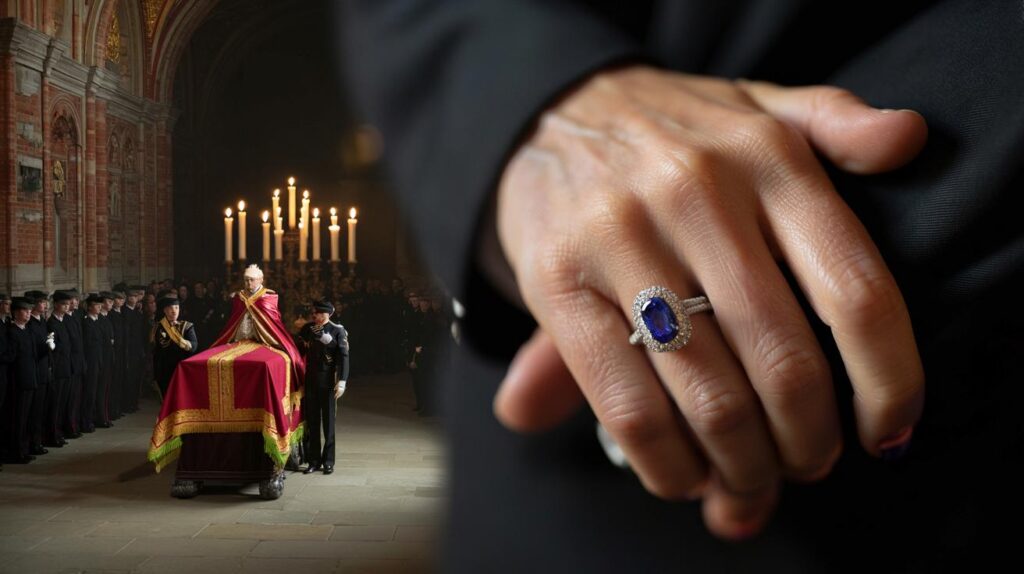
A candlelit vigil, an historic farewell, and a family thread running through two days of ritual in central London.
The Duchess of Kent’s farewell unfolded in quiet stages, from a private vigil to a public Requiem Mass. Within that sequence, a single jewel caught the eye and carried a message of duty, memory and continuity.
A quiet tribute in sapphire
At a private vigil for her mother, Lady Helen Taylor chose a gesture both intimate and unmistakable. Dressed in black, she wore the Duchess of Kent’s engagement ring — an oval sapphire framed by round diamonds, set in platinum — a piece first seen when Katharine Worsley became engaged to Prince Edward, Duke of Kent, in March 1961. The ring reappeared at the funeral the following day, a discreet but eloquent link between past and present as Lady Helen walked into Westminster Cathedral, at one point linking arms with her father.
The ring bridged two moments: the promise of 1961 and the farewell of 2025, held together on Lady Helen’s hand.
Its design echoes the style beloved by the Duchess’s mother-in-law, Princess Marina, whose own engagement ring also centred on an oval sapphire flanked by diamonds. That visual rhyming matters in royal symbolism: repetition signals a lineage of taste, loyalty and shared milestones across generations.
A historic Catholic farewell
Katharine, Duchess of Kent, died on 4 September at the age of 92 at Kensington Palace, after 61 years of marriage. Her funeral took place on 16 September at Westminster Cathedral, the first Catholic funeral for a member of the royal family in modern British history. The evening before, on 15 September, her coffin travelled by hearse from Kensington Palace to the cathedral for the Rite of Reception and Vespers.
From Kensington to Victoria Street, the route carried a modern royal first: a Catholic funeral for a much-admired duchess.
The Royal Hearse, designed under Queen Elizabeth II, bore the Duchess’s coffin draped in the Royal Standard. On departure, a piper from The Royal Dragoon Guards — the regiment for which the Duchess served as Deputy Colonel-in-Chief since 1992 — led the way. The bearer party receiving the coffin at the cathedral drew on the same regiment, embedding the service within her service.
Family gathered in numbers
The Duke of Kent arrived supported by his three children and their families, a full complement that underlined how closely knit the Kent branch remains. Lady Helen attended with her husband, art dealer Timothy Taylor, and their children: Columbus, Cassius, Eloise and Estella. The Duke’s elder son, George Windsor, Earl of St Andrews, was joined by his wife, historian Sylvana Palma Tomaselli, and their three children: Edward Windsor, Lord Downpatrick; Lady Marina Windsor; and Lady Amelia Windsor. The youngest, Lord Nicholas Windsor, came with his wife, Paola, and their sons Albert, Leopold and Louis.
Broader family support was visible at the cathedral doors. Lord Frederick Windsor and Lady Gabriella Kingston were present, with Frederick’s wife, actress Sophie Winkleman. The Duke’s siblings also attended: Prince Michael of Kent arrived early, while Princess Alexandra arrived by taxi, using a wheelchair. Alexandra’s children, James and Marina Ogilvy, stood with their cousins.
Three children, ten grandchildren, and cousins across two generations marked the Duchess’s life with visible solidarity.
Key moments, people and numbers
- Engagement: March 1961; marriage: June 1961 at York Minster.
- Death: 4 September, aged 92, at Kensington Palace.
- Vigil and Rite of Reception: 15 September, Westminster Cathedral.
- Funeral: 16 September, Requiem Mass attended by the King and Queen.
- Children: George, Lady Helen and Lord Nicholas; grandchildren: 10.
- Signature jewel: oval sapphire ring with round diamond shoulders, platinum mount.
From procession to prayer
The two-day observance balanced private mourning and public ritual. The vigil limited attendance to immediate family, offering a pause before the more visible service. The Requiem then brought together senior royals, clergy and representatives of the regimental community that had worked with the Duchess across decades.
The coffin’s careful choreography held layers of meaning. The Royal Standard signalled national identity rather than personal arms. The presence of The Royal Dragoon Guards acknowledged longstanding ties. The choice of Westminster Cathedral reflected the Duchess’s conversion to Catholicism in 1994, a decision that quietly reshaped royal religious precedent without fanfare.
How a ring speaks in public mourning
Jewellery carries memory in a way clothes rarely can. By wearing her mother’s engagement ring, Lady Helen shifted attention from sartorial novelty to continuity. The piece connects the Duchess’s early public life to her final rites, framing six decades of service within a recognisable design language. It also nods to Princess Marina’s similar ring, linking three generations through a shared gemstone choice.
Such gestures often go unannounced. They are read by family first, then by those who follow the visual grammar of royal occasions. Here, the sapphire’s deep blue worked as a visual signature against black attire, formal yet intimate, public yet personal.
What the route and rituals tell you
| Stage | Location | Significance |
|---|---|---|
| Departure | Kensington Palace | Home setting and family presence underline privacy before ceremony |
| Procession | Royal Hearse with piper | Service ties through The Royal Dragoon Guards and royal design choices |
| Reception | Westminster Cathedral | Vigil, prayers and the Catholic setting marked a modern royal first |
| Requiem Mass | Cathedral nave | Royal family, including the King and Queen, gathered for final prayers |
Voices around the family
Tributes from senior royals arrived swiftly after 4 September. The King and Queen signalled mourning across engagements, with dark dress and black armbands during public duties. The Prince and Princess of Wales described the Duchess as a much-missed member of the family who devoted herself to charitable work, a characterisation echoed by those who encountered her away from cameras at schools, music programmes and military events.
If you inherit a sapphire ring like this
Heirloom sapphires are durable, yet they benefit from thoughtful care. A platinum mount resists wear better than gold, but daily knocks still dull stones and settings. Avoid ultrasonic cleaners when a ring is antique, as old mounts may be fragile. Book periodic checks with a trusted jeweller to ensure claws remain tight, especially on pieces with side stones.
- Cleaning: warm water, mild soap, soft brush; pat dry.
- Storage: separate pouch to prevent diamond abrasion on softer gems.
- Insurance: updated valuation every 3–5 years, documented with photographs.
- Wear: remove during sport, gardening and heavy lifting to protect settings.
Why sapphires suit engagement rings
Sapphires rate 9 on the Mohs scale, just below diamond, which makes them a sound daily-wear choice. Their colour range reaches beyond royal blue to green, pink and yellow, allowing families to select a stone with personal resonance. In royal contexts, blue sapphire often signals fidelity and steadiness — qualities aligned with the public expectations placed on consorts.
Reading the details without missing the moment
Royal ceremonies carry codes, yet they are not puzzles to be solved so much as stories to be read. On these September days, the story ran on two tracks: a historic Catholic service and a daughter’s understated salute. The numbers add shape — 61 years of marriage, 10 grandchildren, two days of rites — but the feeling rests in a single ring, lifted from a mother’s jewel box and brought back into the light of Westminster.



What a quietly perfect tribute: wearing the Duchess of Kent’s oval sapphire at both the vigil and the Requiem. The echo of Princess Marina’s ring makes the lineage feel tangible, not just ceremonial. After 61 years of marriage and ten grandchildren gathered, that deep blue read like a thread tying the family together. And the Catholic service at Westminster Cathedral — a modern first — was framed so respectfully, from the Royal Hearse to the Dragoon Guards. Moving, and very human.