
Leaving a spare key with a neighbour sounds friendly, simple, human. But the night you actually need that key rarely goes to plan.
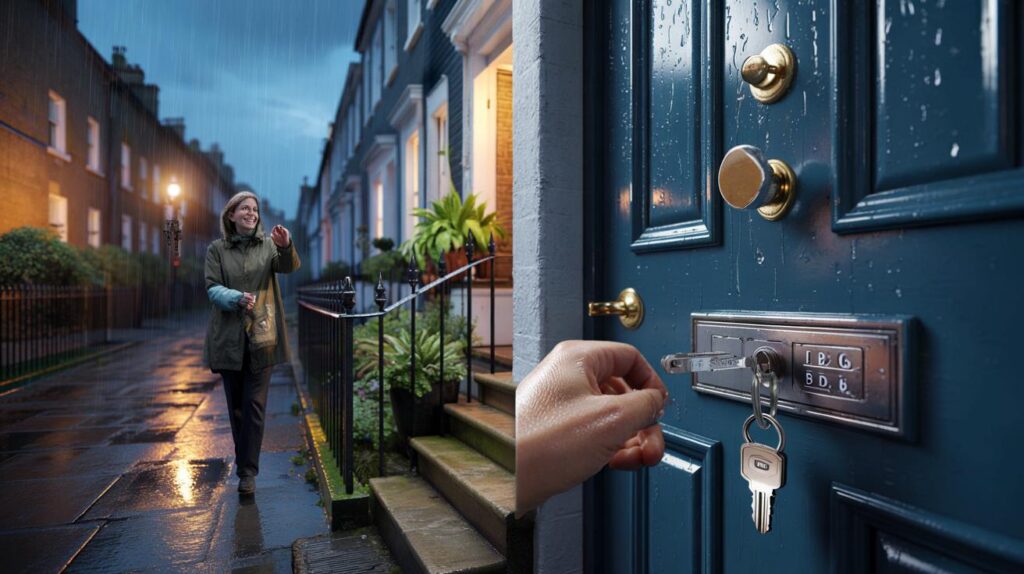
The street was quiet in that heavy, muffled way London gets after a sudden downpour. I patted my coat pocket, then the other one, then the rucksack with the confidence of someone who knows exactly where the key is. It wasn’t there. A light flicked on across the road, and in the window was the neighbour who waters my plants when I’m away. I waved, sheepish, rain tapping my fringe. Where’s the spare key? With them? Under a pot? At my sister’s? My heart did that small, ridiculous sprint we pretend we’re too grown-up to have. I walked over and rang the bell, already rehearsing the apology. The lock clicked. A plan didn’t.
Neighbourly trust is great — but keys need a plan
We love the quiet pact of the street: the nod in the morning, the parcel taken in, the “I’ll feed the cat, you enjoy the weekend.” It feels old-fashioned in the best way, like pegged washing and a borrowed cup of sugar. Leaving a spare key with a neighbour lives in that same warm space. It’s cosy. It’s British. **A spare key is not a plan.**
A friend in Manchester told me about the Sunday she locked herself out with a lasagne in the boot and a toddler in a buggy. The key was with “Dave next door,” which sounded foolproof until Dave popped to Leeds, phone on silent. The locksmith arrived an hour later, the child napped, the lasagne cooled, the neighbour returned waving apologetically from the pavement, baffled by all the commotion. We’ve all had that moment when the simplest arrangement turns into a tiny epic.
Trusting a neighbour is about goodwill; planning for emergencies is about predictability. The first runs on vibes and kindness, the second on clarity and backups. When a situation gets tense — a burst pipe, a cat in distress, a child who’s misplaced their own set — randomness costs time. A spare key sitting in one place with one person creates a single point of failure; strong plans create options. You’re not replacing neighbourly trust. You’re giving it rails.
From spare key to emergency plan: a practical playbook
Start simple: create a two-key circle. Keep one spare in a wall-mounted lockbox with a code, and place another with a trusted adult within five minutes’ walk. Share the code and the address of the lockbox only with two contacts you’d trust with your bank card. Set one shared “trigger” text — a single word like “umbrella” — that means “I need the key now; call me if unsure.” Test the code every three months, like smoke alarms. *It’s only funny later.*
Write a short, clear card that lives in your wallet or phone notes: where the lockbox is, who has the second spare, how to reach your landlord, where the stopcock is, who can collect a child, who can unlock the bike shed. Two or three lines for each, no fluff. Keep physical copies: one sealed envelope with the neighbour you trust, one with a family member. Let them open it only in an emergency. Let’s be honest: nobody really audits their emergency contacts every month. Do it when the clocks change and you’ll remember.
Don’t hide keys under mats, in boots, or behind loose bricks; burglars know the clichés better than we do. Label keys with a code, never your address. Rotate your lockbox code after tradespeople visits or house-sitters. Give your neighbour permission in writing to let in a locksmith or a plumber if you’re unreachable; some will ask for it. **Clarity beats panic.**
“Good neighbours make life easy; clear plans make life safe.”
- Choose two keyholders within a five-minute walk
- Install a proper lockbox, not a garden stash
- Set one trigger word; keep instructions short
- Update codes with the clock changes
- Write permission for emergency access
Leave room for goodness, prepare for mess
Neighbourliness is precious because it isn’t contractual. It’s care, not compliance. An emergency plan respects that gift by not loading too much onto one person’s availability, memory, or comfort level. It removes awkwardness: no late-night knocks if there’s a lockbox; no anxious “Are you in?” messages if there’s a second keyholder; no guessing under pressure. **Trust thrives when you give it structure.** It’s still human. It’s just less fragile.
| Key points | Details | Interest for reader |
|---|---|---|
| Build a two-key circle | One lockbox with code, one trusted human nearby | Reduces single points of failure |
| Write a tiny playbook | Contacts, stopcock, permissions, trigger word | Confidence under stress, faster decisions |
| Refresh and rehearse | Change codes with the clock changes, do a quick drill | Keeps the plan real, not theoretical |
FAQ :
- Is a lockbox safe on a terraced house?Choose a police-preferred model, fix it to brick with security screws, and place it discreetly but reachable. Pair with good door locks and lighting.
- What if my neighbour loses the spare key?Label keys with a code, not your address, and keep the lockbox as your reliable fallback. If a key goes missing, change the cylinder and update your plan.
- Can renters set this up without the landlord?Yes to the plan and the people; for a lockbox or cylinder change, get written consent from your landlord or managing agent first.
- How many people should know my lockbox code?Two is enough: one nearby, one outside your immediate street. More people don’t mean more safety, just more leakage risk.
- What’s a good trigger word?Something ordinary you won’t accidentally use: “umbrella”, “kettle”, “tram”. Short, neutral, memorable.



Loved the distinction between neighbourly trust and predictability. The two-key circle + lockbox plan is so obvious in hindsight, yet I’ve never actually written anything down. I’m definitley setting a code-change reminder for the clock changes. “It’s only funny later”—too real.
Genuine question: don’t visible lockboxes basically advertise to burgulars that there’s a key nearby? Beyond “police-preferred,” any guidance on placement so the box isn’t a giant sign?