
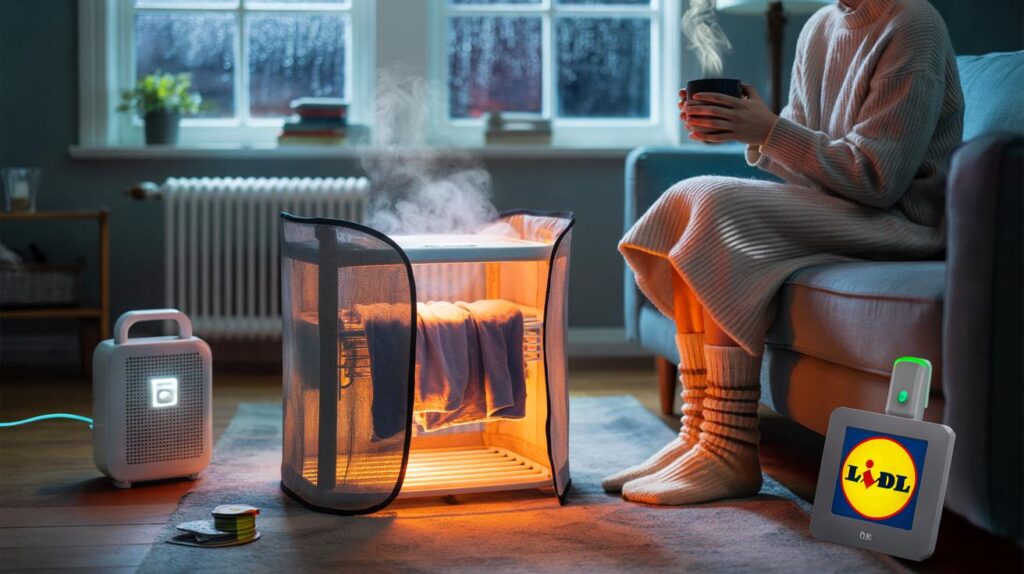
Energy bills are still nibbling at household budgets, radiators are switched on with a wince, and the laundry never seems to dry. Next week, Lidl is rolling out a small, low-watt gadget that taps straight into Martin Lewis’s favourite winter mantra — warm the person, not the whole house — and it might just change how your home feels on cold nights.
It was one of those wet, grey Tuesdays where the sky looks like unwashed wool. Socks hung over chair backs. The tumble dryer’s red light blinked like a warning about money. In the kitchen, the smart meter ticked up pennies with every clunk of the boiler, and the air smelled faintly of damp denim.
In the middle aisle at Lidl, people were already hovering, a quiet choreography of baskets and curious glances. Next week, the crowd will be thicker. Because the chain is bringing back a Martin Lewis–approved way to stay warm and get laundry done for pennies, not pounds. It feels like a tiny rebellion against the cold.
It runs on pennies.
Lidl’s next-week launch: the low-watt winter helper
Lidl is set to drop a heated clothes airer with cover under its own brand — the sort of gadget that mirrors Martin Lewis’s long-standing advice to cut bills by heating you and your immediate space, rather than blasting the whole house. It’s a simple idea: warmed rails, a breathable cover that traps heat, and a footprint that tucks into a corner.
This isn’t glitzy tech. It’s practical, compact, and built for British weather that can’t commit to a forecast. The best part? It’s the kind of tool you’ll actually use on an ordinary Tuesday night, when the school uniforms need drying and the lounge is a degree colder than you’d like. That’s real-world value.
Here’s the quick maths. A typical heated airer draws around 230W. On a standard variable tariff of roughly 29p per kWh, that’s close to **around 7p an hour**. Run it for five hours and you’re spending roughly 35p. A tumble dryer can easily use 2–3kWh per cycle, which is around 58p–87p depending on settings.
If you dry two loads a week, swapping the dryer for the airer could trim £1–£2 weekly. Over a damp winter, that’s enough for a couple of extra meals in your trolley. And because the airer throws off gentle warmth, it can take the chill off a small room while it works. Two birds. One plug.
Why it works is part physics, part habit. Warm rails speed up evaporation right where moisture sits — on fabric. The cover creates a pocket of warm air so clothes dry faster without blasting heat into the room. If you position it near where you sit, you’ll feel that microclimate of warmth too.
Pairing an airer with a dehumidifier can help on heavy laundry days. Lowering humidity makes water leave clothes faster, and rooms feel warmer at the same temperature. You also dodge the damp smell that sometimes hangs around in winter. It’s a smarter way of living with the weather, not fighting it.
How to get the most warmth for the least money
Set the airer in a lived-in spot — near the sofa or by a desk — and partially open the cover to direct warmth toward you. Space items with gaps between rails. Rotate thick pieces halfway through. If yours has a timer, try 90-minute bursts, then a pause, then another burst; the cover holds residual heat, so you’re not paying to re-warm cold metal each time.
Keep a cheap digital hygrometer nearby. If humidity climbs above 60%, crack a window for ten minutes or run a dehumidifier. That short ventilation flush can speed drying without draining heat from the whole house. Small fans on low can also move air through the cover and help, especially on dense fabrics like hoodies.
Common mistakes? Overloading, which traps moisture and doubles drying time. Putting the airer in the coldest, stillest room, then wondering why it’s slow. Closing every window all evening, letting humidity creep up until the air feels clammy. Soyons honnêtes: nobody tweaks settings perfectly every day.
Safety matters too. Keep cords clear of walkways, don’t drape anything over the plug block, and give heated rails some breathing space from bedding and curtains. Think of it like a slow cooker: steady, safe, and better when you don’t rush it. Your clothes will last longer than with the tumble, and your bills will thank you.
“Heat the human, not the home.” — Martin Lewis
Use that as your winter filter. If the airer’s running, sit close. Pop on thick socks. Sip a hot drink and let that pocket of warmth do its quiet work. A few quick wins:
- Dry lighter items first; they free up space and speed the rest.
- Spin your wash at 1200–1400 rpm to halve drying time.
- Add a clean microfibre cloth to rails — it wicks moisture fast.
- Target a small room and shut the door to build a warm bubble.
- If you can, use a smart plug to track actual cost in pence.
A small buy that says a lot about how we’ll do winter
There’s a reason this kind of kit keeps selling out in the middle aisle. It fits the mood: careful with cash, practical over flashy, and kinder to clothes than tumble cycles. We’ve all been there when a school shirt won’t dry and the radiator isn’t an option. A low-watt airer turns that headache into a routine you can live with.
It also taps a broader shift. People want control in tiny increments — an hour here, a room there, a small cost they can see on the meter. A heated airer is the domestic version of that control. You feel the difference, you see the pile go from damp to done, and you don’t wince at the bill. That’s powerful psychology on a bleak Thursday night.
When Lidl puts this back on shelves next week, it won’t hang around. It’s practical, it’s seasonal, and it lines up with what the most trusted money voice in Britain has been saying for years. Look for the box with a cover. Look for a handle you can carry to the lounge. And look for that two-word promise printed on your smart meter in tiny numbers: less spent.
| Key points | Details | Interest for reader |
|---|---|---|
| Low running cost | Approx. 230W; roughly 7p per hour at 29p/kWh | Know exactly what each drying session may cost |
| Launch timing | In Lidl stores next week, **while stocks last** | Plan a visit before shelves clear |
| Practical benefits | Faster drying with cover; gentle room warmth | Warmer evenings and fewer damp clothes |
FAQ :
- Is Martin Lewis actually endorsing this specific Lidl product?He hasn’t endorsed a specific brand here. He has repeatedly recommended the approach — **heat the human, not the home** — and often points to heated throws and low-watt dryers as smart, lower-cost choices.
- When exactly is it in stores?Lidl says next week in the Specialbuys aisle nationwide. Availability varies by store and region, so check your local leaflet or the app before you head out.
- How much will it cost to run?A 230W airer is roughly 7p per hour at a 29p/kWh rate. Your cost depends on your tariff. If you use it for five hours, expect around 35p.
- Can this replace central heating?No. It’s a targeted, low-watt helper. Use it to warm your immediate space and dry clothes efficiently. For whole-home warmth, central heating still does the heavy lifting.
- Any safety tips?Keep fabrics spaced, avoid covering controls or plugs, place it on a stable surface, and leave a clear perimeter from soft furnishings. Unplug when not in use or when you leave the house.



This is exactly what my flat needs — warm me, not the whole house 🙂 If it really runs at ~7p an hour, that’s a game-changer. I’ll definately try it near the sofa. Anyone paired one with a dehumidifier and seen faster drying?