
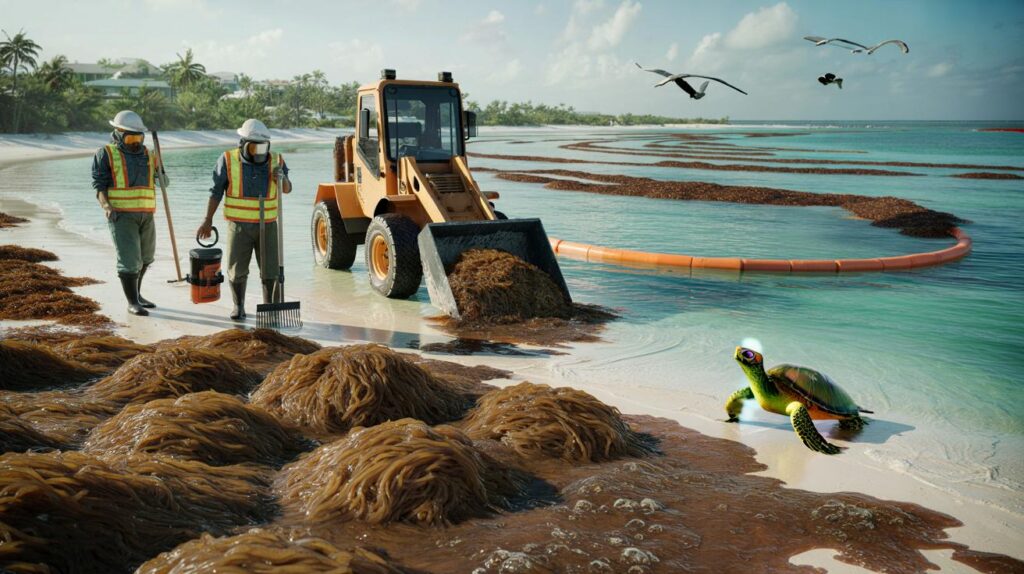
Across the Atlantic, a brown, sprawling presence is testing coasts, economies, and patience as warmer months return again.
New satellite measurements and decades of field data now show the Great Atlantic Sargassum Belt is not a passing quirk but a recurring fixture. Fed by nutrient surges from the Amazon, fertilisers and sewage, the bloom stretches thousands of kilometres and periodically piles onto beaches from West Africa to the Gulf of Mexico.
What scientists are seeing from space
Fifteen years ago, most sargassum drifted within the Sargasso Sea. Today, vast bands span the tropical Atlantic. In May 2025, satellites tracked roughly 37.5 million tonnes of sargassum stitched into a belt more than 8,800 km long, a swathe large enough to dwarf many countries and rival continents in area.
37.5 million tonnes. 8,800 km. A belt visible from orbit and now part of the Atlantic’s seasonal calendar.
Ocean currents act like conveyor belts. The Gulf Stream and related flows lift and carry mats west, while winds herd them into broad surface lines. The result is a transoceanic corridor that can steer rafts towards the Caribbean, Florida, the Gulf of Mexico and parts of West Africa.
Why it is exploding in size
A 40-year data record points to nutrients
Researchers working with four decades of satellite imagery, water samples and chemical records report a persistent upswing in blooms since about 2011. They find more nitrogen and phosphorus in the system and more in the algae themselves.
- Algal tissue nitrogen has risen by around 55% compared with the 1980s.
- Dissolved nitrogen and phosphorus in surface waters are up by roughly 50% over similar periods.
- Blooms now recur in most years rather than appearing as sporadic anomalies.
Where do those nutrients come from? Three main sources dominate the picture.
- Agricultural runoff: fertilisers and soil from farms flow into rivers and then the sea.
- Wastewater: sewage and inadequately treated effluent add nitrogen and phosphorus near coasts.
- Atmospheric deposition: particles and reactive nitrogen settle out of the air onto the ocean.
The Amazon’s seasonal push
The Amazon River adds a powerful seasonal pulse. During the wet months, its discharge flings nutrient-rich freshwater far into the Atlantic, priming sargassum growth. During drier months, that momentum slackens and the belt thins. This natural rhythm now interacts with human-driven nutrient loads, tilting the balance towards larger, longer blooms.
When floating habitat turns into a hazard
In modest amounts, sargassum creates nurseries for turtles, fish and invertebrates. The National Oceanic and Atmospheric Administration recognises it as habitat supporting more than a hundred species. Trouble starts when mats arrive in bulk or linger offshore for weeks.
- Rotting algae release hydrogen sulphide gas, which can irritate eyes and lungs and trigger headaches.
- Thick canopies shade coral reefs and seagrass, choking light and slowing growth.
- Bacterial breakdown strips oxygen from the water, creating low-oxygen dead zones where fish cannot survive.
- Decomposition also emits methane and other greenhouse gases, adding to warming pressures.
When blooms stack up in bays and on beaches, the oxygen drops, the water smells of sulphur, and marine life retreats.
Fishing crews report clogged propellers and fouled nets. Turtles and manatees can struggle near dense clumps. For beachgoers, the stench and irritation push holidays indoors, and local lifeguards face repeated closures.
People and ports paying the price
Caribbean islands and Gulf of Mexico resorts now plan for sargassum the way they plan for high season. Clean-ups cost councils and hotel consortia millions of pounds each year, and shifting tides can undo a day’s work overnight. In 1991, a Florida nuclear station had to pause operations when algae clogged its cooling water intake. Smaller water and power plants face similar risks when rafts jam inlets.
Coastal councils juggle trade-offs. Heavy machinery can clear beaches fast but crush dunes and nesting sites. Leaving mats to decompose can smother turtle nests and create health complaints from hydrogen sulphide. Many authorities now trial offshore barriers to divert rafts and designate controlled landing zones to minimise damage.
Forecasts, fixes and what you can do
Better prediction and early action
Satellites, drifting buoys and current models can flag landfall weeks in advance. That window matters. Ports can safeguard intakes. Hoteliers can deploy booms. Crews can schedule night-time rakes to avoid heat stress and nesting turtles.
- Use seasonal forecasts to time barrier deployment and shoreline staffing.
- Skim offshore where feasible, with bycatch guards to protect fish and turtles.
- Designate access routes for machinery to protect dune vegetation.
- Store collected algae on lined pads to contain leachate and odours.
Some firms convert sargassum into biogas, compost or biochar. These options reduce landfill pressure, but caution applies. Caribbean samples often contain arsenic taken up by the algae. That limits use on cropland unless treated to immobilise or remove contaminants.
Cutting the feed at source
The belt thrives when rivers carry surplus nutrients. Reducing that feed is the durable fix.
- Farm practices: precision fertiliser application, cover crops, and buffer strips near waterways.
- Wastewater upgrades: nutrient removal at treatment plants and septic-to-sewer conversions.
- Stormwater controls: wetlands and retention basins that trap runoff before it reaches the sea.
- Air quality: policies that cut reactive nitrogen emissions from traffic and industry.
Turn down the nutrient tap on land and the ocean’s algal response begins to soften within seasons.
Key numbers at a glance
| Metric | Latest picture |
|---|---|
| Belt length | Over 8,800 km across the Atlantic |
| Biomass | About 37.5 million tonnes (May 2025) |
| Trend | Near-annual blooms since around 2011 |
| Nutrient shift | Algal nitrogen +55%; dissolved nitrogen and phosphorus roughly +50% since the 1980s |
| Habitat role | Supports 100+ species in normal amounts |
| Main risks | Hydrogen sulphide, hypoxia, coral shading, methane release |
What this means for you this season
If you live or work near the Atlantic, plan for rolling arrivals rather than a single event. Check local advisories before beach trips. Those with asthma or heart conditions should avoid areas with strong sulphur smells from rotting mats. Keep pets away from thick accumulations and stagnant pools created by stranded algae.
For small businesses on the shore, simple steps help. Fit removable mesh guards on pumps. Stock odour control materials and protective masks for staff working near decomposing mats. If you compost sargassum, do it on impermeable surfaces and keep it away from crops unless tested for heavy metals. Communities that coordinate—sharing forecasts, labour and disposal sites—tend to clear faster and at lower cost.
The bigger picture scientists are watching next
Researchers are refining models to predict when Amazon discharge and wind patterns will line up for large blooms. They are also testing whether targeted nutrient cuts in key river basins can reduce biomass within a few years. Trials with floating barriers, low-impact harvesters and shoreline redesigns aim to protect turtle nesting and reduce sand loss.
The belt’s rise signals a changing nutrient balance in the Atlantic. Managing that shift means acting on land as well as at sea. The tools exist—better farm practices, upgraded wastewater treatment, and smarter coastal operations. The question is whether enough places adopt them before the next 37.5 million tonnes drift ashore.



For coastal residents with asthma, what H2S exposure threshholds should trigger a beach skip? Are handheld meters useful, or are local advisories enough? Any evidence of long‑term effects from repeated low‑level exposure, or mainly acute irritation? Trying to set family rules before summer—thanks. Also, do N95s help at all with hydrogen sulfide, or is that wishful thinking?
Not convinced the 37.5m‑ton figure isn’t exagerated. Satellites see floating mats, sure, but how do they seperate sargassum from other debris or turbidity? Feels a bit like apocalyptic framing to me. Show error bars and ground-truthing stats, not just big scary numbers.