
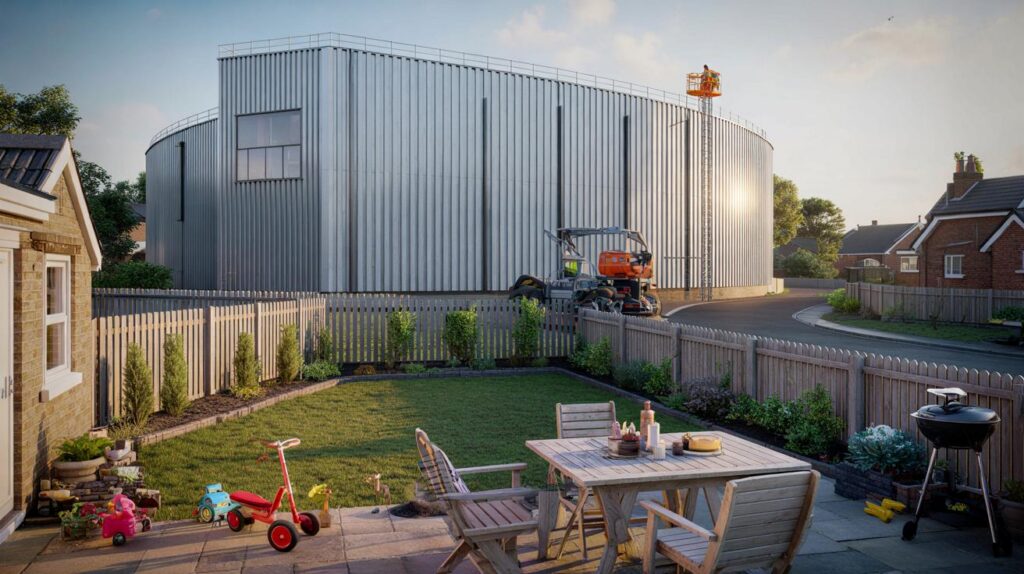
In a quiet Tyldesley cul-de-sac, a wall of corrugated steel now fills the skyline, dividing neighbours and shaking routines.
On the Henford Estate in Greater Manchester, families say an industrial complex is arriving almost on their doorsteps. Two giant sheds now loom above garden fences, part of a 350,000 sq ft logistics scheme that has transformed views, habits and house price calculations in a matter of months.
How a logistics hub appeared on the doorstep
The development sits a short hop from back gardens in Tyldesley, Wigan. Planning documents set out four new warehouses, with two allowed to reach 18.3m (about 60ft). The frames are already visible from the estate, and residents say the nearest structure is roughly 30m from the closest homes.
Parcel firm Whistl has committed to the site, signing a 15-year deal for a 140,000 sq ft unit. The scheme’s backers say new jobs and investment will follow. The council insists the application travelled through formal consultation and committee, with landscaping promised to soften the impact.
Two sheds up to 18.3m high are rising within roughly 30m of back gardens in a 350,000 sq ft scheme.
From drawn lines to steel walls
Neighbours say the finished scale is far beyond what many expected when initial drawings circulated. Several residents say only a limited number of letters went out, leaving some households who back onto the site unaware until piling and steelwork began. A packed local meeting reportedly drew more than 200 people, and a campaign group has formed.
Some long-term homeowners speak of losing a cherished outlook. Others worry constant noise, construction traffic and site lighting will erode the quiet they once relied on. A few are already pondering whether to move—though many fear any sale would carry a discount.
Residents say the mass and height eclipse hedges and fences, turning a green fringe into a solid industrial backdrop.
Light, privacy and daily routines
Families on the estate describe a new routine: checking the sun’s angle, gauging how much of the patio sits in shadow, and thinking twice about evening sits in the garden. Parents talk about privacy, with windows now facing the silvery flank of a warehouse rather than open fields. Some point to cracks and dips in their homes; they fear nearby heavy works have aggravated existing defects, though proving cause will likely require professional reports.
House prices and stalled plans
For those midway through life plans—downsizing, upsizing or moving for work—the timing feels brutal. Homeowners worry about valuations, the stigma of being “next to the sheds,” and buyer questions about noise, light and future expansion. One elderly resident who has lived locally for decades says the constant building has tipped him towards moving away altogether.
What the council and developer say
Wigan Council says the scheme followed due process. A senior official points to landscaping, screening and ongoing monitoring through construction. The authority says it will ensure the developer delivers the project properly, and adds that the town needs investment. The developer declined to comment when asked about residents’ concerns.
Officials say consultation took place and further planting will screen the buildings; residents say the plan grew in size.
The numbers at a glance
| Element | Detail |
|---|---|
| Total site area | Approx. 350,000 sq ft |
| Number of warehouses | Four planned |
| Maximum approved height | 18.3m (around 60ft) for two units |
| Nearest distance to homes | About 30m, according to residents |
| Pre-let unit | Whistl, 140,000 sq ft, 15-year term |
| Initial consultation letters | 90 households, say neighbours |
| Public meeting turnout | More than 200 people |
The rules that shape light and height
Most councils use recognised guidance on daylight and sunlight when judging impacts. The commonly referenced document is published by the Building Research Establishment (BRE). It sets out ways to test whether a new building significantly reduces natural light to windows and gardens. Local planning policies also weigh visual impact, traffic, noise and economic benefit.
There is also the civil concept known as a “right to light.” This sits outside planning and hinges on long-term light enjoyed through specific windows. It usually needs specialist surveyors and, if unresolved, can end up in private negotiation or court. Not every home qualifies, and claims depend on precise geometry, so early expert advice matters.
Even after permission is granted, planning conditions typically control working hours, lighting, dust suppression and construction routes. Landscaping—bunds, tree belts and acoustic fencing—often arrives late in the programme, meaning residents live with bare steel long before planting matures.
What you can do if a mega-shed lands near you
- Track the file on your council’s planning portal and read the officers’ report and conditions.
- Ask for the Construction Management Plan and site contacts; report breaches to the planning enforcement and environmental health teams.
- Log noise, vibration and dust with dates and times; recordings and photos help build an evidence trail.
- Commission an independent daylight/sunlight assessment if you believe windows or gardens fail BRE guidance.
- Get a chartered surveyor’s view on any new cracks or subsidence; notify your insurer promptly.
- Form a residents’ group to coordinate queries, share costs for expert reports and maintain dialogue with site managers.
- Request details of planting schedules, bund heights and acoustic barriers, and push for earlier installation where feasible.
- If you plan to sell, obtain multiple valuations and ask agents for comparable sales near similar developments.
Inside the consultation question
Neighbours argue the notice process missed key households. Councils typically notify properties closest to a red-line boundary and also publish site notices and entries on their website. That can still leave people feeling late to the party. If the final scale diverges from the drawings residents thought they saw, frustration deepens, even when documents technically match what committees approved.
What happens next in Tyldesley
Construction continues, with the council promising extra oversight and a landscaping phase to soften the view. Screening trees and earth mounds take time to establish, so the sheds may remain stark for a while. As operations begin, the balance between jobs, traffic and neighbourhood amenity will be tested in real conditions.
For homeowners doing the maths, the immediate concerns are practical: light in winter, evening noise, vehicle routes and resale prospects. A pragmatic approach pairs vigilance—recording issues and pressing for conditions to be enforced—with steady requests for design tweaks, such as darker cladding panels, motion-triggered lighting and thicker planting belts. These small changes rarely grab headlines, but they often decide how liveable the edge between houses and warehouses becomes.



If the nearest wall is ~30m from gardens and two units reach 18.3m, has anyone commissioned an independent BRE daylight/sunlight assessment yet? I’d like to see VSC/APSHi figures for winter afternoons. If they fail, what mitigation is on the table—darker cladding, earlier planting, taller bunds, acoustic fencing, motion-triggered lighting? And are these actually secured as enforceable condtions?