
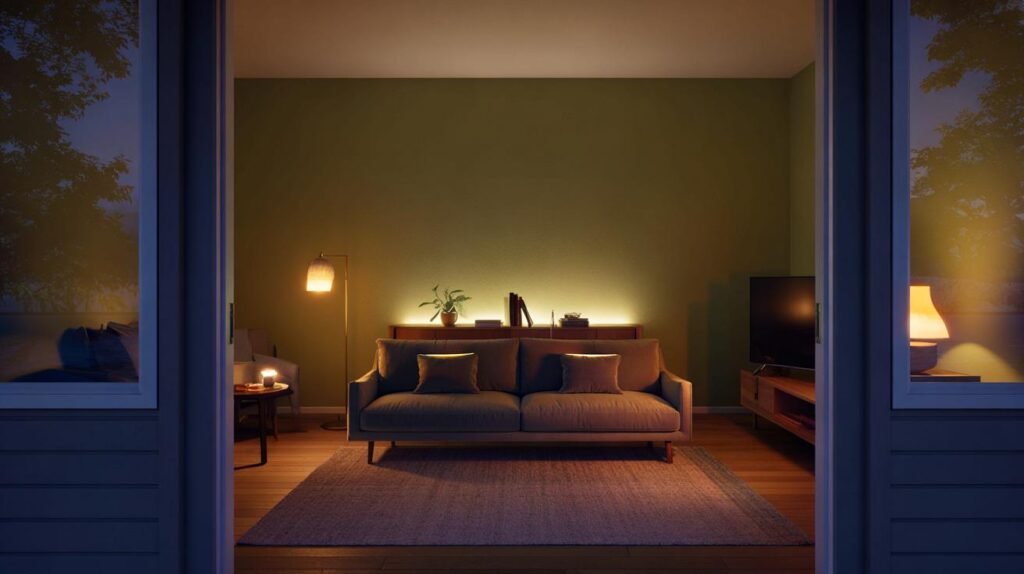
Your living room isn’t wrong. It’s just working against you. When a space feels flat or oddly tense, it’s rarely the paint or the cushions. Nine times out of ten it’s the sofa glued to a wall and light that’s either blinding or nowhere near where you actually sit.
The first clue landed on a quiet Sunday evening, rain on the window, telly murmuring. My friend dropped by, clocked the room in three seconds, and asked if we could “borrow” the hallway lamp. We slid the sofa 30 centimetres off the wall and nudged the light to the corner like we were tuning a radio. The air shifted. Voices softened. The rug made sense. Nothing else changed.
Why your lounge feels off (and how it sneaks up on you)
Rooms tell stories through lines. A sofa jammed against plaster reads like a bookmark left too far in, and the ceiling light throws a harsh spotlight on the middle of life. You sit down and everything points away from people and towards the biggest black rectangle. *Move the sofa by 20 cm and you change the room.* That tiny gap gives you a “shadow line” and, oddly, dignity. Suddenly the wall stops shouting.
We’ve all had that moment when you open the door and the room greets you with a shrug. A reader in Bristol told me she lived with a stern, echoey lounge for two years. She pulled the sofa off the wall, tucked a floor lamp behind the arm, and the next morning her partner made coffee and sat there without a word, like the room had finally offered him a chair. Small shifts. Big feeling.
There’s a simple reason this happens. Our eyes anchor to bright spots and big blocks. If the only bright thing is overhead, faces look flat and sides feel dark. If the largest object — the sofa — is plastered to a wall, you get a corridor, not a conversation. Pulling it forward creates flow around and across, so you walk through the room, not along it. Pair that with warm, low light and you’ve built a welcome.
Fix the layout: start with the sofa and the light
Float the sofa if you can. Even 15–30 cm from the wall changes everything. Aim for a 60–90 cm walkway between seating and anything people need to pass, and let at least the front legs sit on the rug so the set-up reads as one scene. If your room’s tight, angle the sofa a few degrees or borrow space from a corner with a slim console behind it. That sliver becomes a glow lane for a lamp and books.
Next, layer light like you’re choreographing mood. Start with one warm floor lamp at eye level in a back corner, add a table lamp near where you read, and soften any ceiling downlights with dimmers or warm bulbs. Let’s be honest: no one calculates lumens after a long day. So keep it simple — one glow for the room, one for the task, one for the face. Layer the light, then test it at night, not just in the afternoon.
Most “off” rooms share two habits: the sofa clings to a wall and the only working light comes from above. Swap those and you’ll feel the floor plan breathe.
“Light is the first piece of furniture,” a lighting designer friend once told me, “because you sit where the glow is.”
That sentence changed how I arrange everything. Here’s a quick cheat sheet you can screenshot:
- Pull seating off the wall by a hand’s width, minimum.
- Place a lamp behind or beside the sofa’s back corner to halo the room.
- Use one low, one mid, one high light source to avoid glare.
Mind the glare and watch conversations linger a bit longer.
Let the room breathe (and do more with less)
When layout and light click, the whole place feels taller, even if your ceiling hasn’t budged. You’ll notice the telly looks calmer, plants read greener, and the rug stops floating like a raft. People lean back. Shoulders drop. You might even hear the soft sound of a room exhaling, which sounds silly until you’ve heard it once and can’t un-hear it.
This isn’t about turning your lounge into a glossy spread. It’s about making it work on a Tuesday night with socks on the radiator and a mug ring on the table. Try things for ten minutes at a time and walk in from the hallway as if you’re a guest. If your eyes land on the sofa, good. If they ping to the ceiling lamp, lower the glow or move it. The room will tell you when you’ve got it.
One last nudge: be gentle with scale. A tiny lamp makes a big sofa feel louder, and a rug that’s too small chops the scene like a bad haircut. Go larger on the rug than your instinct, keep shades at or just below eye level when seated, and let the corners stay a touch mysterious. Bright doesn’t mean better. Warm, placed, and a little quiet wins most evenings. Soyons honnêtes : personne ne fait vraiment ça tous les jours — and that’s okay.
150-word synthesis that invites sharing
Most living rooms don’t need an overhaul. They need the sofa to stop kissing the wall and the light to stop interrogating the coffee table. Once you float one, layer the other, the room becomes what you wanted it to be in the first place — a place to be with people you like, even when it’s just you.
I keep thinking about the 30 cm rule, not as a measurement, but as an attitude. Leave a little room for air. Let the furniture breathe. Let the light find faces. You’ll catch yourself sitting in spots you’d ignored for years, surprised by how natural it feels to finally use the room you already own.
If you try the shuffle tonight, tell someone. Share a photo, or just the feeling. Is the telly less bossy? Did the corner you thought was dead come alive with a lamp and a book? That’s the magic of small moves done with care.
| Key points | Details | Interest for reader |
|---|---|---|
| Float the sofa | Create a 15–30 cm gap from the wall and allow 60–90 cm walkways | Instantly improves flow and comfort without buying anything |
| Layer the light | Combine low, mid and high light sources with warm bulbs and dimmers | Makes evenings softer, faces warmer, and TV glare calmer |
| Scale matters | Front legs on the rug, larger rug than instinct, shades at seated eye level | Unifies the scene and stops the room feeling chopped or cold |
FAQ :
- Where should my sofa go in a small living room?Pull it off the wall by a hand’s width and angle it a touch. Use a slim console or lamp behind the back corner to anchor it.
- How many light sources do I need?Three per zone is a solid start: one ambient, one task, one accent. Test the mix at night, not just in daylight.
- Is it okay to put a sofa under a window?Yes, if the back is lower than the sill and the fabric tolerates occasional sun. Add a floor lamp to one side for depth.
- What size rug works under a three-seater?Big enough for the front legs to land on it. If in doubt, size up. A larger rug calms the composition.
- How do I cut TV glare without a dark cave?Place a warm lamp behind or beside the screen to balance contrast, and dim any overheads. Aim for glow, not spotlight.



Moved my sofa 25–30 cm off the wall and borrowed a lamp from the hallway—boom, the room finally made sense. I didn’t buy anything, just shuffled stuff and the TV stopped bossing me around. The “shadow line” idea is spot on; even my rug looked less floaty. Only hitch: my walkway’s down to ~55 cm. Is that a deal-breaker or okay for a small flat? Also, is a 2700K bulb warm enough or should I go lower? Definitley trying dimmers next.