
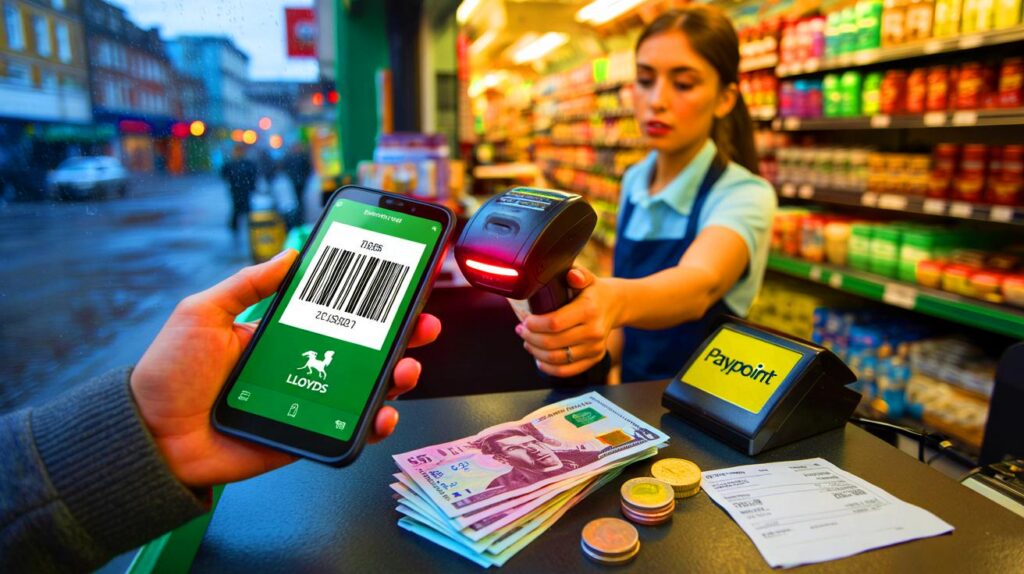
A fresh twist on everyday banking is quietly landing on your phone, promising speed, choice and fewer queues for cash.
Lloyds Bank is rolling out a barcode-powered cash deposit feature across the UK this month, letting customers pay notes and coins into their accounts at more than 30,000 PayPoint counters. The move introduces a £300 daily cash deposit rule via the app and caps app-enabled deposits at £600 per month.
What is changing
For the first time among the big high street players, Lloyds customers can open the mobile app, generate a time-limited barcode and hand over cash at a local PayPoint till. The shop assistant scans the barcode, counts your cash and the money heads to your account.
Deposit up to £300 a day, within a £600 monthly cap, by scanning an in‑app barcode at 30,000+ PayPoint locations.
The bank says most people live near a participating outlet. With 99.5% of the population within a mile of a PayPoint and 94% of stores open seven days, this turns the local corner shop into a mini cashier for small deposits.
How the £300 rule works
The new limits apply to cash paid in using the barcode at PayPoint. You can use notes and coins. The barcode stays valid for two hours, so you have a tight window to complete the drop‑off once you generate it.
The barcode expires after two hours. Generate it when you are ready to pay in, not at the breakfast table.
These app-based limits sit alongside existing ways to pay in larger sums via traditional routes, such as branches or Post Office counters.
Step-by-step: paying in cash with the app
- Open the Lloyds app and head to the Everyday section.
- Choose the cash deposit option and generate your barcode.
- Take your cash to a PayPoint store before the two-hour cut‑off.
- Ask the retailer to scan the barcode and hand over your notes and coins.
- Keep the receipt and check your app for confirmation.
Where you can pay in
PayPoint retailers include thousands of convenience stores, newsagents and petrol stations across towns and villages. Many operate long hours, which suits shift workers and parents juggling the school run.
You can still use:
- Lloyds, Halifax and Bank of Scotland branches for counter deposits.
- Lloyds cash in/out machines in selected locations nationwide.
- Banking Hubs offering counter services staffed by the Post Office.
- Any of the UK’s 11,500 Post Offices for day‑to‑day banking, including cash in/out.
The essentials at a glance
| Feature | Detail |
|---|---|
| Daily cash deposit via barcode | £300 limit |
| Monthly cash deposit via barcode | £600 limit |
| Barcode validity | 2 hours |
| Network | 30,000+ PayPoint locations |
| Opening pattern | 94% of PayPoint stores open seven days |
| Proximity | 99.5% of people live within a mile of a PayPoint |
Why Lloyds is doing this
Cash use remains part of many households’ routines, from weekend market takings to pocket money and club subs. At the same time, branch networks have thinned and opening hours have tightened. By tapping the PayPoint estate, Lloyds gives customers a cash‑deposit option near home, often late into the evening.
The bank frames it as flexibility and choice: you can pay in while picking up milk or dropping a parcel. PayPoint, for its part, cements its role as a footfall driver for local shops, bundling bill payments, parcel services and now mainstream bank deposits under one roof.
Who benefits most
Households juggling time
Parents, carers and commuters can bank cash during errands, without planning a trip to a branch. The two‑hour window suits quick errands and avoids long queues.
Cash earners and side‑hustlers
Tradespeople, market sellers and hospitality workers who receive small cash sums can drip‑feed takings rather than holding cash at home. The £300 ceiling encourages regular banking of modest amounts.
Rural and small‑town communities
Where branch coverage is thin, the local PayPoint shop becomes a practical extension of banking services, open seven days in most cases.
What this means for your money
The new cap does not replace higher in‑branch allowances; it simply sets a guardrail for barcode deposits. If you need to pay in more than £600 during a month, you can switch to counter services at Lloyds, Halifax or Bank of Scotland, or use Post Office counters where applicable.
Use PayPoint for fast, small deposits; use branches, Post Office counters or cash machines for larger sums or specific needs.
Receipts matter. Keep them until the credit shows in your app. Time your barcode to your visit so you do not get caught out by expiry. If a store’s PayPoint terminal is offline, try another location or return later.
Safety and fraud tips
- Generate the barcode only when you are ready to pay in.
- Do not share the barcode screenshot in group chats or on social media.
- Count your cash before you hand it over and check the receipt total.
- Store receipts until the deposit appears in your account.
How this sits in the wider banking shift
UK banks increasingly lean on shared infrastructure to keep cash services alive. The Post Office network already handles deposits and withdrawals for many current accounts. Banking Hubs add staffed counters in towns that lost branches. PayPoint extends that idea into late‑opening convenience stores with digital barcodes. Each strand reduces the distance between customers and cash services, while pushing routine tasks through technology built into the mobile app.
Planning around the limits
Think in small, regular deposits if you often handle cash. A simple routine could be £100 to £200 at a time, two or three times a week, staying under the £300 daily limit and within the £600 monthly cap for barcode deposits. If you expect a larger cash week—say after a community fundraiser—book time at a branch or Post Office counter rather than risking a last‑minute rush.
Extra pointers that save time
- Check the nearest PayPoint in the app before you head out, especially late at night.
- Bag coins neatly to speed up counting at the till and avoid hold‑ups.
- Keep a small envelope in your bag or glovebox for cash earmarked for deposit.
- Set a calendar reminder near month‑end if you rely on the £600 monthly allowance.
The bottom line for customers
This change gives people another way to bank cash without detours. It adds convenience without removing branch or Post Office options. The £300‑a‑day, £600‑a‑month caps steer the feature towards frequent, smaller deposits. For many, that is exactly what day‑to‑day life requires. For bigger cash moments, the old‑school counter remains open.



That £600 monthly cap via barcode feels low for side‑hustlers; I could hit that in a week, definately. Can I mix PayPoint deposits with Post Office or branch in the same month without issues, and do the limits overlap across Lloyds/Halifax/Bank of Scotland?