
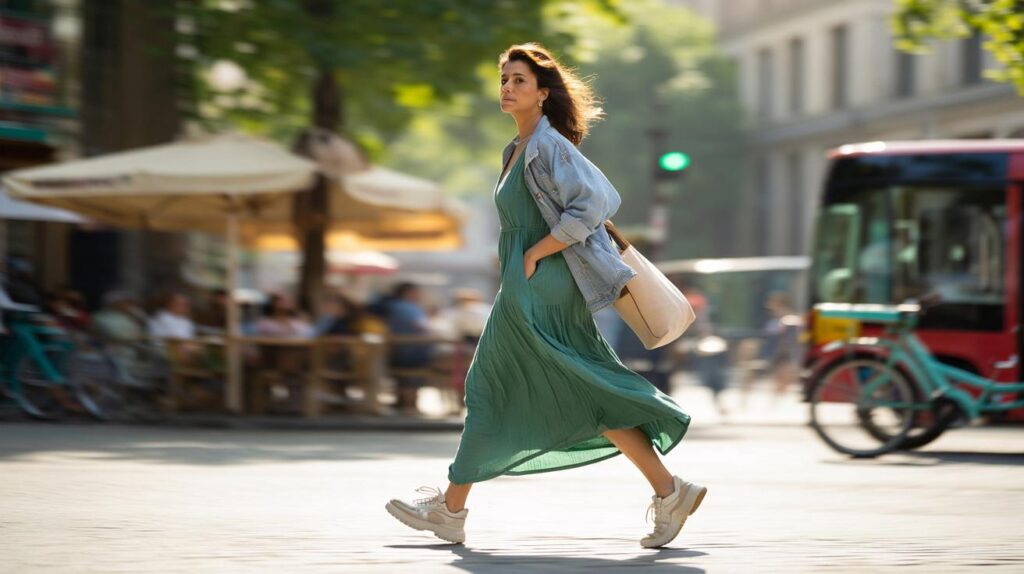
The first hot day of the year arrived like a dare. Pavements shimmered, the bus windows fogged with sunscreen, and everyone seemed to be negotiating with their clothes. On the platform, a woman unknotted her long dress, letting the fabric fall around her calves like a small private breeze. No tugging. No zipper drama. Just movement. People watched, then looked away, the way we do when someone looks completely at ease. It’s easy to say long dresses are fussy or prudish. It’s easier still to miss how they work in real life when the city turns into a slow oven. The truth is less tidy and more human. We want comfort that doesn’t ask permission. We want clothes that don’t keep a running commentary on our bodies. And sometimes the answer is the fabric that floats rather than clings. Here’s the real surprise.
The long hem that lets you live
Long dresses have a reputation they didn’t earn. They’re filed under “formal” or “too much” by people who haven’t tried walking at speed in one on a humid Tuesday. The length doesn’t trap you. It hides the admin: waistband negotiations, thigh concerns, the constant micro-adjustments. You gain ease without losing shape. When fabric moves with you, not against you, everything else gets quieter. This is the paradox worth noticing.
I watched a friend, Priya, swap her skinny jeans for a breezy column dress on the Northern line. Two stops in, she smiled the kind of smile that belongs to someone who just remembered her own body. Then she bounded up the escalators, free hands, long stride, no tugging. Later she ran errands with a tote slung across the dress, trainers on her feet, hair frizzing in the heat like a halo. No one stared. One person asked where she got it. By evening she’d thrown on a cardigan and sat in a beer garden, knees tucked under the fabric like a secret. The day asked for everything. The dress covered it.
There’s a logic to this. Long dresses distribute attention rather than concentrating it on one patch of skin. They’re not about hiding; they’re about flow. A single piece means less friction at 7 a.m., fewer choices, less noise. That quiet is freedom. The hemline protects against sticky seats, sunburnt thighs, blasting office air-con, and the sudden shower that finds you between Tube stops. Call it **ease over display**. When your clothes don’t shout, you get to speak louder.
Make a long dress work hard for you
Start with the “60-second movement test.” Put the dress on and do three things: sit on a low chair, take ten brisk strides, and walk up a flight of stairs. If nothing pulls, twists, or traps, you’re golden. If the hem bites at your ankles, try a side slit. If the armholes dig, size up and belt it later. Fabric matters: cotton poplin for heat, viscose or Tencel for swoosh, light knits for travel. And yes, pockets change everything — **pockets equal power**.
Common misstep: overstyling. A long dress doesn’t need twelve accessories and a complicated heel. It needs balance. Chunky sandals or classic trainers ground the float. A denim jacket or boxy blazer reins in the romance for Monday morning. If you’re petite, aim for a clean column or a waist seam that sits right where you bend; trims and tiers can overwhelm. We’ve all had that moment when a mirror suddenly feels like a jury. Be kind to yourself. Try different lengths until your stride feels natural. Let’s be honest: no one really does that every day.
A confidence trick that’s not a trick: choose one anchor point. Maybe it’s a sturdy shoe, maybe it’s a belt, maybe it’s a crisp collar. Once anchored, the rest can float. It feels like a small permission slip you didn’t realise you needed. The dress becomes a backdrop for your day, not a performance.
“A long dress is a way to move through the world with your hands free and your shoulders down,” a stylist told me. “It’s not modesty. It’s momentum.”
- Pick swish-friendly fabrics that recover fast and don’t cling.
- Anchor the look with trainers, chunky sandals, or a city boot.
- Layer light: denim jacket, cropped cardigan, or a sharp blazer.
- If you want shape, add a belt or tie a shirt at the waist.
The bigger picture beyond the hem
Long dresses often get lumped into debates about modesty or rules that never loved us back. The real story is different. When a garment lowers the background buzz of self-consciousness, you get time back. Energy, too. That’s the kind of freedom that doesn’t show up on mood boards but does show up in your calendar. It’s walking to work without chafing thoughts. It’s sitting cross-legged on the grass without planning an exit strategy. It’s carrying groceries with both hands because your outfit doesn’t need babysitting. The hem isn’t a border. It’s a portable boundary you control. Style shifts when it serves your life first and the gaze second. Try wearing one on a day you’d usually reach for leggings and a T-shirt. Notice what you don’t think about. That silence has weight. And yes, it reads as style. That’s the quiet magic.
| Point clé | Détail | Intérêt pour le lecteur |
|---|---|---|
| Flow over fuss | One-piece dressing cuts decision fatigue and reduces wardrobe “admin.” | Frees mental space for the day, not the outfit. |
| Anchor and float | Ground with sturdy shoes or a structured layer, let the fabric move. | Confidence without losing comfort or mobility. |
| Fabric first | Breathable weaves and soft drape keep things cool and unrestrictive. | Practical ease in heat, travel, and long workdays. |
FAQ :
- How long should a maxi dress be?Ideally it just kisses the top of your foot and clears the floor by a centimetre or two. If you swap between flats and heels, hem for flats and let a small heel show the ankle.
- Can petite people wear long dresses?Yes. Look for clean columns, vertical seams, or a higher waist seam. Avoid heavy tiers and oversized prints. A slight front slit keeps your stride easy.
- What shoes work best with long dresses?Trainers for city pace, chunky sandals for summer, ankle boots for cooler days. If you want height without wobble, try a block heel or platform sole.
- Are long dresses office-appropriate?Go for structured fabrics, sleeves or a neat cardigan, and a blazer if needed. Add a belt to define shape. The hemline reads polished when the styling is clean.
- How do I avoid looking too “boho”?Swap frills for crisp lines, pick solid colours or quiet prints, and add a sharp jacket or leather belt. A minimal bag and simple jewellery steer the look. **Permission to breathe**, not costume.



J’adore l’idée « ease over display » traduite en « fluidité plutôt que parade ». Depuis que j’ai trouvé une robe en tencel avec de vraies poches (poches = pouvoir!), je rentre du boulot avec les épaules basses. Le test des 60 secondes est brillant: s’asseoir, marcher, escaliers — ça change tout. Et merci d’avoir rappelé que l’ourlet protège autant qu’il libère. On oublie le bruit des micro-ajustements… et on respire. Bref, article super utile, bien ecrit, et inspirant 😊
Et quand il pleut à verse et que le tissu colle, cest toujours « liberté » ou juste une serpillère élégante? Je suis preneuse d’astuces anti-ourlet mouillé (autre que « prendre un Uber »), parce que dans le métro bondé, c’est pas si simple.