
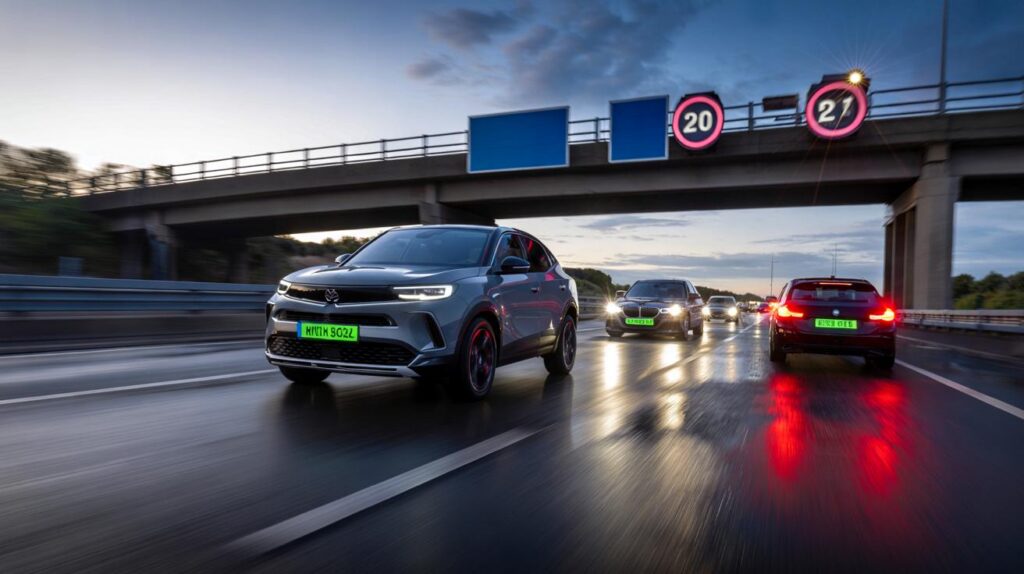
Variable speed cameras on the M4 and M5 keep flashing, and drivers say they struggle to read changing limits in time.
This week a Swindon motorist learned what those changes can cost. A camera on the M4/M5 corridor recorded her at 72mph while a 60mph limit applied, leading to a court bill and penalty points.
What happened on the motorway
Kelly Stubbs, 43, of Mill Lane, Swindon, drove a Vauxhall Mokka Ultimate Turbo along the M5 northbound between junctions 17 and 16 and the M4 between junctions 19 and 20 on 31 August 2024. Gantry signs showed a variable 60mph limit on that smart motorway stretch. Cameras recorded her vehicle at 72mph.
Variable limits operate on the M4/M5 around the Almondsbury area to manage congestion and incidents. When those red-ringed numbers appear on gantries, the law treats them as enforceable limits. The cameras linked to the system do not switch off just because traffic seems to flow.
72mph in a 60mph variable limit on the M4/M5 corridor triggered a court bill of £314 and three points.
The court outcome
Stubbs appeared at Bath Law Courts on Tuesday 26 August. She pleaded guilty to exceeding a variable speed limit. Magistrates imposed a £146 fine and three penalty points. The court added a £58 victim surcharge and £110 in prosecution costs, bringing the total to £314.
The endorsement will sit on her licence for four years (with three years counted for totting-up). Many insurers load premiums for three to five years after a speeding conviction, so the financial impact can outlast the fine.
Another driver faces penalties
The M4 eastbound case
Weeks earlier, the same enforcement regime caught another driver on a neighbouring stretch. Rei Diko, 28, of Pen Y Lan Road, Roath, Cardiff, drove a BMW 420 eastbound on the M4 between junctions 20 and 19, and also passed through the M5 between junctions 15 and 17. Cameras recorded 58mph with a 50mph variable limit in force.
Magistrates fined him £220, imposed three penalty points, and ordered a £88 surcharge plus £110 costs. His total reached £418.
58mph in a 50mph limit cost £418 and three points—another reminder that variable limits bite.
Two recent cases at a glance
| Driver | Age | Road and junctions | Recorded speed | Limit | Fine | Surcharge | Costs | Total | Points |
|---|---|---|---|---|---|---|---|---|---|
| Kelly Stubbs | 43 | M5 J17–J16 northbound; M4 J19–J20 | 72mph | 60mph | £146 | £58 | £110 | £314 | 3 |
| Rei Diko | 28 | M4 J20–J19 eastbound; M5 J15–J17 | 58mph | 50mph | £220 | £88 | £110 | £418 | 3 |
How variable speed limits work
Smart motorway systems change limits to smooth traffic and reduce collisions. Controllers set limits for incidents, congestion and weather. The limit appears on gantries above each lane and also on roadside signs. Enforcement cameras monitor each lane and trigger if a vehicle exceeds the displayed limit.
Ignoring a variable limit carries the same penalties as breaking a permanent one. The limit applies from the sign until the next sign changes it or cancels it. On multi-lane sections, a different limit can apply to each lane, so lane changes demand an extra glance at the nearest gantry.
Why drivers get caught out
- Limits change quickly when congestion clears or builds, so a legal speed moments earlier can become illegal after the next gantry.
- Following faster traffic tempts drivers to match the flow, not the sign.
- Lane changes can place a driver under a different limit than the one they saw seconds earlier.
- Sat-nav speed data can lag when limits change and should not replace the gantry display.
- Speed creep on downhill grades can nudge an indicated speed above the limit without noticing.
What the penalties usually look like
Sentencing follows national guidelines. At 72mph in a 60mph limit and 58mph in a 50mph limit, both speeds sit in Band A. That band usually brings three points and a fine of around 25% to 75% of weekly income, reduced for a guilty plea. Courts then add a victim surcharge (currently 40% of the fine) and standard prosecution costs.
Some drivers receive an offer of a speed awareness course for lower-end offences if they have not taken a course in the previous three years and their speed falls within set thresholds. A course avoids points but still carries a fee and time commitment. Police decide eligibility before any court listing.
What happens after a notice of intended prosecution
The registered keeper typically receives a Notice of Intended Prosecution within 14 days. That notice includes a Section 172 requirement to name the driver. Failure to respond can bring six points and a separate fine. After the driver admits responsibility, the police may issue a fixed penalty, offer a course, or refer the case to court. Where a court handles it, many cases go through the Single Justice Procedure on paperwork unless the driver asks for a hearing.
Why this stretch catches people out
The M4/M5 around Almondsbury carries heavy interchanging flows between Wales, the South West and the Midlands. Limits there change often as congestion ebbs and spikes. Multiple lanes, short weaving sections and frequent gantries mean drivers must look farther ahead than on a conventional motorway.
A quick calculation puts the risk in perspective. At 60mph you travel about 26.8 metres per second. At 72mph you cover roughly 32.2 metres per second. That extra 5.4 metres every second adds up to more than 320 metres in a single minute—enough to remove the margin that prevents rear-end crashes when traffic bunches.
How to stay on the right side of the cameras
- Scan gantries early and often, and recheck after every lane change.
- Use cruise control or a speed limiter to cap speed when limits drop.
- Leave a two-second gap in dry weather and longer in rain; space buys reaction time when limits change.
- Keep your dashboard camera and windscreen mount clear of your sightline to gantry signs.
- Do not rely on sat-nav limits in variable zones; trust the gantry.
Extra context for motorists
Points add up. Reach 12 within three years and a court can impose a totting-up disqualification, often for six months. Newly qualified drivers face a different risk: six points within two years of passing a first test trigger licence revocation and a full retest route. Three points for low-end speeding can also push insurance premiums higher at renewal, especially for younger drivers or high-mileage policies.
If a fixed penalty offer arrives and you accept it, you avoid court costs and the process ends quickly. If you believe the sign displayed wrongly or the limit had ended, independent legal advice helps, because camera systems record the displayed limit with the measured speed, and courts rely on that paired evidence.



If the limit changes every few gantrys, no wonder people miss it. The signage is there, sure, but lane-specific numbers + weaving at Almondsbury is a lot to process. Enforcement is fair in principle, but could Highways at least add more countdown repeaters or improve legibility in rain? Also, sat-nav lag is real—punishing folks for trusting it feels harsh.