
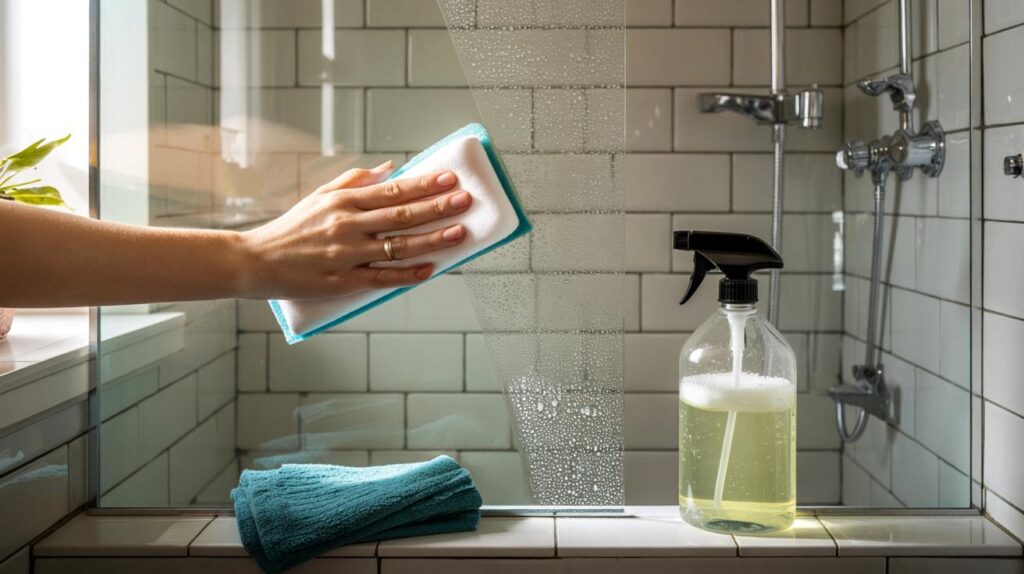
Hotels seem to win the war on shower glass while the rest of us battle streaks, limescale and soap scum week after week.
Behind those spotless screens sits a simple routine many housekeepers rely on. No harsh chemicals, no gimmicks, just a cheap sponge, a quick spray and one minute after each shower. Here is how to bring that five-star clarity into an ordinary bathroom without blowing your budget.
Why hotels keep glass pristine
Hotel teams beat mineral build-up because they act fast and keep the routine short. Hard water leaves calcium and magnesium on warm glass within minutes. Soap binds to those deposits and forms a dull film. Leave it for days and you face elbow-grease. Remove it daily and it never wins.
Two moves underpin the hotel method: mild micro-abrasion for the stubborn bits, and a 50:50 acidic–soapy spray for the rest.
The £2 sponge that lifts deposits
Melamine foam, often sold as a “magic” sponge, behaves like an ultra-fine sandpaper. The foam’s microscopic structure shears off mineral crust and soap film with water alone. It feels soft in the hand yet bites into residue, so the glass clears quickly.
How to use it like a pro
- Rinse the glass with warm water to soften residue.
- Wet the sponge, squeeze until just damp, then work in light circles from top to bottom.
- Rinse the pane and hardware, then dry immediately with a clean microfibre cloth.
- Use gentle pressure; let the foam do the cutting.
- Avoid high-gloss lacquer, acrylic screens, tinted films and delicate coatings until you test a hidden corner.
- Retire the sponge when edges crumble; a fresh face prevents streaky drag marks.
Patch-test first. Melamine foam is micro-abrasive, which is why it cleans so well.
The 50:50 spray that cuts limescale
An equal mix of white vinegar and washing-up liquid tackles both chalky deposits and greasy soap scum in one go. The acid dissolves mineral salts; the surfactant lifts fatty residues. You spend less time scrubbing and more time rinsing.
Recipe and timing
Fill a trigger bottle with 50% white vinegar and 50% washing-up liquid. Shake gently. Warm the vinegar first for extra bite if you like. Mist the glass until lightly wet, wait 10 to 15 minutes, then wipe with a soft sponge and rinse thoroughly. Finish with a dry microfibre.
Hotel-style ratio: 1 part white vinegar to 1 part washing-up liquid, 10–15 minutes of dwell, then rinse and dry.
Keep acids away from natural stone such as marble, limestone or travertine, and from unsealed grout. Mask or avoid those surfaces and rinse fittings well to protect finishes.
Daily 60-second routine that prevents streaks
Prevention beats restoration. A short habit after each shower stops minerals settling and halves weekend cleaning time.
- Use a squeegee from the top down in overlapping passes.
- Buff splashes on glass and taps with a dry microfibre.
- Run the extractor for 15 minutes and leave the door ajar to drop humidity.
- Do the 50:50 spray once or twice a week; use the melamine sponge only when deposits return.
One minute after you shower saves thirty on Saturday.
Alternatives from the cupboard
Bicarbonate booster
On stubborn haze, mist the pane with white vinegar, then sprinkle bicarbonate of soda on a damp sponge and glide gently. The mild alkali and fine particles help lift films. Rinse well and dry.
Lemon on the spots
Halve a lemon and rub it over visible limescale dots. The citric acid nibbles at deposits without harsh odour. Rinse and dry to avoid sticky trails.
Blanc de Meudon paste
Mix blanc de Meudon (whiting) with a little water to a cream. Apply, let it haze, then buff and rinse. It brightens glass without gritty scratching when used lightly.
What actually works best?
| Method | Best for | Typical time | Cost per use | Watch-outs |
|---|---|---|---|---|
| Melamine sponge + water | Stuck-on limescale dots, soap film edges | 5–8 minutes for a full screen | £0.20–£0.30 (sponge wear) | Micro-abrasion; test on coated or acrylic surfaces |
| 50:50 vinegar + washing-up liquid | General film, weekly reset | 10–15 minutes dwell, 3–5 minutes wipe | £0.05–£0.10 | Avoid natural stone; rinse metals well |
| Bicarbonate over vinegar | Heavy build-up and grout edges | 10–15 minutes | £0.05 | Fizziness; extra rinsing needed |
| Lemon rub | Spot treatment | 2–4 minutes | £0.10 | Sticky if not rinsed |
What to avoid if you value your glass
- Don’t mix bleach with vinegar or ammonia; that releases dangerous gases.
- Avoid scouring powders and green pads on glass; they leave permanent haze.
- Skip razor blades on tempered glass edges; chips can propagate cracks.
- Keep acids off marble, limestone and some metal finishes.
- Beware “anti-limescale” nano coatings; aggressive cleaning voids warranties. Use only pH-neutral soap and water on coated panes.
Money and time maths you can feel
A four-person household often spends 30–40 minutes each week scrubbing a neglected shower screen. The hotel routine shifts that effort into tiny daily actions. A squeegee-and-buff habit adds roughly one minute per shower, yet it trims the weekly deep clean to five or ten minutes. Over a month, many households claw back 60–90 minutes.
Costs stay low. White vinegar comes in at roughly £0.60 per litre. A teaspoon of washing-up liquid adds pennies. A pack of ten melamine sponges costs £3–£4; each lasts several full cleans if you use light pressure and rinse it between passes. That puts the typical weekly spend well under £1.
Troubleshooting stubborn cloudiness
If glass still looks milky after descaling and drying, you might be staring at etching, not residue. Etching happens when minerals or harsh cleaners roughen the surface. To tell the difference, wet a small patch with vinegar for five minutes and dry it. If the patch clears, keep descaling. If it stays dull and rough to the touch, only polishing or replacement will restore clarity.
Very hard water (above 300 mg/L CaCO₃) accelerates build-up. A basic inline shower filter can reduce spotting, and a whole-house softener changes the game entirely. Short of that, the daily squeegee is your strongest defence.
Extra gains you can make this week
Upgrade to a wide, silicone-lipped squeegee for faster, streak-free pulls. Pick microfibre cloths of at least 300 gsm; they grab more moisture and leave fewer lint specks. Store melamine sponges dry and sliced into halves for better control. Ventilate until mirrors stop fogging; that’s the cue the glass has stopped collecting fresh deposits.
If your screen carries a factory coating, stick to mild soap and water for maintenance and the 50:50 spray only on uncoated areas. Keep a small log of what you used and how often. That simple record helps you spot what really saves minutes in your bathroom and avoids repeating anything that dulled a finish.



Tried the 50:50 mix today—genuinly impressed. The melamine sponge did the stubborn dots, then a quick microfibre dry and the glass looks hotel-clear. Didn’t need fancy chems. Thanks for the step-by-step!