
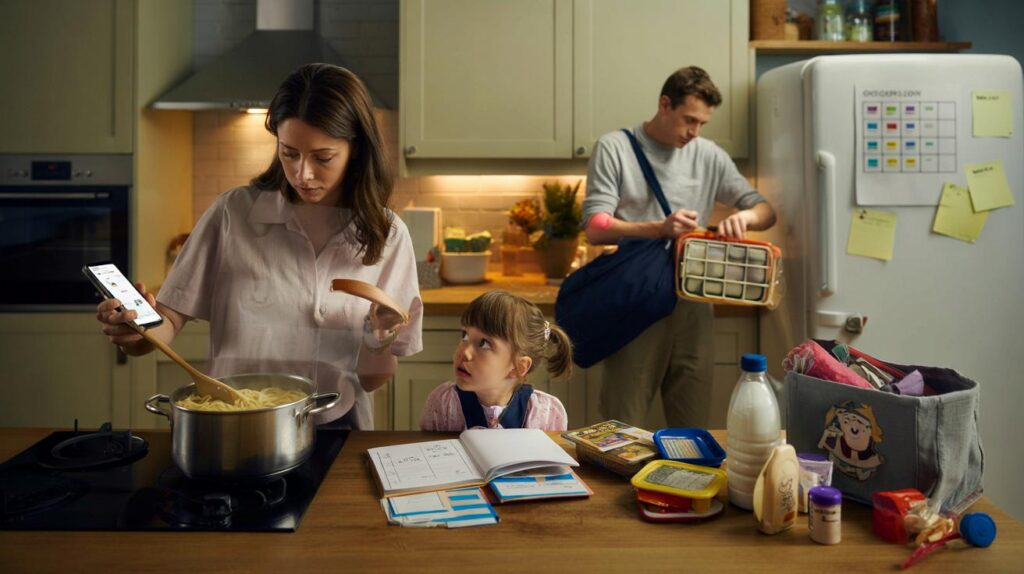
The mental load isn’t housework. It’s the invisible project management behind housework — remembering the PE kit, knowing the milk runs out on Thursdays, tracking who’s on antibiotics and when. In many homes, she carries it by default, even when both partners earn and care.
It’s 7:42pm in a small British kitchen and the dishwasher hums with that half-satisfied rumble. She’s stirring pasta, fielding a maths question, and quietly recalculating tomorrow’s logistics because she’s just remembered it’s “dress like your favourite book character” day. He walks in with good intentions and a tea towel, says, “Anything I can do?” She smiles, because there is always something — but it never feels simple to say it without sounding like a manager delegating tasks at work. The sauce bubbles. The reminder pings. The mental tabs multiply. There is.
The invisible job description
The mental load is the thinking, anticipating, and keeping-in-mind that keeps a household upright. It’s not just doing; it’s noticing and planning, start to finish. In many couples, that cognitive layer has stuck to women like Velcro.
ONS data suggests women still shoulder the majority of unpaid care and household planning in the UK, even when they work similar hours. It shows up in small ways that add up — the one who buys the birthday card, remembers the school trip consent form, knows which jumper is itchy. A thousand tiny, unpaid tabs, open all day.
Why does it cling to women? Social scripts, early training, and the way we label tasks as “help” rather than shared responsibility. If one person is the “default parent”, they don’t just do jobs — they own the calendar in their head. *It’s the programme running in the background that drains the battery, even when the screen looks calm.*
From helping to sharing, for real
Start by externalising the load. Do a 20-minute “household download” where everything that lives in someone’s head goes onto paper or an app — meals, uniforms, gifts, dentist, bins, pet vaccinations, the lot. Then assign ownership end-to-end: conceive, plan, execute. If you own “packed lunches”, you choose the menu, check stocks, do the top-up shop, and pack the bags. No reminders required.
Set a “good enough” bar together. Agree on the minimum viable standard for laundry, homework, tidying — and stick to it as a team. Don’t weaponise incompetence or micromanage. We’ve all had that moment where you think, it’s quicker if I do it myself. That’s the trap. A weekly 15-minute stand-up keeps the system honest and the tone kind.
Help is not the same as ownership. Real sharing is transferring responsibility, not just distributing tasks when asked. Let the person who owns a job solve it their way, even if it’s not your way.
“If I have to remember it, plan it, and remind you to do it — I still own it. Sharing the mental load means I don’t carry the thinking for you.”
- Do the download: list everything that gets done, daily to yearly.
- Divide by ownership, not by task fragments.
- Set standards together; avoid “quality control” later.
- Run a weekly check-in: what worked, what broke, what swaps?
- Build “off-duty” windows where the default parent fully logs off.
What changes when the load is shared
When ownership shifts, the house feels less like a call centre and more like a team. You see fewer 10pm scrambles and more “I’ve got this” moments. The soundtrack of home changes from reminders to updates, and the late-night mental tabs start to close.
There’s a knock-on effect on work, sleep, and mood. People show up to their day jobs with more headspace, and evenings stop being a second shift. Children notice, too; they learn that care is a skill all genders can carry, not a reflex that belongs to Mum.
Silence isn’t peace; it’s usually one person thinking for two. The goal isn’t symmetry in every week. The goal is trust that the cognitive load is shared over time, and that priorities can be renegotiated without resentment. Let’s be honest: nobody really does this every day.
There’s also the matter of fairness that you can feel. When someone owns a domain — meals, the calendar, the bins — they form memory and pride around it. That pride is glue. It holds when work gets chaotic or a child gets ill, because ownership doesn’t evaporate the moment things get messy.
On the rough weeks, the system is a safety net. A partner can step in, not as a substitute, but as a fully briefed co-owner who understands the moving parts. That’s the difference between a household balanced on a single mind and a household that breathes.
And yes, some weeks will tilt. A deadline swallows you. A parent needs hospital visits. A child’s sleep collapses. The weekly check-in is where you rebalance the seesaw and decide what gets dropped. Your home won’t crumble if the floor isn’t mopped. Your sanity might if the load never moves.
Sharing the mental load also changes the relationship temperature. Gratitude returns because contributions are visible, not hidden in someone’s head. Intimacy does better when you’re not quietly furious about the milk.
There’s a long game here. Children who see both parents plan, not just “help”, grow into adults who can hold life in both hands. They’ll be better friends, partners, colleagues. The future load gets lighter before it even lands.
None of this requires fancy apps or perfect discipline. A shared notes file, a pinned calendar, and a simple agreement about ownership beats any shiny system. Start small. Stick with it. Swap when it makes sense. The shift is cumulative, not cinematic.
Yes, people will roll their eyes at “meetings” about laundry. Let them. You’re building a house that runs on trust, not whispers. You’re making headspace, not spreadsheets. And you’re doing it so nobody has to be the eternal foreman of the family.
Some couples find a rhythm quickly. Others need a restart after old habits creep back in. That’s normal. Treat it like any long-term project: review, refine, forgive, try again.
You’ll notice the change in tiny, satisfying ways. He texts the dentist to rearrange a check-up without being asked. She shrugs when the socks aren’t folded “right” and doesn’t redo them. The kids remind Dad about costume day because they know he owns the calendar on Thursdays. It’s not pomp. It’s proof.
And on one evening, months in, you’ll look up at 7:42pm, feel your shoulders drop, and realise your head is quieter. The pasta still boils. The day still sprawls. But the load is finally shared, and that changes everything.
That’s the real win — not perfection, but partnership that holds when life wobbles. Not clean lines on a rota, but a cleaner line between my job and your job, without the hidden labour flowing back to the same person by default. It’s unflashy, grown-up, and deeply kind.
The culture will catch up slowly. Your home can move faster. You don’t need permission from anyone’s nan, neighbour, or favourite influencer. You just need a conversation and a pen. And maybe a cuppa.
One last thing: if you’re reading this and thinking, “We tried a rota and it fizzled,” you’re not alone. That was a task list, not an ownership shift. Restart. Be explicit. Make it yours, not Instagram’s.
Your version might include a “no-thinking night” for each adult once a week. It might include “off-duty Saturdays” where the other parent is truly the default. It might be messy and imperfect and yet miles better than before.
The mental load will never disappear. Life is life. But shared thinking feels lighter, kinder, and less lonely. And that’s worth doing, for all of you.
| Point clé | Détail | Intérêt pour le lecteur |
|---|---|---|
| Switch from “help” to “own” | Assign end-to-end responsibility for domains, not ad-hoc tasks | Reduces reminders and resentment; builds trust |
| Externalise the load | Download everything into a shared list or calendar | Makes invisible work visible and shareable |
| Weekly 15-minute stand-up | Review what worked, rebalance, swap ownership if needed | Keeps the system alive without nagging |
FAQ :
- What exactly is the “mental load”?It’s the unseen cognitive work of running a home: remembering, planning, anticipating, and coordinating. Not the washing itself, but knowing it has to be done before the school trip.
- How do we start without a big argument?Pick a calm moment, not a crisis. Share why you’re tired, not just what you want changed. Then do a 20-minute download together and pick two domains to reassign this week.
- What if our standards are different?Agree a minimum viable standard and stick to it. If the owner wants extra polish, they handle the extra. No stealth “quality control” after the fact.
- We tried a rota and it failed. Now what?Rotas split tasks, not responsibility. Shift to ownership: one person conceives, plans, executes. Review weekly and allow swaps when life tilts.
- Isn’t this all a bit formal?It’s a lightweight structure to replace constant reminders. Like brushing your teeth, it takes minutes and saves hours later.



Powerful piece. The shift from “helping” to “owning” hit me hard. We did a 15‑minute check-in this week and it stopped the late-night nag‑reminder loop. The example of “packed lunches” end-to-end made it click. Any tips for keeping the calender visible without micro‑managing?
Isn’t this just management-speak for chores? If both people work 60+ hours, where does the extra time come from—magic? Also, data point: in our house I (a dad) track meds and school stuf. The gender angle feels a bit too broad-brush.