
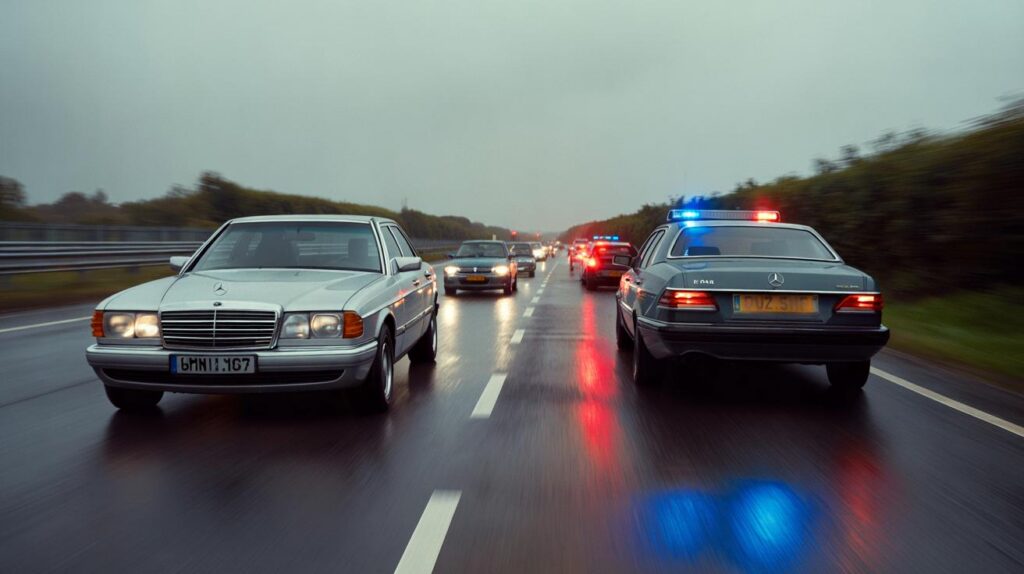
A Mercedes driver has been fined after sitting stubbornly in the outside lane for five long miles, and the story has set off a fresh wave of frustration on British roads. Not because it’s dramatic or high-speed or viral-for-the-sake-of-it, but because everyone recognises the feeling of being stuck behind someone who simply won’t move over. This small act of road etiquette, ignored, makes the whole motorway feel that little bit meaner.
The morning’s light was flat and grey, the kind that settles over the motorway and makes the brake lights seem a touch angrier. In the outside lane, a silver Mercedes held its line, never straying, never passing anything, just there — a steady lid on a boiling pot. Behind it, traffic breathed in and out, drivers hovering between patience and horn, indicator and impulse, while an unmarked patrol shadowed the scene, counting the miles and the missed chances to move left. Five miles later, blue lights. A short chat. A fine for careless driving. And a lesson, perhaps, for the rest of us.
Five miles in the fast lane — and why it stung
The outside lane isn’t a throne. It’s a tool, meant for overtaking and then giving back. When someone treats it like a private carriageway, it turns a smooth-flowing motorway into a rolling bottleneck, with little waves of irritation pulsing through the traffic. You can feel it in the way people hover a fraction too close, in the way speeds shimmy up and down, in the tiny frictions that nudge tempers into the red.
Police say the Mercedes held that far-right lane for roughly five miles, cruising at a steady clip and passing no one, while the inside lanes ebbed and opened like chances never taken. Rule 264 of the Highway Code spells it out: keep left unless overtaking. Since 2013, officers have been able to issue a £100 fixed penalty and three points for lane-hogging as careless driving. Surveys regularly rank lane-hogging among the most annoying habits on UK roads, a small act with big consequences for flow and mood.
Why do people do it? Partly fear: the inside lane can feel like a river of lorries, and lane changes are work. Partly muddle: smart-motorway limits, variable speeds and wall-to-wall traffic can make “overtake-and-return” seem theoretical at best. And then there’s the human bit — the belief that holding lane three at an “OK” speed is harmless, or even helpful, because it “keeps things moving.” Over five miles, that logic falls apart. **Hog the outside lane and you don’t just slow cars — you compress choices.**
How not to be that driver
Build the “overtake-and-return” habit like a rhythm: check mirrors, signal, pass, then drift back left as soon as the space is clean. Count to three after clearing the vehicle you’ve passed — if, by three, your left mirror shows you can slot in with room, take it. Keep your speed smooth, leave a proper buffer, and treat lane three as a borrowed seat, not a reserved table. *It feels good to hand it back.*
Common mistakes? Waiting for a “perfect” gap rather than a good one. Sitting next to a lorry’s blind spot because it feels safer, when in truth you’re invisible. Or pacing a car in lane two because you’re matching their speed, not the flow. We’ve all had that moment when your heart rate jumps and you freeze in the wrong lane because someone is sitting on your rear number plate. **Let’s be honest: nobody checks mirrors every ten seconds like an instructor’s watching, but two glances and a blinkers-on nudge go a very long way.**
If you’re nervous about moving back left, shrink the task. Take one lane at a time, with a calm pause between, rather than a big diagonal swoop. Keep your head turning, not just your eyes, and look for tyre tracks as much as tail-lights — they reveal intent sooner.
“Treat lane three like you treat a zebra crossing: use it with purpose, clear it with respect,” a veteran driving instructor told me. “If you pass a car and you can read their number plate in your left mirror, you’re probably ready to return.”
- Quick check: Can you see both headlights of the car you passed in your left mirror?
- Signal early, steer late — indicate, then wait that heartbeat before moving.
- If you’re boxed in, ease off a touch; space creates exits faster than impatience.
- Don’t stare at the car behind; drive your gap ahead.
- If in doubt, take the next safe chance — not the perfect one.
Beyond one fine: what this moment says about our roads
A single fine won’t fix motorway manners, just as a single speed camera never cured speeding. What it does is underline a shared promise: we keep left so everyone gets a turn. Lane discipline is less about punishment than choreography, and when even one dancer refuses to move, the whole floor shuffles out of time. Technology can help, but the core remains human — patience, attentiveness, and a willingness to share space instead of hoarding it. The five-mile Mercedes story will fade; the feeling of a motorway that breathes, that gives and takes, will not. **The smallest habits decide whether a long drive feels like a queue or a conversation.** What kind of road do you want to build with the people beside you?
| Key points | Details | Interest for reader |
|---|---|---|
| Outside-lane hogging is careless driving | Highway Code: keep left unless overtaking; on-the-spot £100 and 3 points | Know the rule that turns frustration into a fine |
| Five miles can trigger enforcement | Prolonged cruising in lane three without overtaking disrupts flow and draws police attention | Understand where the line is in real-world policing |
| Overtake-and-return is a simple fix | Mirror–signal–manoeuvre, count to three, and reclaim the left | Actionable steps to drive smoother and avoid penalties |
FAQ :
- Is lane-hogging actually illegal in the UK?There’s no offence called “lane-hogging”, but cruising in the outside or middle lane without need can be treated as careless driving under the Highway Code.
- What’s the penalty if I’m stopped for it?Typically a £100 fixed penalty and three points on your licence, issued roadside or by post, depending on the situation.
- How long is “too long” to stay in the outside lane?There’s no fixed distance; it’s about context. If you’re not overtaking and you’ve had multiple safe chances to return left, you risk enforcement.
- Can I sit in lane three if I’m at the speed limit?No. The limit isn’t a licence to block. You should still return to the left once you’ve passed.
- What if the left lane is full of lorries and feels unsafe?Wait for a reasonable gap, then move across one lane at a time with a steady pace; give yourself space and keep scanning, not staring.



Five miles? Was the left lane lava or something.