
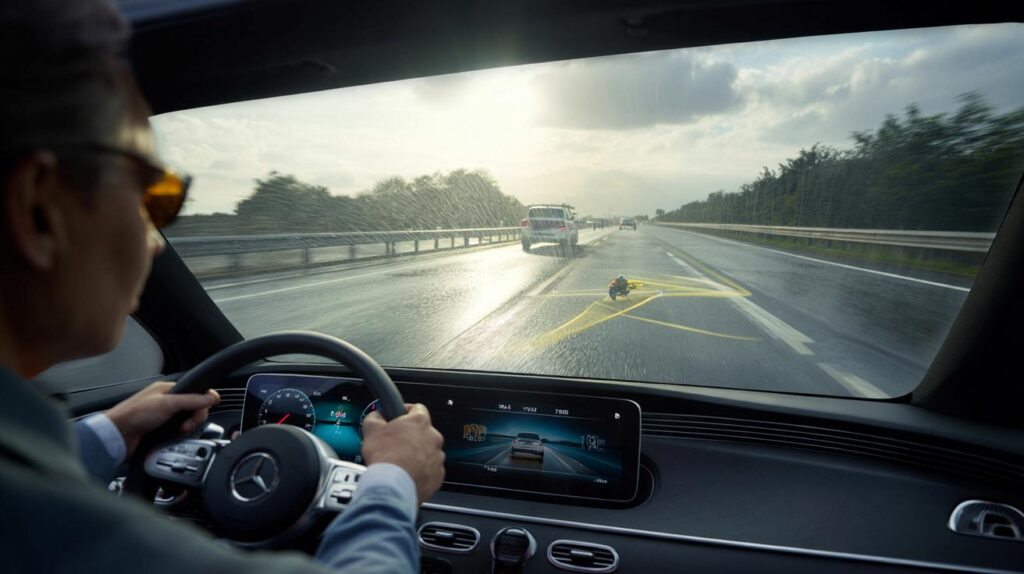
Whispers from Stuttgart hint at a cockpit overhaul that swaps glass for pixels, raising fresh questions for drivers, insurers and regulators.
Rumours point to Mercedes evaluating pillar-to-pillar LCD panels in place of traditional windscreens, fed by a suite of forward cameras. The idea follows the brand’s fixation on ever-larger displays and arrives as rivals trial radical visibility solutions. The stakes are clear: safety, legality, cost and the simple question of whether motorists actually want this.
What sits behind the headline
Mercedes has spent the past few years pushing its dashboard screens to cinematic proportions, most famously with its Hyperscreen. Industry chatter now suggests engineers are studying an even bolder step: replacing laminated safety glass with a full-width display that renders the road in real time. It would be the most aggressive escalation of the “digital-first cabin” trend to date.
The pitch sounds simple. Cameras outside the car capture live, ultra‑wide footage; processors stitch it into a single seamless view; the interior screen shows the feed with augmented overlays for speed, navigation and hazard prompts. In theory, the system could brighten shadows, cut glare and flag danger long before human eyes spot it. In practice, it shifts the most basic driving task—seeing—into the hands of silicon, software and a very large TV.
Any road‑legal version would need rock‑solid redundancy, near‑zero latency and daylight brightness comparable with the midday sun.
The likely hardware recipe
Engineers would need a stack that blends cinema tech with automotive grit. Expect multiple high‑dynamic‑range cameras with heater elements, hydrophobic coatings and self‑cleaning nozzles. A low‑latency pipeline would push 120Hz video to a 50in‑plus LCD or OLED hardened against heat, UV and vibration. A 48V power bus would feed the display without starving other systems. Gesture and voice inputs would replace a chunk of physical controls, as screens eat more of the dashboard.
- Latency target: sub‑20ms from camera to screen to avoid motion sickness.
- Peak brightness: 1,000–2,000 nits to stay readable in full sun.
- Refresh rate: 120Hz to reduce blur on fast A‑road or motorway traffic.
- Power draw: 80–150W depending on technology, brightness and ambient conditions.
- Redundancy: at least two camera paths and an emergency “see‑through” window or viewport.
Regulation and safety landmines
There is a blunt legal reality: current UK and EU rules require a transparent windscreen made from certified safety glass. United Nations ECE Regulation 43 covers glazing; no clause permits a full electronic substitute. Regulators have allowed camera‑based mirrors, but they have not touched windscreens. Even markets that lead on tech pilots, such as China or the US, would need rule changes before any mass rollout.
No major jurisdiction currently allows a road car without a clear windscreen. That is the starting line, not the finish.
Engineers also face fail‑safe design questions. What happens if a camera lens ices over on the M6? How does the system handle a software crash at night in heavy rain? Where does a driver look during a brief black‑screen reset? A credible plan would include a physical backup view, independent power for the cameras and a human‑machine interface that guides the driver safely to a stop when things go wrong.
Polarised sunglasses, rain and grit
Old‑fashioned glass copes elegantly with sunglasses and spray. A large LCD has to fight physics. Many panels use polarisation that can appear black at certain angles with polarised lenses. Rain and salt will blur lenses unless jets and wipers keep them clean. Snow and ice require fast heating. Bright sun can wash out an image. These aren’t edge cases on British roads in February.
- Polarisation: screen must stay legible with common sunglasses at all seating positions.
- Weatherproofing: camera windows need wipers or air knives to clear spray at speed.
- Night glare: HDR and anti‑bloom algorithms to manage oncoming headlamps and signage.
- Diagnostics: constant self‑tests with on‑screen alerts before vision degrades.
Costs, insurance and repairs
Modern windscreens already cost four figures when ADAS sensors sit behind the glass. A pillar‑to‑pillar display could push repair bills even higher. A stone chip becomes a panel replacement, not a resin fix. Expect longer workshop time for calibration, higher parts prices and fresh training for technicians. Insurers will notice.
| Factor | Traditional windscreen | Pillar‑to‑pillar LCD vision |
|---|---|---|
| Regulatory status | Fully approved | Not permitted today |
| Damage from debris | Chips often repairable | Likely full panel replacement |
| Weather performance | Proven in all conditions | Relies on cameras, heating and cleaning |
| Running energy | Negligible | 80–150W typical, higher at peak brightness |
| Insurance sensitivity | Medium with ADAS | High due to cost and complexity |
Why carmakers keep chasing bigger screens
Screens sell. Buyers respond to the theatre of a vast display, and software opens doors to subscriptions and feature unlocks. A fully digital view also allows AR lane guidance, smart speed warnings and adaptive highlights for hazards hidden behind trucks or hedges. Mercedes has leaned into this logic with increasingly broad displays, while competitors such as Polestar have experimented with removing the rear window on certain models and using a camera feed instead. Step by step, direct vision gets digitised.
Augmented reality can add value—highlighting a cyclist in a blind spot or projecting a safer line through a foggy junction.
Control creep: from buttons to voice and gestures
Screen‑centric cabins often delete physical switches. That shift brings its own friction. Voice improves every year but still stumbles with accents, road noise and the odd cough. Gesture controls impress in demos then frustrate when a casual hand wave triggers the wrong thing. If a windscreen becomes a display, designers must prove that critical functions remain accessible without hunting through layers of UI while doing 70mph.
Likely timeline and a plausible middle path
Even with deep pockets, no brand bolts a concept like this into showrooms next year. Rule changes take years, and public acceptance takes longer. A nearer‑term path looks incremental: brighter AR head‑up displays, wider camera‑mirror adoption, and thicker glass with clever coatings that cut glare. The logical waypoint is a hybrid—real glass with an optically bonded layer that can overlay data or switch to camera view only when necessary, for example in heavy spray or deep fog.
What drivers should watch
Look for three signals. First, test fleets with full camera vision on private tracks, collecting millions of miles of data on latency and failure modes. Second, regulatory pilots that define a minimum standard for electronic forward vision. Third, supplier announcements on ultra‑bright, low‑power automotive OLED or microLED panels that shrug off heat and last a decade.
If you want a sense of the energy impact, run a quick back‑of‑envelope: a 120W display over a two‑hour motorway stint draws 0.24kWh. In a small EV with a 50kWh battery, that’s roughly 0.5% of the pack—small, but not nothing in winter. In a petrol car, the alternator drag lands in your tank as a fraction of a litre.
There are upsides if engineers nail the execution. AR could label a hidden junction in heavy rain, stitch multiple camera angles into an extra‑wide view at a tricky roundabout, or automatically dim blinding reflections. The risks are tangible too: higher repair costs, new failure modes, and extra cognitive load if the interface overwhelms. For now, the glass windscreen remains the benchmark. The next few seasons will show whether Mercedes can turn a headline‑grabbing idea into something drivers genuinely trust when the weather turns grim and the motorway is slick with spray.



Cool idea, but how does it handle polarised sunglasses and low winter sun? If the panel goes black at a certain angle, that’s game over. Also, what’s the plan during a black‑screen reset—do we get a physical viewport, or just pray the latancy stays sub‑20ms?
At 70mph I definately prefer glass to a giant TV. Call me old‑fashioned, but windscreens don’t need firmware updates.