
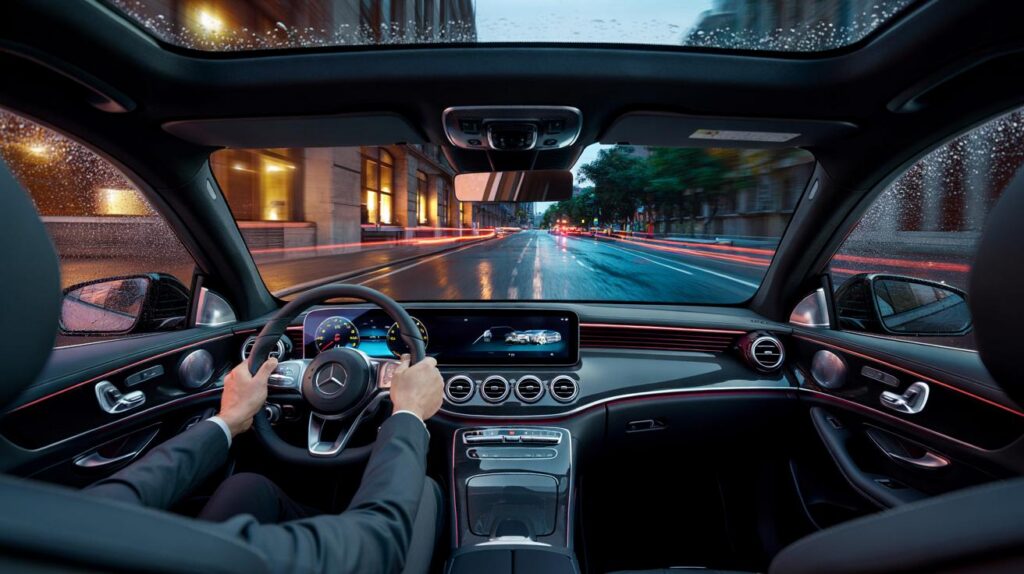
Car interiors keep filling with pixels, and now a bold idea is testing how far the screen rush might go.
Reports circulating online claim Mercedes is weighing a radical move to replace the front windscreen with a pillar-to-pillar LCD panel fed by external cameras. The notion sounds like a concept-car stunt, yet it taps into a very real industry trend: bigger dashboards, fewer buttons, and software-led cabins that promise constant upgrades.
What the claim actually suggests
The proposal, described in leaked materials and amplified on social media, would see the traditional laminated glass windscreen swapped for a full-width, high-brightness display. External cameras would deliver a live feed to the panel, creating a digital view of the road ahead. The rest of the cabin would pivot even harder to touch, voice and on-screen controls, with most physical switches binned.
Replace glass with a pillar-to-pillar LCD showing a real-time camera feed. That is the bold, headline idea.
Mercedes has already marched towards immersive digital dashboards. Its so-called “Hyperscreen” stretches across the cabin in select models, and newer concepts showcase even broader, single-piece displays. The windscreen-as-screen leap would be the most extreme expression of that trajectory.
Could a screen legally replace a windscreen today?
Short answer: not in the UK or EU. Current rules require a clear, impact-resistant, laminated glass windscreen that supports wipers, demisting and direct vision. Any system that replaces the front view with cameras would collide with UN ECE regulations on glazing and driver field of view, and with Construction and Use rules in the UK. The US has similar barriers.
Camera displays already substitute some mirrors in certain markets, and one production SUV runs without a physical rear window, using a camera instead. Those steps were possible because regulations for rearward vision are more permissive. The forward view faces stricter standards because it forms part of the structure and the primary safety envelope.
A millisecond of delay at 70mph converts into more than 3cm of travel before you see it. Stack that up and it bites.
Safety hurdles that would not be optional
Any camera-only forward view must beat or match the clarity of glass in dazzling sun, heavy rain and headlight glare. It must still work with fog, mud and snow on the lenses. It must shrug off stone strikes, survive airbag deployment, resist vandalism and keep operating in a heat-soaked cabin in summer and a frozen car park in winter.
The imaging chain would need low-latency capture, processing and display, ideally under 20ms end to end. The screen would need extreme brightness, stable colour and deep contrast to avoid washing out in direct sun. It would also need an anti-reflective surface that cooperates with polarised sunglasses. None of these are unsolved problems, but packaging them together in a single, structural unit is a tall order.
Why carmakers keep adding more screen
There are commercial reasons as well as design ones. Screens allow frequent software refreshes and paid upgrades. They standardise parts across models. They simplify interiors when physical buttons get expensive, fiddly and hard to clean. Buyers also expect smartphone-grade interfaces in their cars, and surveys show many would pay for slicker infotainment.
- Revenue: over-the-air features can bring recurring income per vehicle.
- Packaging: fewer buttons free space for storage and trim personalisation.
- Perception: full-width displays signal “modern luxury” in showrooms.
- Hardware costs: a single large panel can replace multiple smaller units.
- Lifecycle: software keeps the cabin feeling fresh years after launch.
The tech specifications that would make or break it
If a manufacturer ever attempted a screen windscreen, the following targets would sit on the checklist.
| Requirement | Indicative threshold | Why it matters |
|---|---|---|
| End-to-end latency | ≤ 20ms | Limits motion sickness and distance error at speed |
| Peak brightness | ≥ 2,000–3,000 nits | Combats midday sun and reflections |
| Refresh rate | ≥ 90–120Hz | Reduces blur and judder on fast motion |
| Operating temperature | -30°C to +85°C | Matches automotive-grade electronics |
| Power draw | ≤ 150–250W | Keeps EV range and alternator load in check |
| Fail-safe mode | Instant clear fallback | Maintains vision after faults or crashes |
Display tech would likely need to be MicroLED for brightness and durability, as OLED can suffer image retention and heat stress. The camera suite would require redundant lenses, heating elements, hydrophobic coatings and self-cleaning mechanisms. The panel itself would have to integrate with airbag mounting points and contribute to body rigidity, a role glass currently supports.
What Mercedes is actually building right now
Mercedes continues to scale up in-cabin displays, with dash-width panels, augmented-reality navigation and sophisticated driver monitoring. The company has also pushed certified hands-off functions on certain roads, which rely on robust sensing and human-machine interface design. Those are real, deployed steps towards more digital cabins.
A screen in place of the front windscreen would require fresh laws and years of joint work with regulators. It would also need an answer for classic failure modes: what happens if the display dies at night on a rural B-road, or the camera lenses are caked in salt spray? Until those questions have solid, tested answers, the idea remains more talking point than product plan.
The first legal frontier is likely a larger head-up display that occupies a swathe of the glass, not a screen that replaces it.
The Polestar precedent gives a hint, not a blueprint
A production SUV without a rear window shows how far packaging can bend when rules permit. The front view is different. Direct vision requirements are tougher, and the windscreen hosts critical systems from sensors to demisters. Any change there must clear a higher bar than a rear camera mirror.
What it could cost you
Replacing a cracked laminated windscreen can run to hundreds of pounds. Replacing a pillar-to-pillar automotive-grade display could nudge into the thousands, once calibration and sensors are included. Insurance would price that risk. In EVs, a bright, always-on panel could trim a sliver of range in winter when heating loads are high and batteries run cooler.
There are benefits too. A digital view could brighten dark roads, highlight hazards, and overlay navigation arrows with precision. It could shed ice instantly and resist chips. Accessibility gains might be real for drivers with low contrast sensitivity. Yet the system must deliver those wins without distraction, fatigue or nausea.
What to watch next
Expect a surge in larger head-up displays that paint augmented guidance across a big area of the existing glass. Look for expanded use of camera mirrors and smarter forward cameras that clean themselves and de-fog faster. Keep an eye on MicroLED pilots in luxury models, where high brightness and long life can justify the cost.
If you are a buyer weighing a screen-heavy car today, a quick test you can run is simple. Put on polarised sunglasses. Drive at midday and at night. Turn the brightness down, then up. Check reflections in the glass. Watch for lag after hitting a pothole or turning your head. Your comfort in those moments is a decent proxy for how you would fare with even more pixels tomorrow.



I love the ambition—MicroLED, 120Hz, sub‑20ms—sci‑fi creeping into reality. But how do you guarentee zero smear in driving rain and headlight glare, especially with polarised sunglasses? Also, what’s the fail‑safe if a stone knocks out the forward camera array? Genuine question.
Bold idea, but not legal in the UK/EU today under glazing and direct‑vision rules.