
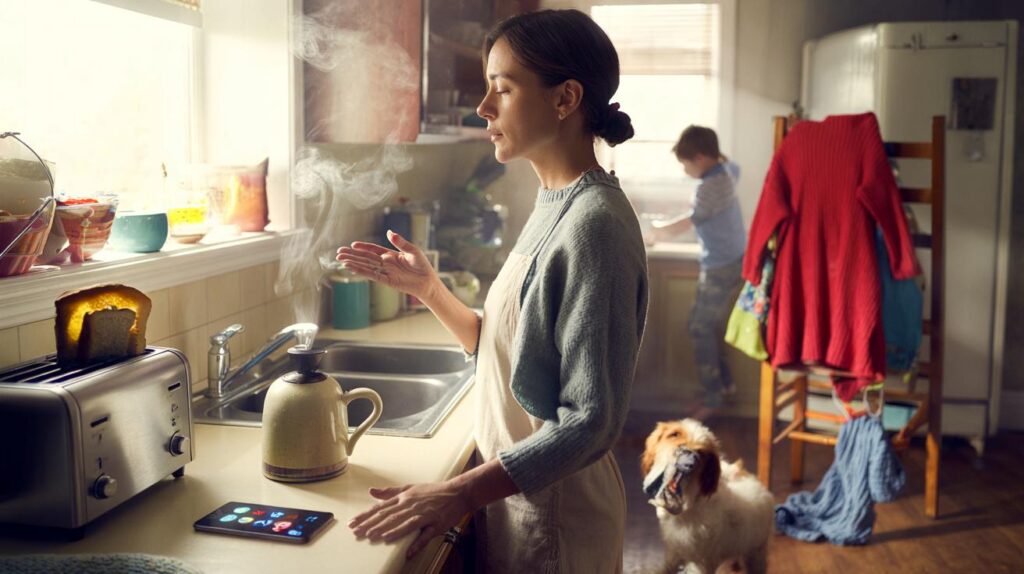
The mental list never ends: school emails, the missing PE kit, dinner, the half-answer to a colleague’s message while stirring a pan, that gift you still haven’t ordered. It hums under the skin like a fridge you can’t unplug.
The toast is burning again. The dog has vanished under the table with a sock, the group chat bings, and a small voice asks where the red jumper went, as though you’re the map of everything. The kettle clicks off and on with a sulk, and you realise you haven’t breathed properly since before sunrise. I wanted a pause, not perfection. I press my palm to the worktop and count the fingerprints on a sticky glass. The room is loud, yet there’s a sliver of quiet in the gap between one breath and the next. I swear the air changes. The kitchen doesn’t, but I do. The kettle became a bell.
The invisible load: why your brain won’t clock off
Call it mental load or the open browser tabs of life. It’s the quiet background task that keeps running while you’re doing everything else. You’re not just cooking pasta; you’re tracking laundry cycles, birthday deadlines, and who needs a new pair of trainers before Thursday’s club.
Anna is 38, a project manager who runs timelines like a pro at work and like a ghost behind the scenes at home. She keeps a list on her phone and another in her head, and the head one always wins. We’ve all had that moment when the lights are off and the brain starts drafting tomorrow’s route through 30 micro-decisions you didn’t ask to make.
It isn’t a character flaw. It’s the mind trying to protect the day from fraying by rehearsing it on repeat. Mindfulness isn’t a miracle; it’s a way to give your attention one safe thing to land on, when everything else feels like it’s pulling at your sleeve. You’re not solving the whole week. You’re training where your next breath goes.
Micro-mindfulness you can do with a kettle in one hand
Try a 3–2–1 Reset at the sink. Three breaths through the nose, slow and quiet, belly moving like a tide. Name two things you can feel with your hands: the mug’s heat, the cool tap. Pick one sound and follow it to the end, like the whistle of a boiling kettle. That’s it.
Aim for honest repetition, not majestic streaks. Your mind will wander, tugging at you with “remember the lunchbox” and “reply to that email”. Smile at it, and come back to the mug, the tap, the breath. Let’s be honest: no one does that every day. You’re building a micro-habit in a messy house, not joining a silent retreat.
Anchor practice to cues already in your life: the door latch, the pram buckle, the car indicator at a red light. One cue, one pause, one breath. You’re training a reflex more than a ritual.
“Small pauses, repeated often, become a place to live rather than a place to visit.”
- Pair the pause with boiling water, waiting for the microwave, brushing teeth, or walking up stairs.
- If a pause is all you get, that counts. If you forget, the next cue is your restart button.
- Use your senses: temperature, texture, weight, sound, smell. Pick one per pause.
- Keep it short enough that you’d actually do it in real life.
- Celebrate tiny: “I did one breath.” Then move on.
Build your calm, one tiny cue at a time
Think of calm like a muscle you train in seconds, not hours. Choose three places to practice on purpose this week: the front door, the kettle, the pillow. When you touch them, breathe once, feel one thing, name one sound. Track it on the back of an envelope with three boxes a day and tick a box when you remember. No punishment when life gets loud. Your home won’t become a monastery, and it doesn’t need to. What changes is the feeling of choice in your chest. You start locating a small island inside the noise and planting a little flag there. The chaos doesn’t stop. Your access to peace gets closer to hand.
| Point clé | Détail | Intérêt pour le lecteur |
|---|---|---|
| Pair pauses with cues | Attach one breath to everyday triggers like the kettle or door handle | Makes mindfulness automatic, even on frantic days |
| Use the 3–2–1 Reset | Three breaths, two sensations, one sound | Reliable calm-in-60-seconds method you can remember |
| Kind inner narrator | Notice, name, return without telling yourself off | Cuts self-critique and keeps the habit alive |
FAQ :
- How can I practise with kids around?Make it playful: “Let’s find one blue thing and breathe once.” Use shared cues like the doorbell or the oven timer.
- What if my mind won’t switch off?Give it a job. Count five slow breaths, feel your feet on the floor, or trace the rim of a cup with a finger.
- Are five minutes enough?Yes. A minute done daily beats a perfect session that never happens. Many short reps build the skill.
- Can I do mindfulness without sitting still?Walk and notice heel-to-toe, wash dishes and feel water, fold laundry and match texture to breath.
- What should I do on bad days?Go smaller. One breath at the door. One sound in the car. Small wins count double when everything wobbles.



Loved the “kettle became a bell” line—tried the 3–2–1 Reset while the microwave hummed and felt a notch calmer. Thank you! 🙂
Isn’t this just glorified deep breathing? When I’m juggling three kids and a deadline, counting mug textures feels impratical. Any evidence it actually reduces mental load vs. just distraction?