
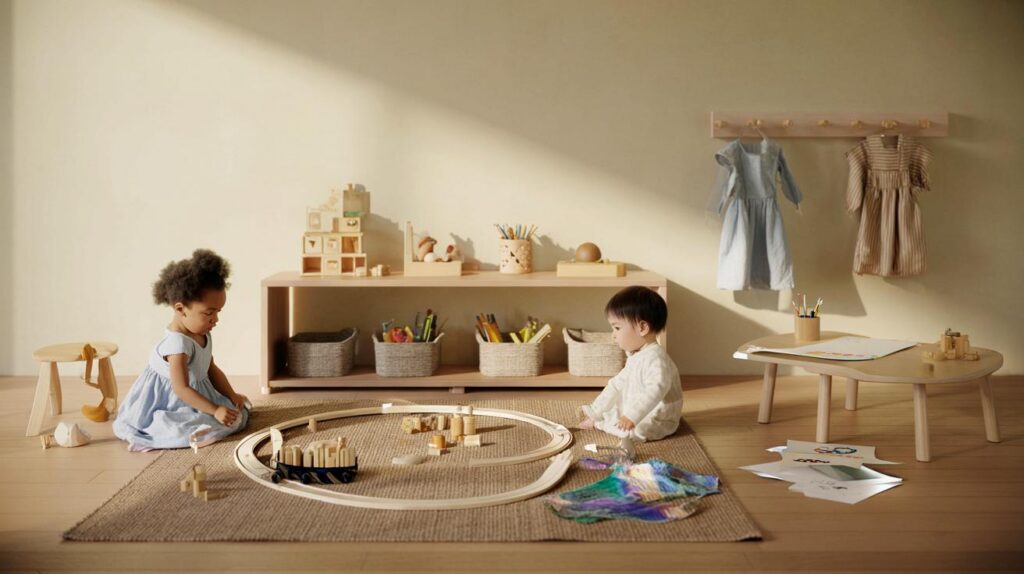
Parents are drowning in plastic, and kids are rushing from one light-up toy to the next. A new wave of research and real homes suggests the opposite might be true: fewer toys, richer play. The minimalist kids’ room isn’t about white walls and rules. It’s about attention.
I’m sitting on a nursery floor in south London, watching two four-year-olds orbit the same wooden train. No batteries, no bells. Just a tinny bell from the street and the soft rattle of wheels over a rug. At first they circle, glance at the bookcase, glance at the basket. Then they settle. One becomes the stationmaster. The other invents a lost dog. Thirty minutes pass and no one asks for a tablet.
Later, the mum tells me there used to be a wall of toys. She boxed up half of them one rainy Sunday and felt a stab of guilt. The next day, the kids built a city with blocks and a scarf. She wondered what she had been waiting for. A quiet room can be loud with ideas.
Why fewer toys can mean richer play
Spend time in a pared-back kids’ room and you notice a shift. Children linger. They repeat, return, refine. Play becomes a thread rather than a ping. A tidy shelf doesn’t make a perfect child, but it seems to clear the cognitive fog. There’s space to imagine. There’s room to be bored, and then to climb out of it.
There’s data behind the hunch. A University of Toledo study found toddlers played longer and in more varied ways when presented with four toys instead of sixteen. Fewer choices reduced flitting and increased problem-solving. In Brighton, I met a dad who tried a ten-day “toy diet” for his five-year-old. He kept one construction set, one soft toy, a puzzle, crayons. By day three, the fort had a council, a bakery and two traffic laws. The puzzle became a spaceship.
What’s happening here is part brain science, part common sense. Too many inputs split attention and muddle decision-making. Fewer inputs reduce noise, so children can sink into narratives and stretch an idea until it squeaks. Designers call it **creative constraint**. Montessori classrooms have championed it for a century: limited, open-ended materials in clear order, so the child chooses, repeats and masters. Minimalism isn’t the goal. It’s the tool that frees the mind to make its own mess.
Making a minimalist kids’ room that still feels warm
Start with zones, not stuff. One for sleep, one for play, one for making things. Keep toys reachable on a single low shelf, spine-out baskets, no lids that trap hands. Aim for eight to twelve items out at any one time, like a tiny gallery. Rotate weekly or when interest drops. Leave the centre of the room free so the play can sprawl, then fold back. *Begin with what your child already loves; not what Instagram loves.*
Watch for common traps. Hidden storage can become a black hole where toys go to retire, so label baskets with pictures the child can “read”. Keep colours calm but not cold; a splashy duvet or handmade poster can carry warmth better than another plastic set. Don’t ban the noisy robot if it’s beloved; give it a “parking spot” and let it visit. Let’s be honest: nobody does this every day. Small resets beat grand overhauls.
When you get the balance right, the room feels lived-in, not staged. You’ll find fewer meltdowns at tidy-up time because everything has an obvious home. You’ll also see your child recombine things in weird and brilliant ways: play food becomes cargo, a scarf becomes river and road. That’s the point: **open-ended play** grows in soil that isn’t already crowded with instructions.
“Children don’t need more to imagine more. They need less to imagine deeper,” says nursery teacher Ria Ahmed, who reorganised her classroom into a single shelf and weekly rotations. “The stories got longer. So did the smiles.”
- Starter set: blocks, figures, a simple vehicle, a ball, a puzzle, crayons, tape, scrap paper, one soft friend.
- One display shelf, one basket for “resting toys”, one peg rail for dress-up.
- Warm light, washable rug, a low table that can take paint and dents.
- Rotate on a Friday; involve your child in choosing what “comes out” next.
The bigger picture: creativity over clutter
We’ve all had that moment when the floor is a sea of tiny parts and no one is actually playing. Minimalist kids’ rooms push against that, not with austerity but with attention. Strip back, and you notice what your child returns to on their own. You see how a cardboard box becomes a theatre and how quiet corners invite big ideas. In that pause, confidence grows.
Parents tell me their evenings are calmer when there’s less to negotiate and less to tidy. Children tell me their rooms feel “bigger” even though nothing moved. Space invites movement; clarity invites stories. Keep one shelf, one rhythm, one small promise to rotate, and life begins to flow. You’re not designing a magazine set. You’re tending to focus, curiosity and play that belongs to your child. In a world shouting for attention, a gentle room can whisper, and be heard.
| Key points | Details | Interest for reader |
|---|---|---|
| Fewer toys, deeper play | Study shows four toys prompted longer, higher-quality play than sixteen; less choice reduces cognitive load | Practical reassurance that decluttering won’t “deprive” your child |
| Design simple zones | Sleep, play, create; 8–12 items on a single shelf; rotate weekly; clear homes for each object | Easy blueprint to copy this weekend without a full renovation |
| Keep it warm, not stark | Soft light, textures, a few beloved items on show; focus on **less but better** | Shows minimalism can feel cosy and personal, not clinical |
FAQ :
- What’s the “right” number of toys?There isn’t one. Aim for a small, varied set out at once (8–12), with the rest resting and rotating.
- What about gifts from family?Display a few, rotate the rest. Create a “guest shelf” so gifts get their moment without crowding the room.
- My children are different ages. Can this work?Yes. Group by theme, not age. Blocks, figures and art supplies span years; keep small parts up high.
- Won’t minimalism kill the fun?Fun comes from the play, not the pile. A clearer room helps kids invent more, not less.
- Are books toys in this system?Treat books as their own mini-rotation. Face-out a handful, keep a crate nearby, swap weekly.



Compelling, but does this over-simplfy attention science? The Toledo study was with toddlers in a lab; can we genralize to neurodivergent kids or larger families where noise is constant? Sometimes “fewer” just means kids fight over the same toy.
Any tips for handling birthday avalanches? We rotate, but grandparents keep gifting sets with 100 tiny parts. How do you set a “guest shelf” without hurting feelings, and do you involve kids in deciding what rests?