
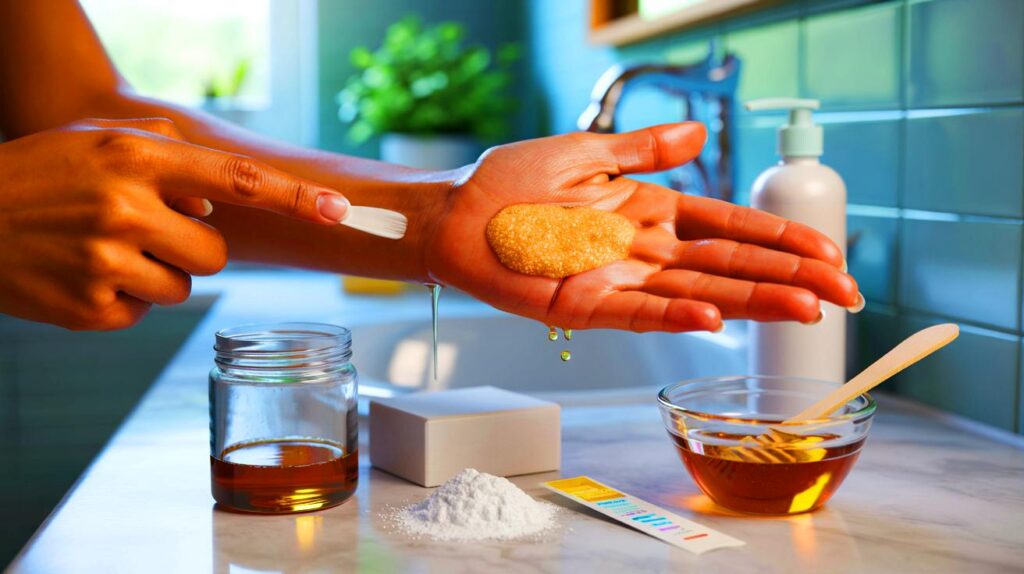
Across Britain, kitchen staples are edging into skincare routines, and a two-ingredient paste is stirring curiosity and careful questions.
As posts multiply on social feeds, a homespun blend of honey and baking soda is being touted as a budget-friendly route to brighter skin. Supporters praise a soft glow and fewer rough patches. Dermatology voices urge care, pointing to skin chemistry, frequency of use and the risk of over-scrubbing.
What people are mixing and why
The pairing is simple. Honey acts as a humectant, pulling water into the outer skin layers. It also contains naturally occurring acids and antibacterial agents that can help with surface debris. Baking soda (sodium bicarbonate) brings fine grit for a short, manual exfoliation. Together they form a paste that loosens dead cells and leaves skin feeling smooth, at least for some users.
The method matters more than the myth: gentle pressure, short contact time, and a strict patch test beat any “magic” claim.
How to try it safely
If you plan to test the mix, treat it like a one-off trial rather than a new daily habit. Keep the recipe modest and the timing tight.
- Patch test first: apply a pea-sized amount to the inner forearm for 24–48 hours. Stop if you notice stinging, redness or warmth.
- Recipe: 2 teaspoons runny honey to 1 teaspoon baking soda. Add 1–2 drops of water only if needed for spreadability.
- Application: on damp skin, use fingertip-light circles for 15–20 seconds. Do not scrub. Avoid the eye area and broken skin.
- Contact time: leave for 2–3 minutes, then rinse with lukewarm water. Pat dry. Follow with a plain moisturiser.
- Frequency: at most once a week. Skip if you already use acids, retinoids or a scrub that week.
What science says
Honey is mildly acidic (pH roughly 3.4–6) and binds water, which can soften the outer layer of skin. Lab research shows honey can inhibit certain bacteria on the surface, mainly through low water activity and slow peroxide release. Baking soda is alkaline (pH about 8.3) and abrasive in fine particles. Skin’s acid mantle sits around pH 4.7–5.5.
Mixing the two creates a paste that shifts closer to neutral than pure baking soda, yet still risks nudging the skin’s pH upwards. Push the pH too high and the barrier enzymes that organise lipids slow down, which can leave skin dry or reactive. There are no large clinical trials on the exact combo as a face mask. Benefits people notice likely come from short-term exfoliation plus hydration rather than a special chemical effect.
Your skin prefers slightly acidic conditions. Keep the mix brief and gentle so you do not dismantle the barrier you are trying to smooth.
Who should avoid it
Some faces react strongly to alkaline scrubs and sugars, even when mixed with water. Skip this trend if you recognise yourself below.
- Eczema, seborrhoeic dermatitis or rosacea sufferers: the barrier is already sensitive.
- Active cystic acne: manual scrubs can inflame deep lesions.
- Skin recently treated with peels, lasers, retinoids or strong acids: wait until fully settled.
- Pollen or bee-product allergies: honey can trigger contact reactions.
- Very dark complexions prone to post-inflammatory pigmentation: irritation can leave marks.
Cost and footprint
A 340 g supermarket honey can cost about £2.00–£2.80, and a 200 g box of baking soda often sits near £0.70–£1.00. A single face application uses roughly 12 g honey and 4 g soda, coming to around 7–12 pence per use. Packaging is minimal and recyclable in many areas, which appeals to those trying to cut bathroom plastic. The trade-off is that home mixes are unpreserved and untested in the way commercial products are.
| Component | Main role | Typical amount | Notes | Risk level |
|---|---|---|---|---|
| Honey | Hydration, mild surface cleansing | 2 tsp | Acidic; can sting on compromised skin | Low–moderate |
| Baking soda | Physical exfoliation | 1 tsp | Alkaline; can disrupt acid mantle | Moderate |
| Water (optional) | Texture adjuster | 1–2 drops | Too much thins the paste and reduces control | Low |
If you notice irritation
Rinse with plenty of lukewarm water. Apply a bland, fragrance-free moisturiser or a thin layer of petrolatum. Avoid acids, scrubs, vitamin C and retinoids for 48 hours. If burning or swelling persists past a day, seek professional advice. Photograph the area to track any change, especially if you are prone to pigmentation.
One rule saves most faces: when in doubt, wash it off and reach for moisturiser, not more actives.
Alternatives that stay gentle
If you want smoother texture without alkaline grit, try these low-cost options that tend to respect the acid mantle.
- Colloidal oatmeal and water: forms a soothing paste that reduces itch and redness.
- Yoghurt mask (plain, live): lactic acid offers light chemical exfoliation; 5–7 minutes, once weekly.
- Soft washcloth exfoliation: use with a basic cleanser for 30 seconds, then moisturise.
Kitchen chemistry: what the mix is really doing
Honey is thick and acidic, so it slows the dissolution of baking soda and buffers some alkalinity. There is little fizz unless you add a proper acid like lemon juice. The grit provides the main action. That is why pressure and time control the outcome. Press harder or longer and you raise the chance of micro-abrasion and dryness.
Skip lemon or vinegar. Adding strong acids ramps up irritation risk without proven upside for glow.
Practical extras for careful users
Skin barrier timing: after an alkaline cleanse or scrub, the acid mantle can take 12–24 hours to rebalance. Space out retinoids and acids to avoid stacking irritation. Choose a moisturiser with ceramides or cholesterol to support recovery.
Simple home check: pH strips cost a few pounds and can show whether your mix leans alkaline. Aim for a reading closer to 5–6. More honey and less baking soda pushes the value down, though texture may become too runny. Adjust slowly and test again.
Cost simulation: two teaspoons of honey and one of baking soda used weekly will consume about 624 g of honey and 208 g of soda over a year. That equates to roughly two jars of honey and a single small box of soda, often under £6 total, assuming supermarket brands. Balance those savings against the lack of standardised testing and the possibility of irritation.
Routine fit: if you already use a chemical exfoliant (AHA/BHA) twice a week, consider skipping this mix entirely. If you keep it, use sunscreen daily. Freshly exfoliated skin can be more sensitive to sunlight, even in overcast months.



Loved the emphasis on patch testing and timing. I tried a half-teaspoon version last week—gentle circles, 20 seconds, 2 minutes on—and it felt smooth but a bit tight after. Moisturiser fixed it, but I wouldn’t make this a habit. Baking soda still freaks me out re: acid mantle and enzyme function. Might switch to yoghurt or colloidal oatmeal next time. Thanks for the realistic breakdown, not the usual ‘7-day miracle’ hype.
Honest question: if skin sits around pH 4.7–5.5, why risk nudging it up with soda at all? Seems… counterprodutive?