
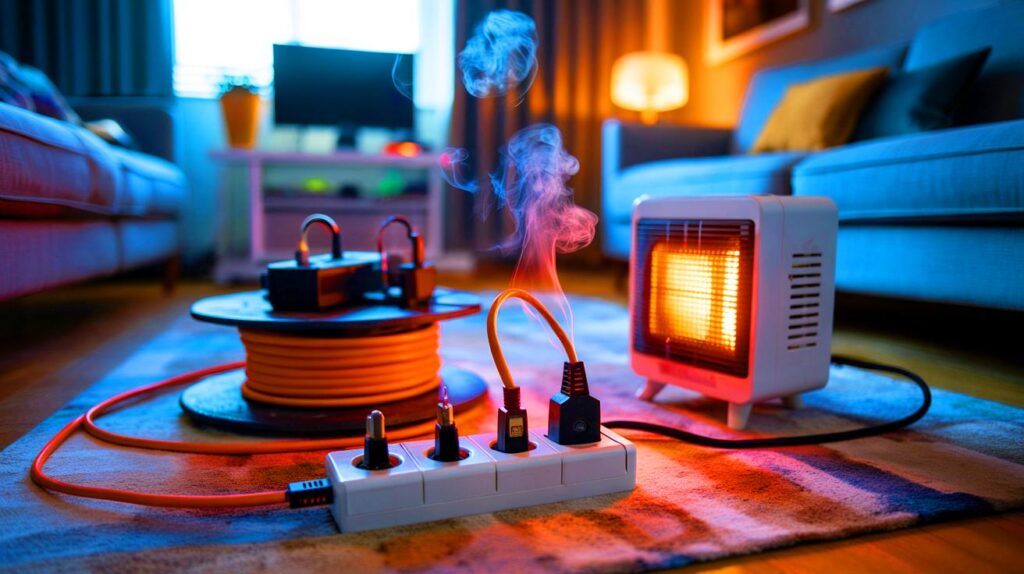
Cold nights push people to quick fixes, while hidden limits inside plastic plugs quietly stack heat where wires should stay cool.
Across Europe, and in the UK too, millions reach for a portable heater to take the edge off a chilly room. Too often, that heater ends up on a crowded multi-socket extension. The numbers look harmless at a glance. They are not.
What people are plugging in, and why it goes wrong
A typical plug-in space heater draws between 1,000 W and 2,500 W. Many extension leads in France are labelled around 3,500–4,000 W total. In the UK, most four- or six-way extensions are limited by a 13 A fuse, which is roughly 3,000 W at 230 V. The arithmetic closes in fast.
Switch on a 2,000 W heater and you have already used about two-thirds of a UK 13 A extension’s allowance. Add a hair dryer, kettle, tumble dryer, or even a gaming PC and monitor, and you can exceed the strip’s limit within seconds. Resistance in coiled cable, tired contacts, and cheap plastic housings turn that overload into heat. Heat builds, insulation fatigues, and the weakest point smokes first: usually the plug, the socket face, or the extension’s switch.
A single 2,000 W heater can consume most of a 13 A extension’s capacity. One more high‑draw device tips the balance.
Surge protection does not fix overload. Those MOV components protect against voltage spikes, not sustained current. Thermal fuses and RCDs can trip late, or not at all, if the heat is localised at a loose connection.
The hidden weak points
- Coiled or bundled cable acts like a radiator and traps heat.
- Loose plug pins spark and arc, carbonising the socket and raising resistance.
- Cheap multi-sockets use thin copper tracks and light springs that fatigue.
- Daisy-chained extensions share heat and current across multiple weak links.
- Dust, pet hair, and fluff near heaters ignite at surprisingly low temperatures.
Common wattages at home
| Appliance | Typical wattage | Safe to share an extension with a 2,000 W heater? |
|---|---|---|
| Kettle | 2,400–3,000 W | No |
| Gaming PC + monitor | 300–600 W | Risky |
| Phone charger + lamp | 20–60 W | Still unwise |
Where to plug a heater safely
Use a wall socket. That single action avoids the extra connections, thin tracks, and shared loads that make extension leads vulnerable. Keep the plug fully inserted, use a socket in good condition, and ensure the heater’s cable runs straight, uncoiled, and unobstructed.
Best practice is simple: plug the heater directly into a wall socket and let the circuit do its job.
If an extension lead is your only option
Sometimes the nearest wall outlet is out of reach. If you cannot rearrange the room, use strict guard rails:
- Pick a heavy‑duty, short extension lead rated at least 3,500–4,000 W in Europe or 13 A in the UK.
- Do not plug anything else into the same lead. One heater per lead, or better, move to a wall socket.
- Uncoil the cable completely and keep it off rugs and soft furnishings.
- Stay in the room. Check the plug and extension body with the back of your hand; warm means stop.
- Never use a reel lead unless fully unwound; the drum acts as a heat sink.
Never daisy‑chain extensions. Each extra plug and socket adds resistance, heat and failure points.
Positioning, ventilation and housekeeping
Keep at least one metre of clearance in front of the heater. Point it away from curtains, sofas, bedding, and paper. Avoid bathrooms and wet floors unless the heater’s IP rating specifically allows it. Place the unit on a flat, rigid surface. Ensure the tip‑over switch and thermal cut‑out work by following the manual’s test procedure.
Dust filters and intakes need attention. Blocked airflow forces hotter operation and raises casing temperature. After use, let the heater cool before moving or covering it.
How to check your load in 60 seconds
Look at the rating plate on each device. Add the wattages. Stay below the lowest limit in the chain: the extension’s printed rating or 13 A (≈3,000 W) in the UK, the socket circuit limit, and the appliance’s plug fuse rating. If the total is close, assume peaks will push it over.
- Example 1: 2,000 W heater + 150 W TV + 90 W laptop = 2,240 W. Technically under 13 A, but still a poor idea on one extension.
- Example 2: 2,000 W heater + 2,800 W kettle = 4,800 W. This will blow a 13 A fuse and may overheat wiring first.
What your fuses and RCDs are telling you
A warm plug top, a softening extension case, or a fishy smell points to overheated plastic. Replace the lead and inspect the socket. A tripping RCD means leakage or a fault to earth. Investigate before reusing the heater. If a fuse blows more than once, stop and reassess the load and the equipment.
Costs and alternatives people are choosing
A 2,000 W heater uses 2 kWh per hour. At 30 p/kWh, that is roughly 60 p for every hour of use. Heated throws and seat pads often draw 60–120 W, warming people rather than rooms for a fraction of the cost and load. Draught‑proofing doors, sealing gaps, and thicker curtains reduce the need to run heaters for long stretches.
If you use space heaters to offset a cold room, consider balancing radiators, bleeding trapped air, or fitting thermostatic radiator valves. These fixes trim peak demand on sockets and make warmth more even, which reduces the temptation to cluster high‑draw devices on an extension.
Different heaters, different risks
Fan heaters deliver quick heat but push hot air across dust and fibres, which can smell and scorch. Convector heaters run quietly but still draw high wattage. Oil‑filled radiators spread warmth more evenly and stay hot after switch‑off, yet they often run at 1,500–2,500 W as well. Whichever type you choose, the electrical load is broadly similar, so the extension‑lead rule does not change.
Extra checks worth doing this week
- Inspect every extension lead for heat damage, browning, or brittleness around the switch and sockets.
- Test smoke alarms and consider a simple plug‑in power meter to read real‑time wattage.
- If a socket faceplate is loose or discoloured, stop using it and get it repaired.
- Match plug fuses to appliance loads: 3 A for small electronics, 5 A or 13 A for higher draws as specified.
Heaters are for short, attended bursts of warmth. Wall sockets, clear space, and simple maths keep homes safe.



This is the clearest explanation I’ve read—thank you. The 13 A math finally clicked: a 2,000 W heater eats most of the allowance, and a coiled extention just cooks itself. I’d always assumed the “surge protected” label made it safer; didn’t realise MOVs don’t help with overload. I’m moving the heater to a wall socket and uncoiling cables, and I’ll check for warm plugs tonight. Lifesaver info. Definately bookmarking this.
Honest question: if my EU power strip is rated 3,680 W and my heater is 2,000 W, why is adding a 90 W laptop “still unwise”? That’s well below the limit. Are you assuming de‑rating for coiled cable, cheap contacts, or peak draw? Where’s the data?