
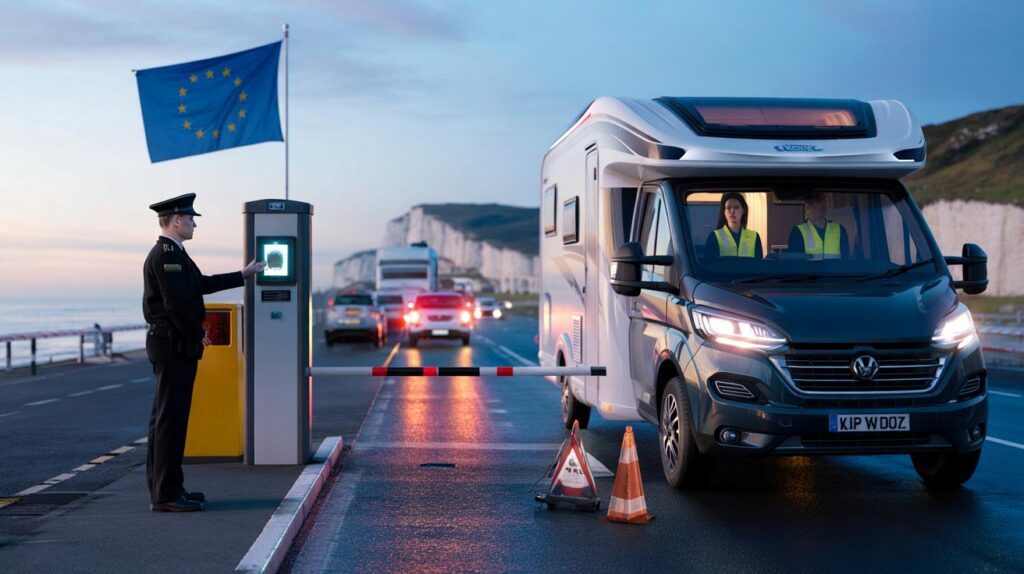
Taking your home on wheels across the Channel just got more complicated, with fresh paperwork, biometrics and timing traps ahead.
From 12 October, the EU rolls out a new automated entry system that changes how British holidaymakers in motorhomes and caravans are processed at the border. The shift affects short breaks and long escapes alike, and it rewards careful planning.
What changes on 12 October
The EU’s new Entry/Exit System (EES) starts phasing in for non‑EU travellers, including UK citizens arriving by ferry, train or road. Passport stamping gives way to a digital register, built from biometric checks and a record of each crossing. Expect your first trip after launch to take longer.
EES begins on 12 October. First‑time registration involves fingerprints, a facial image and a set of questions before you leave the UK or on arrival at the EU border.
Officials will capture four fingerprints, a live facial image and basic travel details. After that initial enrolment, repeat crossings should be quicker as your profile will already exist in the system. The roll‑out is staged over roughly six months, so requirements may vary between ports until April 2026.
Who is affected
Anyone driving a motorhome, towing a caravan, or travelling as a passenger in a campervan for trips of up to 90 days in any rolling 180‑day window falls under the new checks. Safeguard, a specialist insurer, has warned that UK drivers heading to the EU from 12 October will be processed under EES for short‑stay visits.
The change applies across the Schengen area and associated states. If you’re leaving via the Port of Dover, Eurotunnel at Folkestone or Eurostar at St Pancras International, the enrolment happens at the border before you depart the UK.
The 90/180‑day rule explained
Your allowance is 90 days inside the Schengen zone within any 180‑day period. The window moves with you, so each day you spend in Schengen pushes a day out of the back of the 180‑day frame.
Simple example you can copy
- You tour France for 20 days in October.
- You visit Spain for 30 days in December.
- By New Year, you have used 50 of your 90 days.
- On 18 April, the 20 October days “drop off”, restoring that allowance.
Overstaying risks refusal of entry on a future visit and on‑the‑spot penalties in some countries. Keep your own day count.
Where checks happen and what to expect
Processes differ by route. Staff at UK exit points will guide you through enrolment and repeat verification as the system beds in.
| Route | Where checks occur | What to expect |
|---|---|---|
| Dover–Calais/Dunkirk (ferry) | French controls at Dover | Biometrics captured before boarding; allow extra time at busy sailings. |
| Folkestone (Eurotunnel) | French controls at UK terminal | Drive‑through kiosks and staffed booths; first‑timers take longer. |
| St Pancras (Eurostar) | French controls before departure | Enrolment at the station; group trips should arrive early. |
| Regional ferry ports | Varies by operator | Phased delivery; procedures may differ until April 2026. |
Your border checklist
- Passport with at least three months’ validity beyond your planned exit from Schengen.
- Proof of travel plans and funds if asked (return ticket, campsite bookings, itinerary).
- Vehicle documents: V5C logbook (or VE103 if it’s a hire vehicle), motor insurance and breakdown cover that are valid in the EU.
- UK identifier displayed on the rear of your motorhome or caravan.
- Equipment required in destination countries: warning triangle, hi‑vis vests for all occupants, headlamp beam deflectors, spare bulbs where mandated. Rules vary by country.
Ministers say they are working with EU partners to keep queues manageable. Even so, plan for slower processing at launch, particularly at school half term and Christmas getaways.
Fines, refusals and the traps to avoid
EES itself is not a fine‑generating system, but it will make overstays and repeat entries easier to spot. Some states issue on‑the‑spot penalties, often starting around €100, for missing mandatory gear, failing to display a UK identifier, or driving without the right vignette or toll tag. Refusal of entry is possible if you lack documents or have exhausted your 90‑day allowance.
To sidestep £100‑plus headaches, carry the right kit, count your days, and keep proof of bookings handy at the booth.
Motorhome and caravan specifics you shouldn’t ignore
Weight, speed and toll classes
Many countries treat vehicles over 3,500kg differently. That can affect speed limits, toll categories and access to certain roads. If your motorhome tips the scales above this threshold, check local limits before you roll off the ferry. Towing a caravan can lower speed limits on motorways in parts of the EU.
Low‑emission zones and stickers
Major cities run environmental zones. Some require a windscreen sticker ordered in advance. Others register your number plate online. Without the right credentials, entry may be restricted or fined. Plan routes that avoid restricted areas if your vehicle misses the cut.
Gas, ferries and the tunnel
Operators set their own rules for gas cylinders and LPG systems. Expect valves to be shut and cylinders secured; quantities can be capped. Vehicles powered by LPG may face extra restrictions, especially at the Channel Tunnel. Check the small print before you book.
What’s next: ETIAS travel authorisation
From late 2026, most UK travellers are expected to need an ETIAS travel authorisation as a separate pre‑trip approval. It is not a visa, but it must be obtained online before travel and will be checked at the border. Build this extra step into your plans once it goes live.
Timing tactics and practical planning
- First crossing after 12 October: arrive earlier than usual and avoid peak sailings if you can.
- Family groups: make sure every adult is present at enrolment; minors may follow different procedures.
- Keep a simple day log on your phone to track the rolling 180‑day window.
- If you split a long tour across several trips, sketch the dates on a calendar to test scenarios.
Extra tips for a smoother tour
Insurance policies for motorhomes and caravans sometimes cap trip length. Check that your cover matches your planned stay, and extend it if you are close to the limit. Carry a European accident statement and know how to contact your insurer from abroad. A basic tool kit, a compact fire extinguisher and a first‑aid kit reduce risk and can be compulsory in some states.
Travelling with pets demands extra lead time. An Animal Health Certificate is required for each trip, and vaccinations must be up to date. Build vet appointments into your countdown so you are not turned away at the port. If you plan to wild‑camp, read local rules, as fines for unauthorized overnighting are common on coasts and in protected areas.



For first-time EES, will Eurotunnel do the fingerprints and face scan at Folkestone before boarding, or in Calais? And what about kids—do minors give fingerprints too, or a different process? Trying to time our slot.
More queues, more red tappe, more kiosks. Can’t wait to spend my holiday getting my mugshot taken next to the petrol pumps. Are we getting a loyalty card for repeat scans, or just longer sighs?