
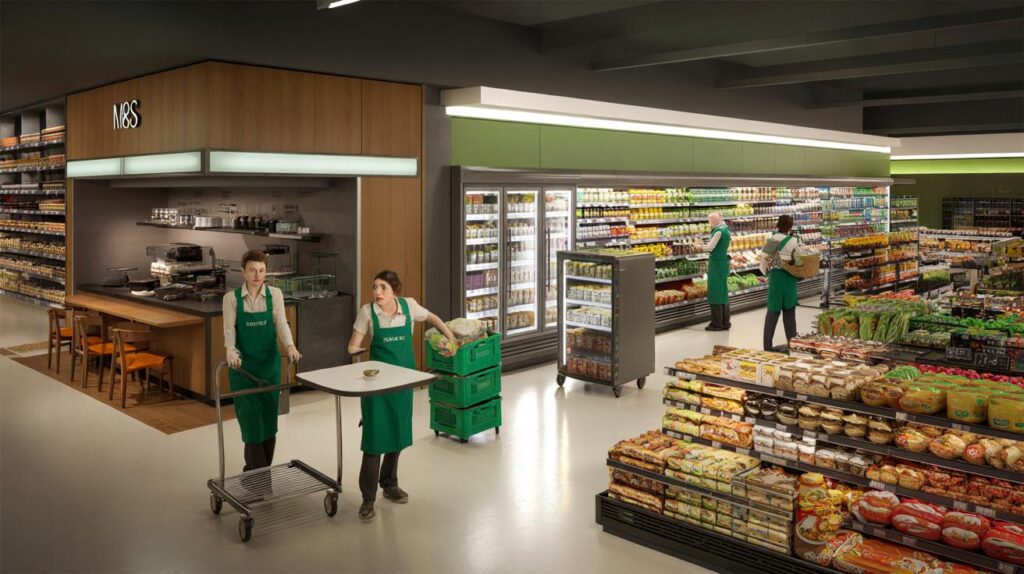
From cappuccinos to chilled counters, a quiet reshuffle on the high street hints at bigger changes inside familiar food halls.
Marks & Spencer will remove seating areas in selected small stores to free space for popular groceries, while promising no redundancies. The move sits inside a wider £300m store investment and rotation programme that tilts the retailer further toward food-led formats.
What is changing
M&S will close 11 cafes housed inside its smaller food shops. The company says the space will switch to grocery aisles and counters that better match customer demand. The change touches fewer than 4% of its 316 food shops. Staff will not be let go; managers will redeploy teams into other roles within the same stores.
11 in-store cafes will close in smaller M&S Food locations, with staff redeployed and grocery space expanded.
At the same time, M&S plans to add or refresh coffee offers elsewhere. Newer, larger sites will gain upgraded coffee shops, coffee-to-go points and barista-made drinks using fairtrade beans. The brand’s forthcoming Bristol Cabot Circus store is set to showcase that approach, with a modern coffee space integrated beside a bigger food hall.
| Measure | Detail |
|---|---|
| Cafes closing | 11 |
| Food shops currently | 316 |
| Share of food shops affected | Fewer than 4% |
| Investment and rotation programme | £300m |
| Planned food stores by end-2028 | About 420 |
| Online order outage after cyberattack | Six weeks |
| Estimated cost of the hack | About £300m |
The £300m rotation: more food halls, fewer full-line stores
The cafe changes form part of a broader store rotation. M&S has been converting some full-line outlets into food-only stores. Food halls at existing sites are also being modernised with new refrigeration, lighting and back-of-house kit. The goal is simple: put more space behind products that sell fast, especially fresh and quick-meal ranges, and make shopping quicker.
By the end of 2028, the group aims to operate roughly 420 food stores. That plan includes opening more than 100 new food outlets on retail parks and in city locations. Format choice remains flexible: smaller urban food shops will lean on high sales-per-square-foot and coffee-to-go, while larger formats can accommodate sit-down cafes where demand justifies the floorspace.
Why seats are giving way to shelves
Grocery retail lives or dies by sales density. Every metre of floor must pay its way. In many compact stores, a sit-down area limits the number of chilled doors or ambient aisles that can carry weekly staples, party food and seasonal lines. M&S believes customers in those locations prefer a deeper range over a place to sit. That assessment reflects pressure on space as meal deals, bakery grab-and-go and premium convenience ranges grow in popularity.
Cost pressures also shape the calculation. Energy costs, business rates and labour make an underused seating area expensive. A coffee counter needs equipment, maintenance, and trained baristas. By contrast, a run of refrigeration can host hundreds of high-margin SKUs with steady demand. The company is therefore keeping coffee in formats that suit it, while allowing busy food shops to stock more of what people actually buy.
New coffee, different footprint
M&S is not walking away from coffee. It is reshaping where and how it serves it. Bigger “next generation” stores will host updated coffee shops, while many locations will rely on coffee-to-go pods that serve barista-style drinks without needing a full seating area. That hybrid approach mirrors how grocery chains balance convenience with dwell time across the estate.
Small shops lose seats; larger and newly opened sites gain upgraded coffee bars and coffee-to-go hubs.
What shoppers may notice
- More shelf space for popular lines, especially fresh, chilled and meal-for-tonight products.
- Faster trips, as narrow aisles and bottlenecks ease once seating areas make way for wider ranges.
- Coffee-to-go or kiosk-style service where full cafes close, instead of sit-down areas.
- Refreshed fixtures and brighter, colder refrigeration to improve product quality and shelf life.
- Store teams moving into bakery, counters, replenishment or click-and-collect roles.
The cyberattack backdrop
The shift lands after a sharp digital shock. In April, a major cyberattack forced M&S to pause online orders for six weeks. The company told investors the incident carries an estimated bill of around £300m. That disruption has placed extra focus on resilience and in-store fundamentals while the business restores full online capability and recovers trading momentum.
The April cyberattack halted online orders for six weeks and comes with an estimated £300m price tag.
Retailers often respond to such events by tightening risk controls, prioritising projects with clear returns, and backing proven formats. For M&S, that means doubling down on food halls that draw frequent visits and generate dependable cash flow, while keeping digital investments pointed at security and scalability.
Impact on staff and communities
M&S says no jobs will go as a result of the cafe closures. Store managers plan to retrain cafe teams for roles on fresh counters, bakery, customer service or replenishment. That can widen skills and support career progression. Communities that relied on a seating area may feel the loss of a meeting spot. Where possible, coffee-to-go options will soften that change, and larger nearby branches with full cafes may absorb some sit-down demand.
How to check if your branch is affected
Shops typically signpost any change weeks in advance. Look for notices at entrances and near the cafe. Ask colleagues in store; they usually know the date work begins and where services will move. Local store pages often carry service updates, opening hours and format changes.
A quick look at the business maths
Retailers judge each area by productivity. A small seating zone might host 24 chairs across 35 square metres. If those seats turn slowly outside peak hours, revenue per square metre can lag. Replace that footprint with two chilled runs and a meal-solution bay and the assortment can climb by hundreds of SKUs. Even modest unit sales across a larger range add up quickly and lift weekly takings.
Consider a simple illustration, not specific to M&S. If 10 additional shelves carry 400 new lines, and each new line sells just eight units per week at an average £3 price, that space generates roughly £9,600 in weekly sales. Even after shrink, labour and energy, the margin can beat a lightly used seating area. That logic explains why many small urban stores prefer coffee-to-go and more choice over chairs.
What this tells you about the grocery race
The UK’s food retail battle rewards convenience, quality and speed. M&S aims to win bigger baskets with broader choice, sharper availability and fresher presentation. Cafe closures in compact sites free the square metres needed for that push. At the same time, the brand keeps hospitality alive in larger destinations where dwell time supports it. For shoppers, the trade-off is clear: fewer seats in some neighbourhoods, more choice on the shelves, and a better chance the thing you want is in stock.



Funny how the £300m ‘rotation’ matches the £300m hack bill. Coincidence, or are customers paying for the outage?
More chilled doors and faster trips sound great—my local is always cramped. If staff are redeployed not cut, that’s a win 🙂