
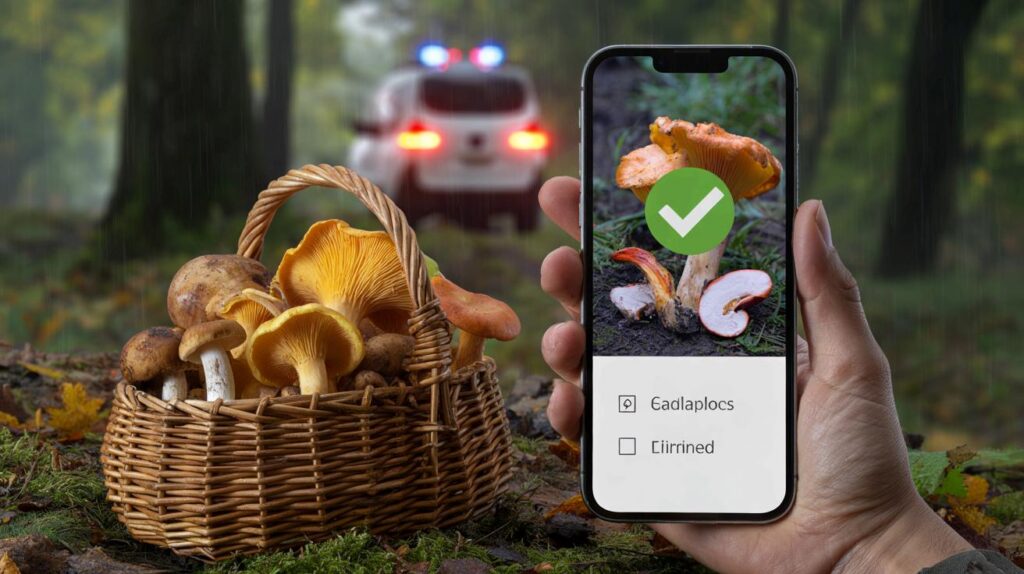
Autumn walks promise baskets of gold and family stories, yet a simple misstep can turn a cosy ritual sideways.
Across Europe, emergency doctors brace for the seasonal mushroom rush. The biggest trap this year sits in your hand: the seductive certainty of a camera and a green tick. As forests fill with chanterelle lookalikes and sneaky boletes, a swathe of weekend pickers now gamble on software that can’t see what it doesn’t know.
Why mushroom picking captures so many of us
October rain wakes the woods. Families head out with wicker baskets, children learn old names, and kitchens fill with earthy scents. The hunt blends food, memory and patience. It also rewards local knowledge. Under oak, beech and pine, thousands of species push through leaf litter, some delicious, some dangerous, many confusingly similar.
That complexity draws people in. It also trips them up. A good bolete sits next to a bitter twin. A fragrant chanterelle shares a palette with the false chanterelle. The difference hides in gill shape, stem hue, cap texture and habitat. Lighting matters. So does soil. A photograph rarely captures the lot.
The fatal error: when apps mislead in the woods
The crucial mistake, made by an estimated eight in ten casual pickers, is to trust an app’s verdict as if it were a field biologist. Convenience wins in the drizzle. Point, shoot, accept. The problem starts with probability. Recognition tools compare your image to a database. Poor light, damp caps or a bad angle nudge the match in the wrong direction. A harmless false positive turns into a pan of trouble.
Never eat a mushroom identified only by an app. Treat every algorithmic “match” as a guess, not a green light.
How algorithms get it wrong
Software leans on visible features. Many key traits are not clearly visible in a single image. Spore colour, smell, bruising reactions and the way gills attach to the stem carry weight in identification. Apps can’t sniff, bruise or time a colour change. They also see what most people photograph: caps. That biases results and discards vital context like trees overhead or soil type.
What poison centres are seeing
French poison control centres report a seasonal spike each autumn, with calls peaking around All Saints’ Day. This autumn 2025, their teams note a sharp rise in cases where misidentification linked to phone apps preceded symptoms. Confusion between chanterelles and lookalikes, and between edible boletes and the dangerous “Satan” bolete, appears repeatedly. The pattern is familiar: one confident photo, one wrong answer, one hurried meal.
Photograph your haul before cooking. In A&E, that image can speed decisions and save precious hours.
How to stay safe without ditching the joy
You can keep the baskets and keep out of A&E. The approach shifts from blind trust to layered checks and slower decisions. Think process, not pictures.
- Use a rigid, ventilated basket or a cardboard box. Skip plastic bags that sweat and speed decay.
- Separate species as you pick. One toxic intruder can contaminate the lot.
- Keep away from roadsides, industrial land and pastures treated with chemicals. Fungi absorb pollutants.
- If in doubt, ask a pharmacist trained in mycology or a local fungi society. Many offer free checks.
- Cook thoroughly: 20–30 minutes in a pan or 15 minutes at a boil. Avoid eating mushrooms raw.
- Eat modestly: 150–200 g per adult per week. Do not serve wild mushrooms to young children.
- Refrigerate within hours, store separately, and eat within 48 hours of picking.
- Keep a few raw specimens aside and take clear photos of the whole haul before cooking.
Spotting the pitfalls: lookalikes that fool the lens
Chanterelles versus the false chanterelle: real chanterelles have decurrent, forked ridges rather than true gills, firm flesh and a fruity scent. The false chanterelle shows sharper, crowded gills and a deeper orange tone. In dim light, an app may prioritise colour and cap shape, then guess wrong.
Boletes versus toxic boletes: many edible boletes have pores that stay yellow or brown and a pleasant smell. Some dangerous relatives show lurid red pores or bruise blue when cut. A phone shot may miss that rapid colour change. Your knife will not.
Simple field checks you can trust
Carry a small notebook and a clean knife. Note trees above you. Slice the stem and cap to check for colour changes. Rub the flesh gently to see if it bruises. Take a spore print at home: place a cap, gills down, on half white, half black paper; cover with a bowl; wait overnight. Spore colour narrows choices far more than a single photograph.
If symptoms appear, act fast
Nausea, vomiting, diarrhoea, abdominal pain, sweating or dizziness can follow a risky meal. Severe poisonings may start late, after a few hours of deceptive calm. Do not wait for confirmation on your phone. Call a poison centre or go to A&E. Bring leftover mushrooms or clear photos. Avoid alcohol and do not self-medicate.
| Time after eating | Common signs | Priority action |
|---|---|---|
| 0–3 hours | Nausea, vomiting, stomach cramps, diarrhoea | Hydrate, keep samples, seek medical advice promptly |
| 3–6 hours | Worsening GI symptoms, sweating, dizziness | Go to A&E, show photos/samples, state time and amount eaten |
| 6–24 hours | Brief improvement, then severe pain, jaundice, confusion | Emergency care immediately—late onset can signal dangerous toxins |
Why the “80% mistake” keeps happening
The lure of simplicity meets the chaos of nature. People crave certainty under dripping branches. Apps offer it in a tidy icon. The woods refuse to play along. Lighting shifts, caps glisten, and lookalikes co-evolve. A single macro photo flattens texture and context. The brain relaxes. That’s when bad decisions creep in.
Another factor is speed. Foragers want to keep moving. Field guides slow you down. Experts ask questions. An app removes friction. It also removes the checks that prevent error. Slowing down restores those checks.
Better habits for the next walk
Build your own routine. Pick, separate, note the trees, cut and inspect, photograph the group, set one aside for identification, then cook thoroughly. Treat apps as a starting point for a shortlist—not a verdict. Cross-check with a trusted field guide. Ask a pharmacist or a local mycology group before you eat anything new.
Practice with safe, distinctive species first. Learn the golden chanterelle by its ridges, scent and habitat. Study a few boletes with reliable traits. Compare them to their closest lookalikes at home, side by side, under good light. Repeat across weekends. Confidence grows from patterns, not from pixels.
Extra context you can use
Risk scales with cumulative errors, not only with species. A plastic bag raises temperature and moisture, which boosts bacterial growth. A mixed basket spreads toxins if one cap is misidentified. Under-cooking leaves natural irritants intact. Each small shortcut adds up. Remove them and your odds improve quickly.
There is also an upside to patience. Careful identification turns foraging into a craft. You notice habitats, tree partners and seasonal cues. You waste fewer specimens. You eat better and feel better. Most of all, you keep family traditions alive without adding a hospital story to the tale.



So my phone can spot my cat but not a chanterelle—guess who’s cooking tonight? 🙂