
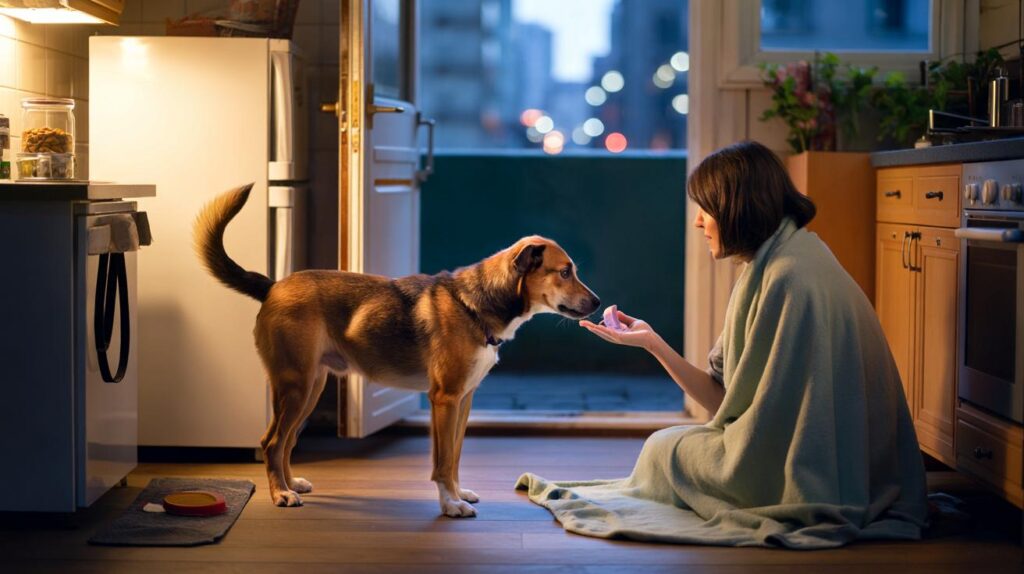
The first weeks with a rescue dog are rarely a montage of cuddles and instant connection. They can be messy, loud, and lonely. This is a true story about the fragile start, the cracks that show, and the small, stubborn commitment that keeps you both in the room.
The first night, he paced a groove into the laminate like a nervous commuter circling a platform. His chest heaved, tail welded tight to his belly, nails clacking a metronome against the quiet of my flat. I lay on the kitchen floor with a blanket and a packet of ham, whispering nothing words.
He found the only rug and peed on it, then stared at me as if waiting for a verdict. I opened the balcony door and the city breathed cold into our small chaos. *I was not his safe person yet.*
I thought love would be enough, right there in the glow of a fridge bulb at 2 a.m. He licked the ham, not my hand. Then the growl.
The first fortnight: fear, noise and the myths that crack
I had believed in the magical click, the film-scene bond where the dog curls up and knows. My dog arrived with a suitcase of fear I couldn’t see. He flinched at the kettle, at keys, at the sound of my coat zipper.
We’ve all had that moment when the thing you dreamed of becomes the thing you have to learn. He ate only at dawn, eyes fixed on the door. The neighbours heard him bark and left a note. I learned how long a hallway can feel at 3 a.m.
On day three, a bus whooshed by and he shot backwards out of his harness like a bar of soap. He pinned himself to a garden fence, panting so hard his cheeks fluttered. I dropped to the pavement with meatballs in my palm and a voice I didn’t recognise, soft and tinny.
A woman across the road froze and held up traffic with the authority of a crossing guard. It took fifteen minutes to move two steps. Two steps felt like winning a war. Back at home, he slept with one eye open, and I watched his paws twitch with memories I couldn’t fix.
People talk about the “3-3-3” rhythm: three days to decompress, three weeks to learn a pattern, three months to believe it. It’s a sketch, not a promise. Triggers stack like plates in a sink until a teaspoon tips it all over.
My rescue lived in a body that expected trouble. The first fortnight wasn’t a behavioural problem so much as a biography. **Rescue reality** means fear has reasons, even if you never learn them. The job is to become boring and safe, on repeat, until his nervous system gets the memo.
What finally worked: tiny routines, big patience
I built a day like a soft box. Same walk at the same dull time, the quiet streets with the nice bins. Scatter-feeding in the grass to turn panic into sniffing, five minutes at a time. A door-opening ritual: sit, treat, door cracks, treat, door shuts, treat, then we go.
I swapped long walks for sniffaris, ten minutes of slow snout work instead of miles. A treat jar by every threshold, so safety lives where fear shows up. We trained one cue only: touch my hand, earn a party. He learned I was predictable. Predictable beats perfect.
People often flood the first weeks with visitors, with love, with new toys and long hikes. It looks kind. It lands loud. Let’s be honest: nobody does that every day.
Start small and keep your circle tiny. Don’t test the dog to see what he “can handle” on day five. You’re building a bridge, not a proof.
I kept hearing the same advice from those who do this for a living, said like a whisper: slow is fast. It became my anchor when progress felt invisible.
“A rescue dog isn’t failing when he panics. He’s succeeding when he recovers a second faster than yesterday,” a London behaviourist told me. “Your job is to help him collect calm moments.”
- Two safe rooms, doors open, baby gate ready.
- Three short sniff-walks, not a single long trek.
- Food they actually want, and a lick mat for evenings.
- A vet check within the first week, even if they look “fine”.
The quiet choice to stay
Trust didn’t land with a ta-dah. It accumulated like compost, slow and ordinary. One morning he stretched and exposed his belly, then startled at his own courage and tucked back in. I didn’t move. I breathed and let the good thing pass through without chasing it.
There were setbacks. A bin lorry unstitched a week of progress. A guest wore a hat and he hid under the table. I apologised more than I wanted to, and I forgave us quicker than I expected. **Slow progress** still moves.
I won’t sell you redemption by Thursday. Adoption isn’t a fairy tale, it’s a relationship formed under stress. The thing that changed everything wasn’t a tool, it was a decision: we’re staying. He stays with me, I stay with him, and the rest is practice.
So if your first weeks are hell, you’re not broken. You’re just early. Tell someone what’s hard and ask for help before you think you’ve earned it. And when a tiny, weird, perfect moment arrives — a sigh at your feet, a nose on your knee — let it count more than the noise. **Small wins** are how you write a new story.
| Key points | Details | Interest for reader |
|---|---|---|
| Early chaos is normal | Fear, pacing, accidents, barking often peak in the first fortnight; “3-3-3” is a guide, not a guarantee. | Reduces guilt and panic; frames behaviour as recovery, not rebellion. |
| Build safety with routine | Repeatable walks, sniffing, scatter-feeding, and one simple cue make you predictable and safe. | Actionable steps to stabilise days and cut overwhelm fast. |
| Get calm help early | Vet check, qualified behaviourist, small social circle, tiny goals tracked daily. | Prevents escalation and keeps adoptions from failing in week one. |
FAQ :
- How long does it take a rescue dog to settle?Some dogs relax in weeks, others take months. Think in layers: first safety, then routine, then skills.
- Why does my rescue dog ignore food or play?Stress can suppress appetite and curiosity. Offer high-value food at quiet times and try short sniff games before meals.
- Should I crate my rescue dog?Only if the crate is introduced as a choice, with the door open at first. The safe place is the one the dog chooses.
- What if my dog growls at me?Growling is communication, not a crime. Pause, give space, and make a plan with a qualified professional to change the picture.
- When is rehoming the kindest option?If safety is at risk or your life can’t meet the dog’s needs, speak early to the rescue and a behaviourist. There’s care in choosing a better fit.



This felt honest without hopelessness. The 3-3-3 “sketch, not a promise” and the idea of becoming boring-and-safe really landed. I love the tiny routines—scatter-feeding, door ritual, one “touch” cue—because they’re doable when you’re sleep-deprived. Also, reframing panic as a biography, not bad behavior, is gold. Slow is fast, indeed.
Quick question: when he slipped his harness on day three, what finally prevented that? Front-clip? Double-ended leash? Did you work with a certifed behavorist, and if so, how did you vet their creds?