
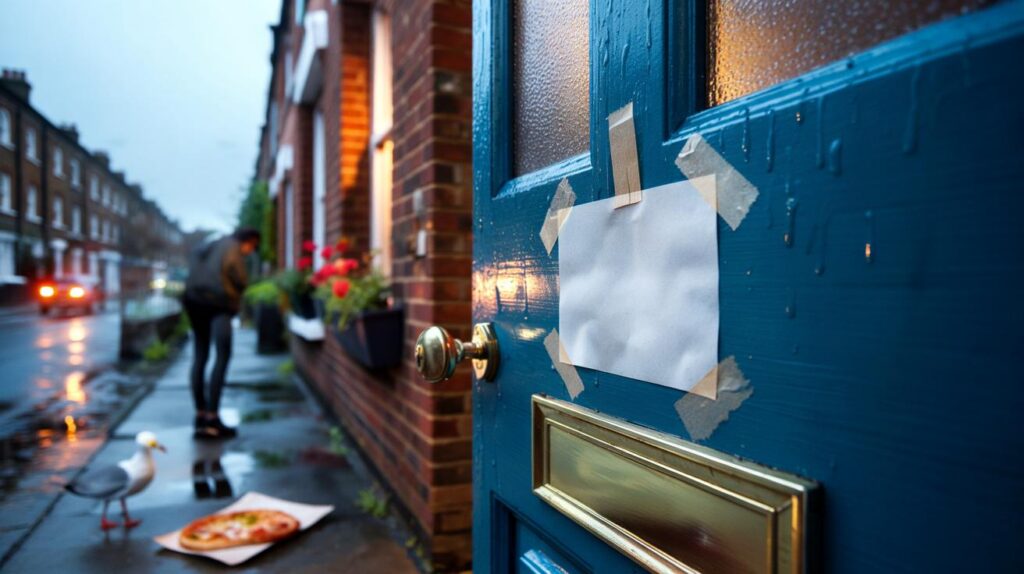
Scraps of paper on front doors are becoming a thing — “No cash kept on premises”, “Nothing to steal here”, even “Please don’t break in”. Some swear these notes chase away burglars. Others say they shout fear, like leaving the porch light on at noon. Which is it: a clever decoy, or an invitation?
You notice the note before the door. A square of white taped at eye level on a red-brick terrace in South London, the handwriting rushed, apologetic: “Nothing worth stealing — please don’t try.” The street is quiet. A gull picks at a pizza box. A neighbour waters geraniums and pretends not to look. The paper looks tired, rain-frayed at the corners. We’ve all had that moment when you clock a small sign and read a whole life into it — worry, habit, hope. A dog barks. Somewhere, a scooter zips past. The note flutters, and you wonder if it’s working. Or doing the opposite. A line of text trying to negotiate with risk. A tiny truce with the night. Then you catch the lock: scratched, bright. It feels like a dare.
What that note really says to someone willing to read it
Messages on doors are not just words. They’re signals. To a chancer walking your street, a hand-scrawled plea does two things at once: declares anxiety and hints at absence. It also tells them you’re thinking about them. Silence reads as strength, at least to people who trade in quick judgments. A clean door, decent lighting, nothing taped or dangling — those are also messages. They just don’t look like it.
A friend in Leeds told me about a run of car break-ins on her road. One neighbour taped up “No valuables left in vehicle”. Two nights later, only two cars were tested — his, and a rental. The window scratches suggested someone took the sign as a shortcut, not a deterrent. Another neighbour tried the opposite: nothing displayed, cabin emptied, glove box left open. That car stayed untouched. It’s not proof, but it’s a pattern you hear from beat cops and posties. Thieves read the street like a menu.
Think of it as signalling theory on your doorstep. People planning a quick grab juggle risk and reward in seconds. A note tries to edit their mental maths, yet it can also add a new column: “nervous owner”. Anxious houses often have predictable habits — piled-up mail, the same curtain closed all week, the blue bin forever out. The risk calculation shifts when cues stack up. A single note rarely carries the day. A whole picture does.
Smarter ways to say “move along” without saying a word
Give your home quiet, boring confidence. That means simple, low-fuss habits that whisper “occupied”. A light on a timer in a lived-in room, not the hallway. A radio murmuring at breakfast and early evening. Curtains that change position every day or two. Parcel instructions routed to a collection point so cardboard doesn’t tower like a vacancy flag. Ask a neighbour to sweep post from the mat. Small cues add up.
What trips people up is thinking one big gesture fixes it — the sign, the fake camera, the monster padlock. Let’s be honest: nobody really does that every day. Real life gets messy. You forget the timer, the bin day shifts, a repair person leaves a sticker that screams “alarm fitted”. Keep it human. Mix your routine a little. Put tools away after DIY so the front doesn’t look in flux. Think layers, not slogans.
“The safest message is the one you never have to write.”
And if you must leave words — say for a courier — keep them neutral and temporary. “Deliver to neighbour at No. 12” reads differently to “We’re out until Friday”. Remove it the moment it’s done. Here’s a quick crib to keep near the door:
- Use lighting and sound on timers that fit your life, not a showroom.
- Keep the threshold tidy: no towers of parcels, no tools left out front.
- Ask one neighbour for tiny favours, and return theirs.
- For notes, go minimal and specific to the task, not your schedule.
- If something breaks, fix the obvious bits first — locks, lights, letterbox.
So, does the note work — or does it tempt?
A “nothing to steal” note is a coin toss you don’t need to flip. Some passing opportunists may shrug and keep walking. Others may see it as proof you’re worried, or out, or both. A home that feels cared for, lived-in, mildly unpredictable will always speak more clearly than paper taped to paint. Less noise, more signal. The trick is not theatre, but rhythm — tiny touches that stack into a quiet story of presence. That story is hard to argue with, even for someone looking for an easy win. Tell that story without words, and your door can stay just a door again.
| Key points | Details | Interest for reader |
|---|---|---|
| Door notes are signals, not shields | They can broadcast anxiety or absence and draw attention | Helps decide whether to tape that message up or bin it |
| Quiet cues beat loud claims | Lighting, sound, tidy thresholds, changing curtains, neighbour help | Gives practical, doable alternatives to signs |
| Keep words neutral and brief when needed | Courier-only notes, removed quickly, no schedule revealed | Reduces risk without complicating daily life |
FAQ :
- Does a “nothing to steal” sign actually deter burglars?Sometimes it may, often it doesn’t. It can read as fear or vacancy, which is the opposite of what you want.
- Is it better to leave no note at all?Yes for general deterrence. If you need a delivery note, make it neutral and temporary, then take it down.
- Should I put up alarm or CCTV stickers?Real systems help. Stickers without substance are theatre. If you have kit, keep it genuine and visible, not shouty.
- What’s one small change that makes a big difference?A lamp on a timer in a real living space. It adds believable presence without effort.
- What if I’ll be away for a week?Stage normality: a neighbour to clear post, bins handled on the right day, curtains that move. No need to broadcast your timetable.



So the note works like a scarecrow for burglars… or a dinner bell? 😅
Loved the point that silence reads as strength. The Leeds car story clinched it: signs can act like arrows for oppurtunists. I’m defintely switching to timers, tidy thresholds, and neighbour help instead of slogans. Less theatre, more rhythm—that line stuck with me.