
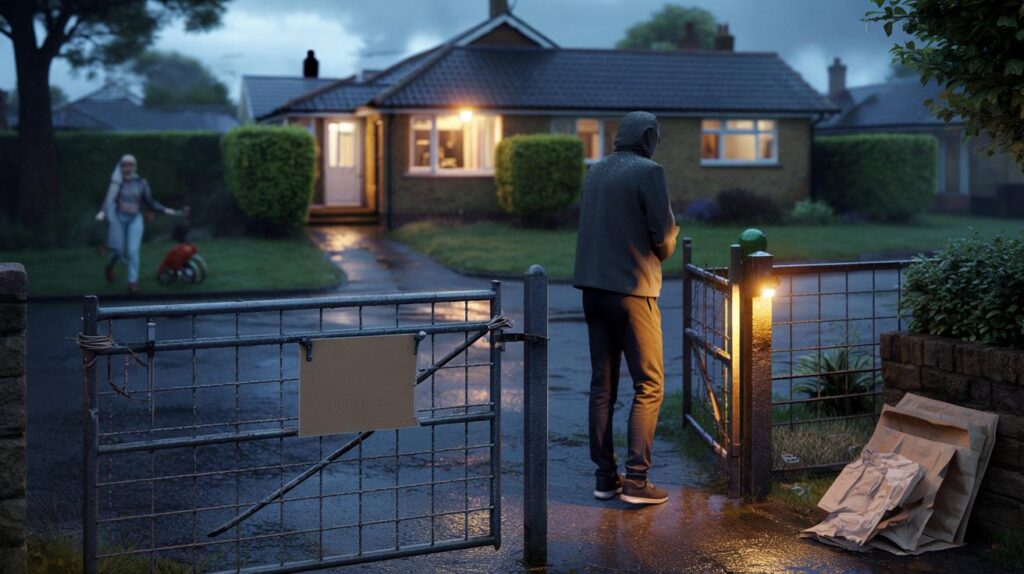
It’s one of those little domestic hacks that spreads on street WhatsApp groups: stick a “Nothing to steal” sign on your gate and move on with your day. Some swear it calms the casual chancer. Others worry it’s like whispering “go on then” to a curious stranger. Is that scrap of plastic a tiny shield — or a nudge to take a second look?
The night I started paying attention, the street was quiet in a way only British suburbs know: foxes in the bins, the hum of a late bus, curtains half-drawn. A delivery driver slowed at No. 37, peered at the porch camera, then glanced at a tiny placard cable-tied to the railings: “Nothing to steal.” A neighbour dog-walked past, smirked, and kept going. The house looked ordinary — bikes in the side passage, a pile of Amazon boxes flattened by the wheelie bin. I waited a minute longer than made sense, thinking about how strangers read our homes. *What do they hear?*
What burglars read between the lines
Most break-ins aren’t Ocean’s Eleven. They’re quick, opportunistic, and guided by tiny cues that say “easy” or “not worth it”. A novelty sign is one of those cues. It tells a story about who lives here and how they think. Is this house cautious and practical, or anxious and a bit performative? Does the sign look new or sun-bleached and brittle? There’s a world of difference to a chancer scanning a street for soft targets. Burglars read signals, not slogans.
Talk to officers who’ve sat through dozens of interviews with repeat offenders and one theme pops up: burglars hate uncertainty. They don’t want to wrestle with a door that might wake a dog, or a neighbour who actually looks up from the telly. Police data across the UK points to a majority of domestic burglaries being spur-of-the-moment picks. Think open windows, unlocked side gates, tools left out. In that context, a “Nothing to steal” sign isn’t a deterrent on its own. It’s a curiosity flag, and curiosity is cheap to satisfy with a quick push on a side door.
There’s a second layer: psychology. Tell people “Don’t look in this cupboard” and you’ve named the cupboard worth checking. The same tension applies to a sign that announces scarcity. It can feel like a bluff, especially if other cues suggest comfort and convenience — a nice e-bike charger in view, a shiny barbecue in the garden, pricey packaging in recycling. That mismatch is a magnet. A sign that says “nothing” while the scene says “something” creates friction, and friction draws eyes. The message that lands isn’t always the one you intend.
Smarter signals that actually work
Security that works tends to be quiet and layered. Start with sightlines: trim hedges around ground-floor windows and keep paths visible from the street. Fit decent window locks and a door with a multi-point mechanism. Add a dusk-to-dawn light by the entrance and a motion light covering the side gate. Use timers to vary the glow indoors when you’re out. If you use signage, keep it factual and backed by reality: “Property marked. Serial numbers recorded.” A small, boring statement beats a clever wink. Real security is layers, not loud claims.
Common pitfalls are painfully human. We post holiday snaps in real time. We stack big TV boxes by the bin the same night. We leave ladders out after Sunday chores. Let’s be honest: nobody really does that every day. The trick isn’t to aim for perfection but to remove the easy wins. Put tools away. Close the side gate. Pull curtains to the same level as your neighbours, not blacked out like a stage set. If you want a sign, choose one that signals active measures, not bravado.
We’ve all had that moment when you shut the door and wonder if you’ve accidentally advertised that new laptop to the whole street. A sign won’t fix that feeling. What does help is a calm routine and a few cues that show a “capable guardian” is present — even if you’re at the office two towns over. The right signals are simple, repeatable, and boring in the best way.
“Burglars aren’t mind-readers. They react to what they can see: light, access, cover, and the chance someone will show up.”
- Lock windows and doors you actually use, not just the front.
- Light pathways and the side return; keep bins from creating cover.
- Mark valuables with a forensic solution and record serials.
- Use signage only for measures you’re genuinely running.
- Ask a neighbour to adopt your drive when you’re away — a car, a bin shuffle, a glance.
So, should you put up a “Nothing to steal” sign?
The honest answer: it’s rarely the best message on your wall. It can read as nervous humour, or as a bluff, or just as noise. A wordy sign also competes with stronger cues: good lighting, tidy sightlines, a lived-in rhythm. Burglars scan patterns, not punchlines. If a sign calms you, keep it small and neutral, and pair it with real steps that are visible from the pavement. And if the sign is covering for a wobbly latch or a dark path, skip the plastic and fix the thing. The quiet signals do most of the talking, and they’re heard even on a windy night when no one’s around.
| Key points | Details | Interest for reader |
|---|---|---|
| Novelty signs send mixed signals | “Nothing to steal” can be read as a bluff or anxiety, especially if other cues suggest value | Helps decide whether a sign helps or backfires on your street |
| Layered security beats slogans | Locks, lights, sightlines, timers, and factual signage work together | Gives a simple, actionable plan you can start tonight |
| Burglars hate uncertainty | Unclear access, visible activity, and small frictions push them elsewhere | Shows how to create “not worth it” vibes without fortress vibes |
FAQ :
- Does a “Nothing to steal” sign actually deter burglars?Not reliably. Many offenders treat it as a joke, a bluff, or background noise. Real deterrence comes from lighting, access control, and visible routines.
- What wording works better if I want a sign?Keep it factual and true, like “Property marked and recorded” or “CCTV in operation” if you genuinely run it. Avoid bravado or sarcasm.
- Is it legal to put up CCTV signs in the UK?Yes, though if your cameras capture beyond your boundary you’re subject to data protection rules. Be transparent and store footage responsibly.
- Should I pretend I have a dog with a warning sign?Risky and not very effective. A real barking dog changes behaviour. A fake sign can be read as theatre and may not stand up if something goes wrong.
- What’s the quickest win if I’ve got 30 minutes tonight?Lock accessible windows, light the entrance and side gate, remove tools and ladders, and pull the curtains to a lived-in level. Tiny frictions are your friend.



So… if burglars hate uncertainty, wouldn’t a jokey sign create exactly the kind of curiosity you don’t want? Feels like reverse-psychology gone wrong.