
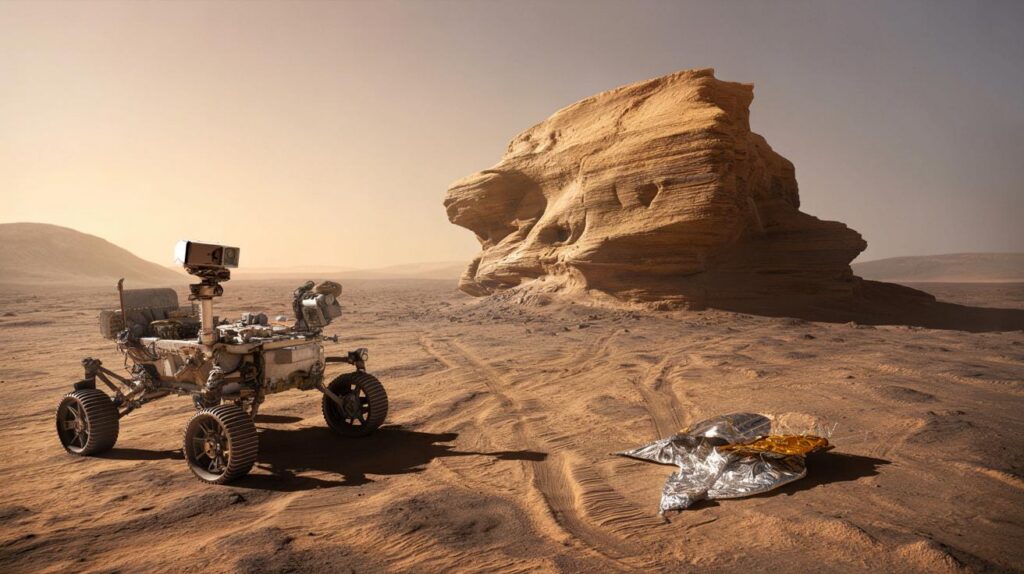
Social feeds lit up with dusty red rocks, shiny angles and bold captions this week. The story behind them matters more.
Claims that NASA’s Perseverance rover has uncovered a rocket‑engined 1984 Pontiac Fiero on Mars surged from a motoring parody, then spiralled into viral certainty. Here is what actually sits on the Martian ground, why those images look the way they do, and how a mid‑engine coupé from the Eighties ended up at the heart of a 225‑million‑kilometre mystery.
What sparked the Martian car chatter
The noise began after a satirical motoring column riffed on real Perseverance updates about unusual, angular rocks in Jezero Crater. The gag married two internet obsessions: space selfies and cult cars. Within hours, screenshots stripped the “satire” label, captions hardened, and a tall tale outran the footnotes. Some posts even upgraded the punchline to a “rocket‑engined” Fiero, as if a home‑built thruster had hurled a fibreglass sports car across interplanetary space.
No, NASA has not found a rocket‑engined Pontiac on Mars. The claim began as a joke and mutated into a rumour.
Perseverance does send back high‑resolution mosaics. It does photograph objects that look mechanical at first glance. That tends to happen when wind, ancient water and harsh temperature swings fracture basalt and mudstone along straight lines. Our brains complete patterns. Engineers call it pareidolia. Rumour mills call it proof.
What Perseverance actually recorded
Perseverance operates in Jezero Crater, a 45‑kilometre basin with a fossilised river delta. Its Mastcam‑Z and SuperCam images routinely reveal polygonal boulders, vein‑filled slabs and fragments of the mission’s own landing gear. In 2022 the rover even photographed a shiny foil fragment from its backshell, which fell to the surface during the dramatic sky‑crane touchdown. Since then, several wind‑sharpened rocks have looked uncannily like moulded panels or scoops. They are rocks.
- Camera facts: Mastcam‑Z shoots up to 1600×1200 images with zoom, filters and true‑colour processing.
- Scale clues: a “panel” in a frame often measures 10–40cm across, not car‑sized metres.
- Local debris: parachute fabric and backshell shreds do exist near the landing site and can reflect light.
- Distance matters: compression, dust and low sun angles can sharpen edges and mislead the eye.
If a metal‑bodied object sat on Mars, we would see consistent specular reflections, fast‑evolving dust tails, and a clear size reference. We do not.
Why a 1984 Pontiac Fiero keeps popping up
Car culture lives off iconography. The 1984 Fiero, America’s mid‑engine, two‑seat coupé, offers the right silhouette for a meme: a low wedge, flat planes, pop‑up headlamps, and plastic body panels over a steel spaceframe. Early cars used a 2.5‑litre four‑cylinder and later a 2.8‑litre V6. Period reliability woes and a handful of engine‑bay fires fed jokes for decades. Online, a Fiero is shorthand for scrappy projects, kit conversions and wild swaps. Add one rumour about “rocket power”, and you ignite a thousand threads.
Could a car reach Mars in one piece?
Short answer: not without the hardware of a purpose‑built spacecraft. The physics stack up like a brick wall. Earth–Mars transfer windows open roughly every 26 months. A vehicle must survive launch loads, months of vacuum, hard radiation, micrometeoroids and a fiery atmospheric entry at several kilometres per second. Without a heat shield and a guided descent system, most terrestrial objects would ablate, shatter or skip out into space.
| Scenario | What it would need | Why it fails |
|---|---|---|
| Car strapped to a rocket | Fairing, guidance, heat shield, parachutes, retro‑rockets | No record of such a payload; entry heating would destroy unshielded polymers |
| Crash arrival, no deceleration | Indestructible structure, perfect trajectory | Impact energy would pulverise metals and shatter composites |
| Ancient alien artefact | Independent corroboration, non‑terrestrial materials | All images show common Martian geology and mission debris near the landing site |
For comparison, SpaceX did launch a Tesla Roadster on a solar orbit in 2018. It never headed for Mars’ surface. It travelled without re‑entry or landing gear. If anything, that stunt shows how different “space” is from “landing on another planet intact”.
How the viral claim took off
A motoring humour column published a clearly tagged satire piece. Readers shared screenshots without context. Captions mutated into statements. A few pages later, the joke hardened into a claim that NASA had confirmed a find. It had not. This arc repeats often: a comic premise pares down to a headline, then comments add fake specifics—“1984”, “rocket‑engined”, “face‑down”—to lend false precision. The posts then borrow genuine NASA frames to bolster the fiction.
Viral certainty often arrives on the back of real images, borrowed authority and invented detail.
How to read Mars images like a pro
Anyone can learn to parse these frames quickly and avoid the trap.
- Look for scale markers in image captions; a “door” might be just 20cm wide.
- Check for repeating patterns that hint at geology: hexagonal fractures, vein networks, bedding planes.
- Scan shadows; low sun angles carve crisp lines that mimic panels and vents.
- Identify mission artefacts; parachute fabric and heat‑shield pieces sit near landing ellipses.
- Compare multiple frames of the same spot; a different angle often breaks the illusion.
So why do we keep seeing machines in the dust?
Pareidolia nudges the brain to find familiar objects in noise. On Mars, erosion sculpts right angles, triangles and arcs as softer layers peel away. Camera compression can heighten contrast at edges. Add our bias for wheels, grills and vents, and you get “cars”. On the Moon we saw “buildings”. On Earth we spot faces in sockets and dinosaurs in clouds. The impulse tells us more about ourselves than about rocks.
Useful context for car fans and spacewatchers
For car fans: the Fiero’s spaceframe and plastic panels make it a perfect meme target, yet those same features undermine the Mars fantasy. Unprotected polyurethane and ABS would char, outgas and crack long before landing. Steel would oxidise and spall under entry heating. Even if a dimensionally similar object sat in frame, spectroscopy would flag polymer signatures or metallic glints far stronger than what we see.
For spacewatchers: Perseverance aims to cache rock cores for a future return mission. That work uses time, power and data budgets planned years in advance. The team prioritises targets that advance questions about water, habitability and ancient chemistry. If a genuinely anomalous artefact appeared, the mission plan would pivot, and the science community would light up with coordinated observations. Silence is a signal.
Try this simple reality check
When a jaw‑dropping claim lands, run three quick tests in under 30 seconds.
- Specifics test: does the post give location, sol number and instrument name, or just vibes and arrows?
- Physics test: does the explanation include entry, descent and landing, or skip straight to a punchline?
- Source test: can you trace the first claim to satire, a forum joke or a meme page?
Strange‑looking rocks are part of the adventure; invented certainty is not. Keep the curiosity, add a filter.
If you want to go deeper at home, try a scale simulation: print a rover image, mark the stated scale bar, then overlay a cut‑out of a known object—say, a 4.2‑metre car—at the correct scale. Most “car‑like” features disappear once you set size honestly. You can also sketch the sun angle from the shadows to see why edges look razor‑sharp near sunrise or sunset on Mars. These small exercises turn a scrolling rumour into a hands‑on lesson in light, scale and geology.
There is a brighter takeaway here. We can spot patterns in red dust from 225 million kilometres away. We can debate them in real time. Use that reach to ask better questions, check the numbers and enjoy the odd shapes for what they are: weathered rock, mission hardware, and a chance to learn how evidence beats a good punchline.



Cmon—this is classic pareidolia plus nearby mission debris. Where’s the sol number, exact frame ID, and instrument metdata for the alleged ‘Fiero’ shot?
If a Fiero made it to Mars, it definately needed a rocket swap and a new wiring harness. Twice.