
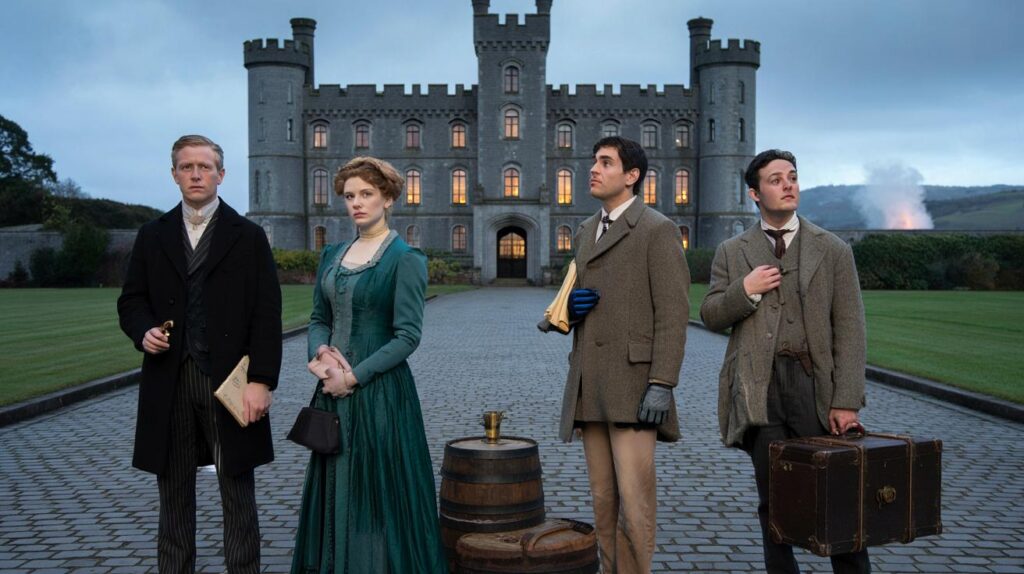
A lavish new period saga has quietly reshaped corners of Wales and England, swapping centuries with painstaking craft and nerve.
Penrhyn Castle, a neo-Norman landmark on the edge of Bangor, has been recast as the Guinness family home in Netflix’s House of Guinness, a sweeping 1860s drama spanning Dublin and New York.
A Welsh stand-in for an Irish legend
The production has chosen Penrhyn Castle to portray Ashford Castle, the storied country residence tied to the Guinness dynasty. The choice feels apt. Penrhyn, completed in 1840 for the Pennant family, was designed to look much older than its years, echoing the show’s themes of heritage, image and power. Ashford Castle itself was expanded by Sir Benjamin Guinness after he purchased it in 1852, making the Welsh location a convincing proxy for a home shaped by brewing wealth and Victorian ambition.
Although the plot lives mostly in Ireland, the cameras spent their time in north Wales and the north-west of England. Modern Dublin simply no longer resembles the city of 1868, the year the story begins with Sir Benjamin’s death and a contested legacy that ripples through his four adult children—Arthur, Edward, Anne and Ben—and across an empire renowned for stout, philanthropy and fierce family loyalties.
Penrhyn Castle doubles as Ashford Castle, anchoring a high-stakes family saga of wealth, rivalry and legacy set in 1868.
Why Dublin moved to the north west
Location scouts criss-crossed Ireland and Britain before landing on a practical solution: stitch together the period on screen with a patchwork of stately homes and Victorian streets. Manchester and Liverpool supplied urban backdrops; north Wales and Yorkshire contributed grandeur and texture. The result is a believable nineteenth-century Dublin and an atmospheric Irish country seat—without demanding a time machine.
- Penrhyn Castle (Bangor, Gwynedd) — sumptuous interiors and exteriors for the Guinness family home.
- Manchester — terraces and civic streets with strong nineteenth-century bones.
- Liverpool — mercantile architecture and dockside grit suited to industrial-era scenes.
- Yorkshire — additional rural and estate settings to round out the period world.
Eight episodes land on Netflix from 25 September, led by James Norton and created by Peaky Blinders’ Steven Knight.
The story: four heirs, one will, and a brewery empire
House of Guinness begins at the moment that defines fortune and fracture: the reading of Sir Benjamin’s will in 1868. His decisions set his children on diverging paths through boardrooms, drawing rooms and streets alive with opportunity and unrest. Dublin’s growing pains, New York’s immigrant surge and a brewery’s global rise all press in on the family, whose influence stretches well beyond barrels and balance sheets.
James Norton fronts a cast tasked with balancing the glamour of privilege against the compromises of power. Steven Knight, known for his sharp sense of industrial-era tension, shapes the narrative around the pressures that turn private disputes into public drama. Expect politics and piety to clash with romance and reinvention, as a famous name is tested in full view of a changing world.
Penrhyn’s layered past meets on-screen fiction
Penrhyn Castle is more than a picture-perfect façade. Built from slate wealth and designed in a revivalist style, it wears its contradictions openly: a nineteenth-century house masquerading as medieval stronghold. The site’s history includes stories of labour, prosperity and protest—echoes that resonate with a drama preoccupied with status, inequality and the costs of expansion. The production’s decision to film here subtly ties the family’s on-screen struggles to real histories of power in Wales and Ireland.
| On screen | Real-life location | What viewers see |
|---|---|---|
| Ashford Castle, Guinness family seat | Penrhyn Castle, Bangor | Grand halls, crenellations and neo-Norman detail standing in for Victorian opulence |
| Nineteenth-century Dublin streets | Manchester and Liverpool | Brick terraces, civic squares and industrial-era avenues reborn as the Irish capital |
| Irish rural backdrops | Yorkshire and north Wales | Rolling estates and gardens framing the family’s private intrigues |
What to watch for when you press play
Sharp-eyed viewers will notice how the production uses architecture to tell the story. Neo-Norman arches at Penrhyn signal permanence; candlelit corridors hint at secrecy. City sequences cut to wider views that sell the period without drowning scenes in nostalgia. Costume and set design work closely with the locations, letting polished wood, slate-grey stone and gaslight warmth carry mood from scene to scene.
- Count the subtle cues: four heirs appear in distinct settings that mirror their ambitions.
- Look for brewery iconography woven into décor, from ledgers to barrels and brass fittings.
- Watch how New York scenes shift pace, underscoring the magnetism—and menace—of transatlantic prospects.
- Note the contrast between public rooms and private chambers inside the “Guinness” home; status versus vulnerability.
When and how to watch
The series runs to eight parts and arrives on Netflix on 25 September. It is positioned for a global audience but keeps a distinctly Irish and British sensibility, letting the geography drive character rather than the other way round. Expect weekly conversation-starters: money versus morality, heritage versus progress, and how families manage fame that outlives them.
From 25 September, eight chapters chart the Guinness dynasty’s most testing hour—across Dublin parlours and Welsh stone.
Visiting Penrhyn Castle after the credits
Penrhyn Castle is cared for by National Trust Cymru and sits a short drive from Bangor. Many rooms open to the public, including lavish interiors and collections that speak to travel, trade and status in the nineteenth century. Not every space that appears on screen will look identical; film crews often reshape rooms with temporary dressing. The pleasure lies in spotting the bones: staircases, arches and views that anchor the drama.
- Check seasonal opening hours before you set off and allow time for gardens and grounds.
- Photography rules can vary by room; signs at entrances usually state restrictions.
- If you’re keen to match scenes, start with the great hall and principal stair, then work outward.
Screen tourism: benefits, pressures and timing your trip
Productions like House of Guinness tend to lift local economies. Location fees support conservation; visitor numbers climb; cafés and B&Bs feel the ripple. Crowds can follow, especially around release dates. If you prefer a quieter wander, consider weekday mornings outside school holidays. Heritage properties balance access with preservation, so patient pacing helps both visitors and fragile interiors.
Keen to deepen the experience? Pair Penrhyn with nearby strongholds such as Conwy or Caernarfon to compare medieval originals with revivalist grandeur. You could also map the Guinness thread back to Ireland by reading up on Ashford Castle’s nineteenth-century expansion under Sir Benjamin. The contrast between an Irish estate’s evolution and a Welsh industrial fortune’s showpiece gives sharper context to the series’ central dilemma: how families wield wealth—at home, in business and before the public eye.



Can’t wait to see Penrhyn doubling as Ashford—Victorian ambition and family drama is my catnip. Steven Knight + James Norton is a killer combo.
So we’re pretending Manchester and Liverpool are Dublin again? If the accents slip and the streets look too clean, it’ll break the spell realy quick.