
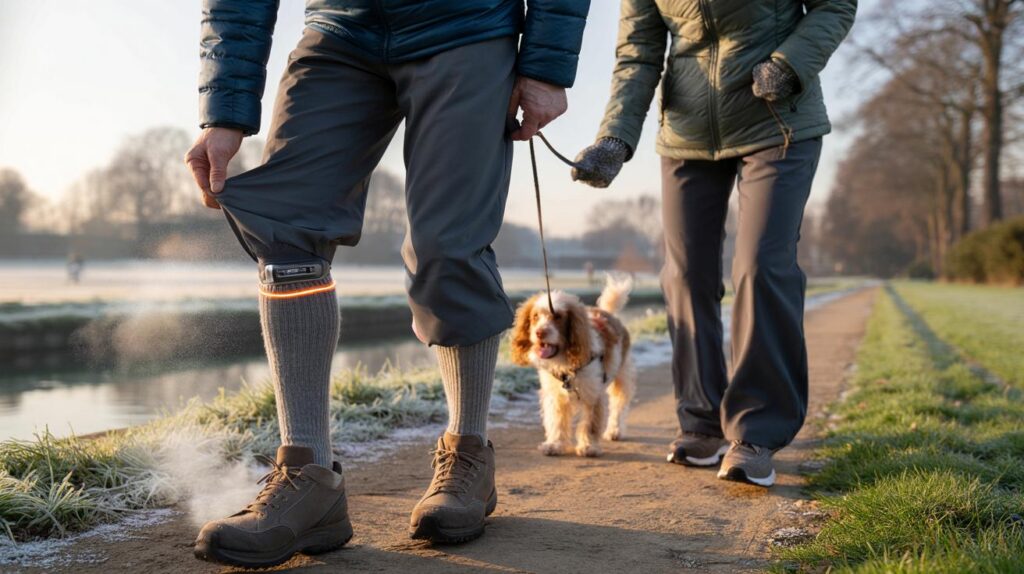
Cold creeps up from the ground. It swallows ankles first, nudges knees, and suddenly a brisk walk becomes a battle with numb toes and stiff joints. For active seniors, that quiet ambush can decide whether you step outside or stay in. Winter 2025/26 is shaping up colder, windier, and a bit wetter. The kit is better too. The question isn’t whether warmth exists — it’s how to keep it where you move.
The frost was still crisp on the grass when Bryan, 71, clipped a small battery pack to his sock cuff in the park car park. Dog lead on one wrist, coffee in the other, he laughed at the tiny glow on his ankle like it was a secret he’d been keeping from winter. His legs were wrapped in lined trousers that didn’t swish, and the wind slid off them like rain off slate. A spaniel yelped, and Bryan set off, a cautious first minute turning into an easy stride. The hum in his toes stayed steady, the pavements didn’t feel as hostile, and he didn’t glance back at the car. The battery light blinked, and he grinned at me like it was a magic trick. There was more to it than heat.
Warm legs and feet change everything
Mobility in the cold isn’t just about temperature; it’s confidence. When your calves and feet feel protected, pace loosens, steps lengthen, and you commit to the next mile instead of calculating the shortcut home. **Thermal trousers** build a microclimate around your thighs and knees, tamping down wind and evaporative chill so your muscles stay supple. **Heated socks** bring the heat right to the stubborn bit — toes that usually go first. The result isn’t dramatic on paper. On pavements, it’s the difference between pausing and pushing on.
Ask Maureen, 68, who started a couch-to-5k programme last winter and abandoned it by January. This year, she pulled on softshell-lined trousers with a high waist and a pair of midweight heated socks set to low. She covered three kilometres at talking pace, and her stride didn’t change when the canal path turned to shade. Her feet stayed warm without the damp, and her knees didn’t seize on the downhill. “It felt like cheating,” she said, not sorry at all. We’ve all had that moment when your toes go numb halfway through a short walk and the rest of the day shrinks.
There’s a logic to this. Heat loss on the move comes from wind stripping moisture, ground sucking warmth, and tight clothing throttling circulation. Good winter trousers block gusts on the front of the thigh and let sweat escape through the back. A brushed inner traps tiny pockets of air, which your body warms fast. Socks with heating filaments over or under the toes maintain a steady baseline, so your arteries don’t clamp down. Keep the heat gentle and steady. Hot blasts invite sweat, sweat invites chill, and the cycle starts again.
What to look for in 2025/26 trousers and socks
Start with fit you can forget. Sit down, stand up, and do a few knee lifts in the shop or at home; trousers should move without tugging. Look for articulated knees, a soft waistband that sits at or just above the belly button, and zip pockets you can open with gloves. A wind-resistant front panel is gold in an easterly. For fabric, softshell or fleece-lined stretch blends hit the sweet spot for daily walks, while merino baselayers under lighter shells suit stop-start days. On the socks side, target 7.4V systems with a gentle toe heat pattern and a thin, merino-rich knit. **Battery life** of 6–10 hours on low is the realistic sweet spot for winter 2025/26.
Common mistakes creep in quietly. People size down “for warmth” and strangle blood flow, or crank heat to high, sweat, then get cold faster. Choose socks that feel like a normal winter weight; bulk isn’t warmth, it’s friction. Don’t bury trousers inside narrow boots and create a cold bridge; let them fall clean, or use a soft gaiter. Washing matters too: cool cycle, wash bag, no tumble dry for anything with wires. Let’s be honest: nobody actually does that every day. Build habits you’ll keep — charge batteries where you charge your phone, and put socks to air the minute you’re back.
There’s a new generation of winter tech that helps without fuss. Bluetooth controls are handy for arthritic hands, USB‑C charging makes spares simpler, and several brands are using recycled shells without making trousers crinkly.
“Think comfort first, heat second,” says Anna Childs, a community physio who walks five miles most mornings before clinic. “If the garment moves well, your circulation will do more of the work for you.”
- Look for toe‑focused heat zones and flat, taped seams.
- Pick trousers with 200–300 gsm brushed linings and a DWR finish to shrug off drizzle.
- Choose batteries rated for low temperatures and a low setting you genuinely like.
- Pair thin heated socks with roomy winter shoes; tight shoes cancel the benefit.
- For icy days, add lightweight microspikes rather than a heavier trouser.
The models we rate, and the rhythm that keeps you outside
Brands have upped their game for winter 2025/26. You’ll see windproof-front softshell trousers from outdoor names like Rohan and Craghoppers that don’t scream “technical” at the café. You’ll see merino-blend heated socks from Therm‑ic and Lenz with app controls you can ignore, and budget-friendly Heat Holders for those who want warmth without wires. Some trousers add fleecy inner patches over knees and hips, which quietly protects the places that grumble first. The trick isn’t buying the most advanced kit; it’s finding the kit that disappears once you’re moving.
One practical pairing works across most British winters. A merino base under a light, lined trouser for dry days. A heavier softshell with a windproof panel for gusty ones. A midweight **heated socks** set on low keeps toes cheerful without cooking them, and a second battery in your pocket extends a day out. *Some days, warmth is the difference between going out and staying in.* That’s not hype; that’s the tug of a front door that opens more easily when your clothing is doing its quiet job.
When seniors talk about winter, they talk about independence. A walk with the dog when frost clings, a bus to the market when the wind cuts, a Saturday parkrun you don’t bail on because your toes gave up. This season’s trousers and socks aren’t gadgets chasing novelty. They’re simple, wearable tools that move the dial on daily life. The best pair is the one you forget you’re wearing until you realise you stayed out longer, turned toward the hill instead of away from it, and came home with a flush in your cheeks rather than a sting in your toes.
| Key points | Details | Interest for reader |
|---|---|---|
| Fit and circulation | Articulated knees, soft high waist, roomy footwear; avoid tight cuffs and sock bulk | Warmth comes from movement and blood flow, not just insulation |
| Fabric and heat pattern | Windproof-front softshell, 200–300 gsm brushed linings; toe‑focused heating zones | Blocks the wind where it bites; warms toes without sweaty arches |
| Power and practicality | 7.4V batteries, USB‑C charging, 6–10 hours on low; app control optional | All‑day comfort on real winter schedules with simple charging at home |
FAQ :
- Are heated socks safe for people with reduced sensation or circulation issues?If you live with neuropathy, Raynaud’s, or use a pacemaker, speak to your GP before using any heated garment. Keep heat low and steady, check skin regularly, and stop if anything feels odd.
- How long do batteries actually last in the cold?On low, quality 7.4V packs usually give 6–10 hours at a British winter pace. Expect shorter run time in sub‑zero wind and as batteries age. Carry a spare for day‑long outings.
- How do I wash heated socks without breaking them?Remove batteries, use a cool cycle and a wash bag, mild detergent, no fabric softener, no tumble dry. Lay flat to dry. For trousers, follow the care label and refresh the water‑repellent finish occasionally.
- What kind of thermal trousers work for urban walks versus hill paths?For town days, go for lined stretch trousers with a neat cut and windproof front. For breezier paths, choose a beefier softshell with a brushed inner and ankle cinches to block drafts.
- Can I travel with heated socks and spare batteries?Yes. Put lithium batteries in your carry‑on, not checked luggage, and cap terminals if possible. Socks and trousers themselves can go anywhere; just remove the packs for security.



Took your advice—merino base + windproof‑front softshell + Lenz socks on low—and my 5k dog walk stopped feeling like a negotiation with my toes. Battery lasted 7.5h at 3°C, which is plenty. Only gripe: the high waist on Rohan runs big; size down? Otherwise, defintely a fab write‑up, cheers.
For those of us with Raynaud’s: would you still start on low, or is a 10–15 min medium “pre‑warm” sensible before dropping down? I worry about sweating then freezing, like you said. Any data on skin temps with 7.4V sets vs 5V power‑bank socks?