
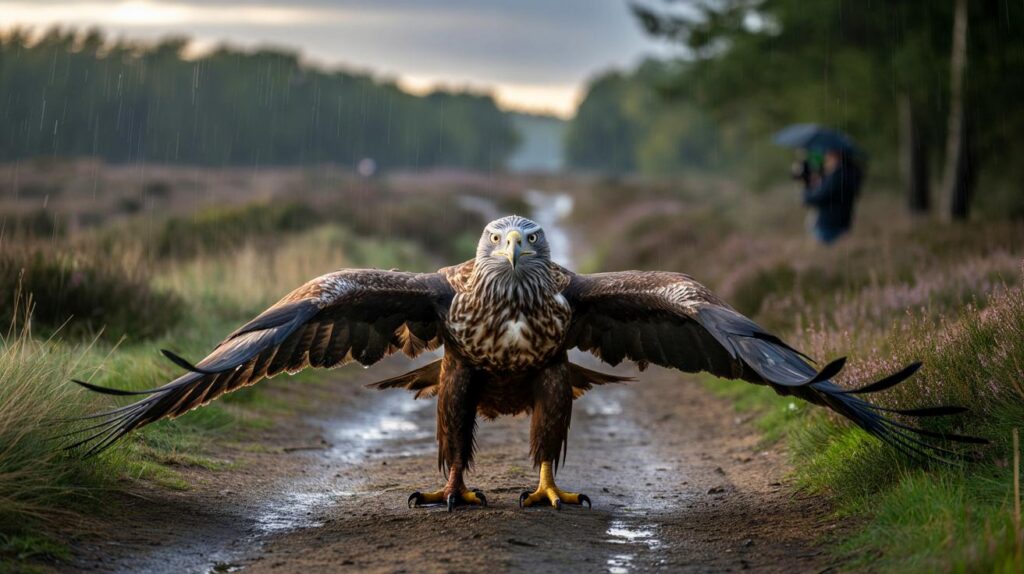
Rain beat down on Hampshire pine and heath as visitors glanced up, momentarily unsure what silhouette owned the sky above.
As a brief shower swept Liberty’s Owl, Raptor and Reptile Centre near Ringwood, a juvenile white-tailed eagle powered across the arena, unfazed by the weather and watched by photographers who ducked under trees for cover before sunshine returned minutes later.
Rain, wings and a sudden clearing
Weekend forecasts promised an all-day soaking in the New Forest. Instead, a single squall pushed through, then melted away. During that five-minute burst, cameras tracked a white-tailed eagle at full stretch. Its wings looked almost rectangular as it drove forward. The rain streaked past; the bird held level.
The shot that stopped people talking was the head‑on view. A broad, yellow beak filled the frame. Eyes locked to the lens. Water beaded on contour feathers. Ten minutes after the shower, the light broke, bright and clean, and the bird circled once more.
With a wingspan that can reach around 2.5 metres, the white‑tailed eagle is Britain’s largest bird of prey.
Meet the white-tailed eagle
Sometimes called the sea eagle, this species sits at the top of the coastal food chain. It favours estuaries, tidal waters and large lakes. Fish rank high on the menu, taken with a steep, controlled descent and talons pitched forward. Carrion supplements the diet, and the bird will lift hares, rabbits and waterbirds when the chance arises.
Adult birds show a bright white tail and a pale head. Juveniles look darker, with mottled tail feathers, but carry the same bulk and long, board‑like wings.
- Wing shape: long and broad, held flat in level flight rather than in a shallow “V”.
- Bill: chunky, hooked and yellow; large even at a distance.
- Feet: yellow with powerful talons, visible when the bird turns or prepares to land.
- Tail: white in adults; dark and patchy in juveniles, squarer than a kite’s.
- Flight style: steady wingbeats, long glides, low over water or high over open country.
Schedule 1 protection applies to white‑tailed eagles in the UK: disturbing nest sites or dependant birds is a criminal offence.
From extinction to a careful return
White‑tailed eagles once nested across southern England. Persecution and habitat loss swept them away by the early 1900s. After more than two centuries without an English‑born chick, a structured reintroduction began on the Isle of Wight in 2019, led by the Roy Dennis Wildlife Foundation with Forestry England.
Tagging data shows the young eagles range widely. They wander along the Solent, over the New Forest, and along the Dorset and Sussex coasts, then back to the island. They can cover dozens of miles in a single day when conditions suit, so sightings rise and fall with wind and food.
In 2020, a pair from the Isle of Wight releases raised a male chick — the first born in England since 1780.
Where you might see one
Watch tidal rivers, estuaries and reservoirs on bright, breezy days. Scan from elevated ground and give yourself time; these birds often drift in and out of view. The New Forest’s open heaths and nearby harbours can produce short, dramatic passes, then nothing for an hour. Patience pays.
Liberty’s Owl, Raptor and Reptile Centre in Ringwood houses several impressive species for demonstrations and education, including an Alaskan bald eagle, a peregrine falcon and a white‑headed vulture. Staff schedule flying displays around the weather, so brief showers can produce striking moments for visitors and photographers alike.
White-tailed versus golden eagle
Golden eagles remain largely confined to the Scottish Highlands. Both species are immense, but their shapes, tails and habits differ in ways you can pick out with binoculars:
| Feature | White‑tailed eagle | Golden eagle |
|---|---|---|
| Wingspan | Up to about 2.5 m, long and rectangular | Up to about 2.3 m, slightly narrower |
| Tail | Adult tail bright white; juvenile tail dark and mottled | Brown tail with greyish banding; no white panel |
| Flight posture | Wings held flat in level flight | Wings often in a shallow “V” (dihedral) |
| Typical haunts | Coasts, estuaries, large lakes, lowland heaths | Upland glens, crags, open moor in the Highlands |
| Favoured prey | Fish, waterbirds, rabbits, hares, carrion | Grouse, mountain hare, rabbits, carrion |
Responsible watching and photography
These eagles attract crowds. Good fieldcraft protects the birds and improves your view. Distance matters, especially in the breeding season, and the law takes a firm line on disturbance near nests or dependent young.
- Keep at least 100 metres from resting birds; more if the bird is alert or repeatedly looking your way.
- Stay on paths and open ground; avoid lingering near tall pines or cliffs that could hold a nest.
- Use binoculars or a long lens rather than moving closer; never bait or flush a bird to prompt action.
- Control dogs on leads in open country and around waterbirds.
- Licences are required for any work near nest sites; recreational visits should not approach them.
White‑tailed eagles are schedule 1 birds: keep your distance, plan your vantage point and let the bird make the choices.
Why rain helped the pictures sing
Brief showers can sharpen a scene. Rain darkens backgrounds and lifts contrast around a pale head and yellow bill. Water droplets catch the light on feathers after a squall. When sun breaks through behind a retreating cloud bank, the light turns crisp and directional. Photographers who ride out the weather often get the cleanest results in the ten minutes that follow.
If you try for your own shots, set a faster shutter speed than usual to freeze both wingbeat and rain streaks. Use continuous autofocus and anticipate the turn into the wind, when the bird slows and presents a head‑on view. Shelter yourself first; equipment survives only when you do.
What this sighting tells you about the New Forest right now
Large raptors signal healthy corridors of habitat. The New Forest sits astride a route between the Isle of Wight and the Hampshire Avon, with heath, pasture and water. Short, surprise appearances fit a roaming species that feeds where conditions look best. A five‑minute window can be enough.
If you want to improve your chances, think like a sea eagle. Check tides for exposed fish near estuary mouths. Use wind direction to choose a vantage point where a bird will face you on approach. Scan for gull alarms; they often find a giant long before people do.
Safety, context and a wider picture
White‑tailed eagles remain few in southern England. Each individual matters to a long‑term project built to last. Centres that keep trained birds offer close views without risk to wild nests, and they support public understanding alongside the small but growing number of wild birds commuting over the Solent. That mix of managed encounters and careful fieldwatching helps people see what returned to our skies after more than two centuries away.
Expect more reports in coming months as young birds range widely, then settle. Some will fail; some will pair. The story advances in increments measured in seasons, not weeks. For many, a single pass in the rain will be enough to remember why the effort continues.



That head‑on shot with the beak filling the frame gave me chills—rain streaks and all. Defintely bookmarking this for the next squall.
Quick Q: was this the juvenile from Liberty’s flying display, or a tagged Isle of Wight bird ranging through? The “arena” mention suggests the former, but the title reads like a wild encounter.