
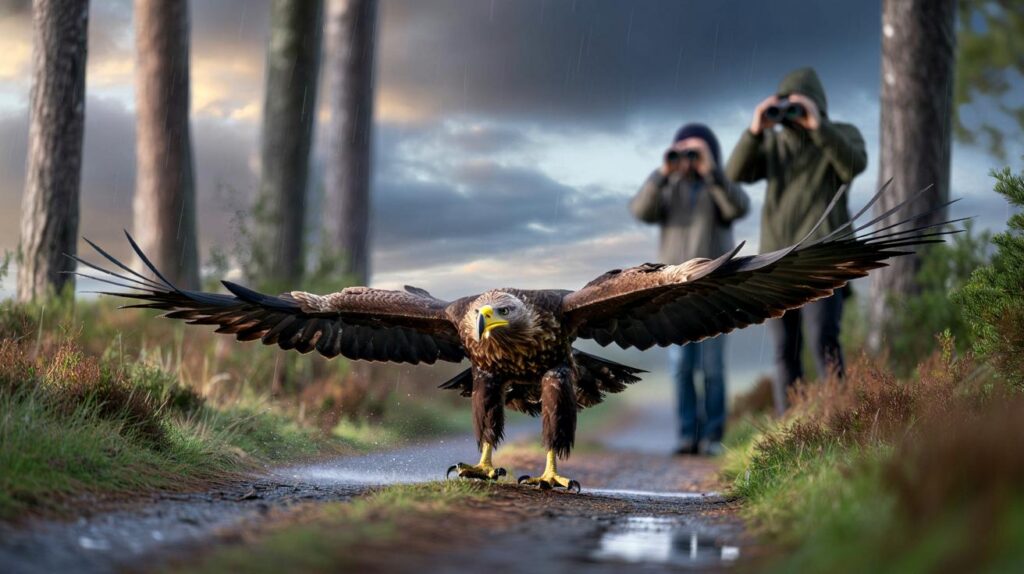
Rain stitched silver threads across the pines as a vast silhouette cut the sky above Ringwood, startling even seasoned birders.
During a brief squall at Liberty’s Owl, Raptor and Reptile Centre, a juvenile white-tailed eagle powered through the weather and straight into a camera’s frame. The shower lasted minutes; the spectacle lingered. The scene offered a rare, close look at Britain’s largest bird of prey in testing light and wind.
Rain, wings and a split-second frame
Forecasts warned of a soggy day, yet the weather blinked. A five-minute burst drenched the arena. Then the clouds parted and shafts of sun returned. Amid that mood swing, Daily Echo Camera Club member Miles Herbert raised his lens and caught the moment the eagle held itself at full span.
The bird did not flinch. The audience did. Some ducked for cover beneath trees. Others stood, riveted by the sheer breadth above them and the yellow glare of a hooked beak arrowing toward the glass.
Across the downpour, a 2.5-metre spread held steady, the primaries splayed like fingers combing rain.
Herbert’s image captured more than a pose. It showed how these eagles hold their wings almost ruler-flat in level flight, a clue that often separates them from other large raptors when seconds count.
Meet the white-tailed eagle
This species wears its name boldly. Adult birds show a stark white tail, a heavy yellow beak and bright yellow feet. Even juveniles project heft and confidence. In the air, the wings look almost rectangular, and the bird cruises low and wide, scanning water and shore for chances.
Unlike the golden eagle, the white-tailed eagle frequently hunts fish. When the sea offers a target, it drops with talons outstretched and lifts off with a writhing catch. The menu runs broad on land too, with hares, rabbits and other birds taken when opportunity knocks.
Field marks you can trust
- Big, blocky wings kept flat in flight rather than in a deep V.
- Chunky yellow beak; bright yellow feet that stand out against dark plumage.
- White tail on adults; younger birds show a mottled tail before it turns clean white.
- Rectangular silhouette, especially obvious when the bird banks or glides.
How it differs from a golden eagle
Confusion creeps in at distance. Two tips help. The white-tailed eagle targets fish and shorelines far more often, and it presents a flatter, more slab-like wing profile. Golden eagles, by contrast, show longer, narrower wings and rarely fish in coastal dives in England.
From vanishing act to a measured return
White-tailed eagles once filled southern English skies. The 1900s changed that. Illegal persecution and human pressure erased them from the region. The void stood for generations, and the species slipped from local memory.
Work began to reverse that loss in 2019. The Roy Dennis Wildlife Foundation and Forestry England launched a five-year reintroduction on the Isle of Wight, with young birds released to establish a breeding foothold. Results followed.
| Year | Milestone |
|---|---|
| 1780 | Last known white-tailed eagle chick previously recorded in England |
| 2019 | Reintroduction project began on the Isle of Wight |
| 2020 | Two released birds paired and later reared a male chick |
A chick hatched to released birds marked the first confirmed birth in England since 1780, a hinge moment for the species.
Since then, sightings across the Solent and the New Forest have become a talking point for walkers and photographers. The birds range widely, so a glimpse in Hampshire can follow a morning over the Isle of Wight or Dorset shores. Patience helps; so does looking up.
What you need to know before you look up
These eagles sit under Schedule 1 protection. Disturbing them is illegal, including at or near nest sites. Respect for distance is not just courtesy; it is the law. That applies whether you carry a camera, binoculars or nothing more than curiosity.
Keep well back, avoid flushing birds, and never share precise nest locations in public.
If you plan a visit to the New Forest or coastal paths, pick a vantage point with space. Bring a map and mark likely lines of flight over estuaries or lakes. If you spot an eagle, let it be the one to close the gap. Do not walk toward it or hover beneath a perch.
Quick kit checklist for a rainy encounter
- Binoculars or a telephoto lens with weather sealing or a rain cover.
- A lens cloth for wiping spray and drizzle from the front element.
- Neutral clothing to reduce glare and movement cues.
- A simple note of the time and place to log your sighting responsibly.
Behind the fence at Ringwood’s raptor centre
Liberty’s Owl, Raptor and Reptile Centre offers controlled views that help visitors learn the basics of raptor shape and behaviour. Alongside the white-tailed eagle, the roster includes an Alaskan bald eagle, a peregrine falcon and a white-headed vulture. Each bird demonstrates different wing shapes, flight styles and feeding techniques.
For photographers, a short shower can be a gift. Rain darkens backgrounds, deepens plumage tones and etches droplets into the air. The challenge is focus. Keep shutter speeds high, pre-focus where the bird will pass, and let the rain tell the story rather than fighting it. Ten minutes after the burst, sun may return and transform the same scene.
Why this sighting matters to you
Encounters like this change how people feel about local wild spaces. A giant silhouette over the pines turns a routine walk into a shared moment. It reminds families that the coast and forest hold living history, revived through patient conservation and public restraint.
If you spend a day in the New Forest, set realistic hopes. You might not see an eagle. You may catch a distant speck that becomes a rectangle on the wing. Learn the signs, enjoy other raptors you meet, and give any eagle the space it needs to thrive. With time, more young birds should settle, and chances of a confident, close view will grow.
Extra context that helps
- Risk: approaching too close can cause nest failure; offences can bring fines and criminal records.
- Advantage: watching from a respectful distance often leads to more natural behaviour and better photographs.
- Related activity: try sea-watching from safe coastal headlands for low, level eagle passes on calm days.
- Seasonal note: young birds roam widely after fledging, so autumn often brings surprise flyovers inland.
If rain sets in, do not pack up too fast. Large raptors use breaks between squalls to move and feed. Stand back, keep your kit dry, and let the weather do the drama. The next gust might carry a 2.5-metre story right over your head.



Absolutely electric writing—I could almost feel the rain pricking the lens. Was this juvenile from the Isle of Wight cohort? I’m curious how often they range over Ringwood after squalls. Also, the ‘ruler-flat wings’ tip is definitley gold.
Cool piece, but the headline feels a tad clickbaity—’skim past you’ at a display isn’t the same as a truly wild flyby, is it? Still, kudos for stressing Schedule 1; too many folks crowd nests.