
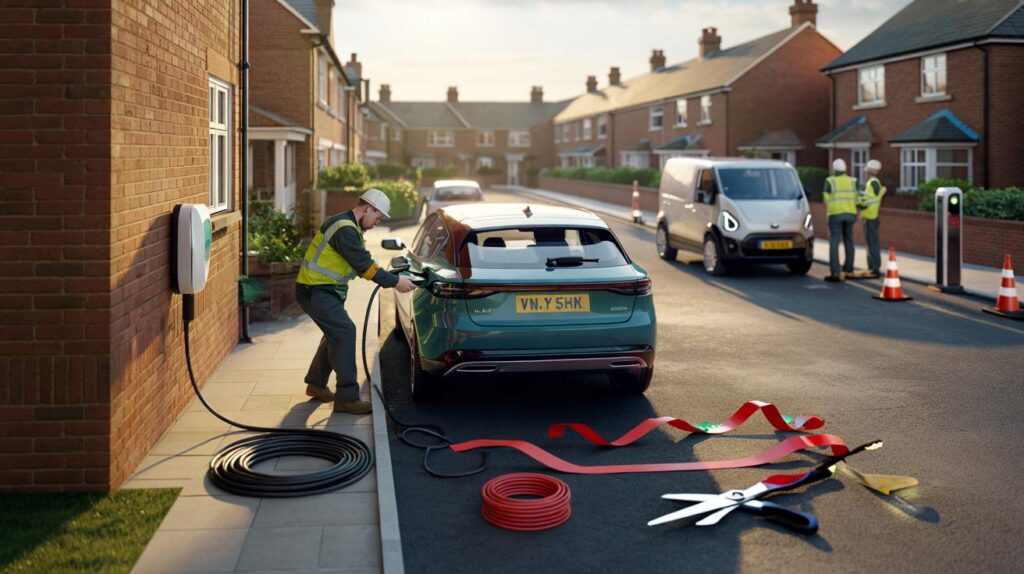
A small policy change could reshape daily charging habits, shave delays for households and firms, and nudge drivers toward electric.
England has scrapped a key layer of paperwork for home and workplace chargepoints, cutting delays and smoothing the road to electric motoring for millions. The shift applies to private driveways, business premises and selected street locations, and it arrives with fresh investment and ambitious targets for public charging.
What has changed
Drivers and businesses in England no longer need planning permission to install most electric vehicle chargers. The Department for Transport confirmed the change after ministers promised to reduce red tape that had been slowing installations across the country.
In practical terms, this means a homeowner with a driveway can book an installer and proceed without waiting for council consent. Workplaces can add bays for staff or fleets more quickly. Councils and operators can expand networks on public land without lengthy planning timetables.
No planning permission is required for most EV chargepoints on private driveways and workplaces across England.
Previously, public charging projects could spend up to nine months stuck in planning queues. Removing that hurdle should accelerate roll-outs, particularly in places where the switch to electric had been held back by slow approvals.
The change supports wider policy. Ministers have said the sale of new petrol and diesel cars and vans will cease in 2030. A National Audit Office assessment reported the deployment of public chargers is on track to reach 300,000 units by 2030, the level officials consider a minimum for national needs.
Why it matters to you
The new rule lands with tangible, day-to-day benefits for different groups.
- Homeowners with a driveway: faster installation, fewer forms, and the option to align fitting with home energy tariffs.
- Drivers without off-street parking: quicker growth of kerbside and public hubs, reducing range anxiety.
- Businesses and fleets: easier expansion of on-site charging to support staff vehicles and electrified vans.
- Installers and operators: fewer administrative bottlenecks and lower pre-build costs.
The before-and-after at a glance
| Aspect | Before | Now |
|---|---|---|
| Planning permission | Often required, case-by-case | Generally not required for chargepoints |
| Time to proceed | Public projects could face up to 9 months’ delay | Streamlined, with paperwork trimmed |
| Scope | Driveways, workplaces and streets subject to local approval | Driveways, workplaces and many streets eased under national rules |
| Public charger target | Growing network | On track for 300,000 by 2030 |
| Government support | Programmes in place | Backed by over £2.3bn for the transition |
The remaining hurdles
Policy alone won’t complete the job. Industry voices say the most stubborn barrier is grid connection. Even when planning is straightforward, some sites wait for capacity upgrades or new substations before switches can be flicked on. That friction is most acute in rural communities and on urban streets where demand has spiked.
Cost is the other sticking point. The gap between home tariffs and public rapid-charging rates can be wide, and it shapes driver behaviour. Lower wholesale electricity costs, smarter pricing, and competition among networks will influence uptake as much as planning reform.
Grid connections and the price of public charging remain the two pressure points that could slow progress.
What this means for your driveway
If you own a home with off-street parking, the process becomes simpler and faster. That doesn’t remove the need for safe installation and sensible choices. A qualified installer will assess your supply, earthing, cable runs and charger location to keep people and property safe.
- Check your electricity supply: installers can confirm capacity and whether upgrades or load management are required.
- Pick a charger location: minimise trailing cables and keep access clear of footpaths and public rights of way.
- Consider smart functionality: load balancing, scheduled charging and energy monitoring can trim bills and ease grid demand.
- Plan for future vehicles: choose connectors and power ratings that suit present and likely future needs.
- Notify where required: installers typically handle any distribution network notifications after fitting.
National planning relief applies widely, but legal exceptions can still exist in heritage settings or locations with specific safety constraints. If your property is listed, in a conservation area, or subject to unusual covenants, ask your installer to confirm any extra consents.
No driveway? here’s what changes for you
For households that park on-street, the rule change helps councils and private networks add kerbside units and rapid hubs more quickly. That reduces reliance on distant chargers and makes ownership more feasible without off-street parking. The goal is to shift charging from “special trip” to “everyday convenience” as bays appear closer to homes and workplaces.
Business impact and fleet planning
Companies gain from the same easing. Without a planning pause, firms can fit bays for employees, customers and delivery vans on predictable timelines. That supports fleet electrification and cuts time idling off-site to top up. For logistics operators, installing charging at depots allows predictable overnight charging, fewer fuel stops and tighter route planning.
Network operators also benefit. If substations and related electrical infrastructure no longer require routine planning approval across most sites, the entire programme from design to commissioning compresses. That helps meet the 300,000-charger milestone and spreads coverage to areas that have lagged.
How to weigh your costs and savings
The headline benefit of a home unit is control. You can schedule charging outside peak hours and track consumption precisely. To gauge your potential savings, compare your electricity tariff with the rates typically posted by rapid-charging networks you use. Multiply the rate (per kWh) by your car’s usable battery capacity or expected kWh per 100 miles to estimate trip costs. The comparison will show where home top-ups versus rapid hubs make financial sense for your pattern of driving.
Some households pair charging with time-of-use tariffs to concentrate charging during cheaper windows. Others prioritise reliability: topping up little and often at home, using public rapids only for long journeys. Businesses can run similar exercises across their fleet to set charging policies and driver allowances.
What to watch next
Keep an eye on grid connection reforms, which affect how quickly new sites can go live. Pricing transparency at public chargers will also shape day-to-day behaviour, especially for drivers without off-street parking. As more hubs open, competition and utilisation should put downward pressure on costs.
If you are planning an installation, ask for an on-site survey, a clear quotation and confirmation of who handles notifications to the network operator. For unusual properties or shared driveways, request written confirmation that your installation fits the current national planning rules. That will keep your project moving under the new regime without surprises.



Great move—slashing nine-month waits will help households and fleets. Quick Q: do listed buildings or conservation areas still require seperate approval, or is everything covered now? My council’s guidance is… vague.
No permission is great, but grid capacity remains the chokepoint. Even with £2.3bn backing, if DNO upgrades take 12–18 months, we’ve only moved the bottleneck downstream. Any timeline reforms for connections?