
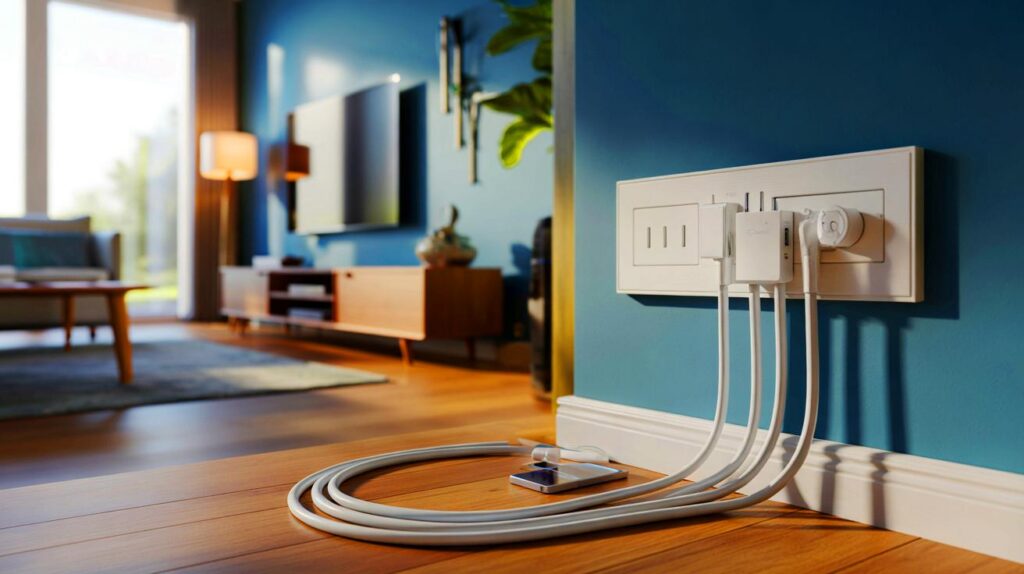
Cables snake under sofas, sockets hide behind skirting, and rental rules loom. A quiet hardware shift is tidying everyday life.
Across older flats, rented homes and improvised home offices, the hunt is on for safe power without dust, damage or delays. A new breed of surface-mounted sockets is stepping in with neat trunking, modular boxes and real numbers that help households cut clutter while staying within load limits.
What is a surface-mounted socket system
It is a set of low-profile boxes and tidy trunking that sits on the surface of a wall, ceiling beam or skirting. The cable runs in a slim moulding that follows the route you plan. You do not chase into plaster. You avoid rubble and mess. You can add a power point exactly where you need it and keep floors clear.
The modules replace floor power strips that overheat behind TV units. Child shutters, on-off rockers and even surge protection live in the same compact body. Finishes range from matte white to brushed metal and warm wood effects, which helps the run blend with joinery rather than shout from the wall.
Surface-mounted means no chasing, no dust, and no landlord disputes about damaged walls. The route is visible, the result is clean.
Why homes are ditching power strips
- Heat and overload risks rise when several adaptors crowd a single multiplug on carpet.
- Trips and tangles lurk under desks; cleaning becomes a chore and cables fray faster.
- Access is awkward behind media units, so people yank cords and loosen contacts.
- Child safety improves when sockets move up the wall and get shutters and switches.
- Layout changes become easy because modules unclip, shift and extend without redecorating.
Safety and compliance in plain numbers
Manufacturers now publish simple sizing rules that mirror established standards. Under the French NF C 15 100 framework, a 1.5 mm² radial circuit protected at 16 A supports up to eight sockets. A 2.5 mm² circuit at 20 A supports up to twelve sockets. Those figures curb overload and help plan future additions. Earthing and residual-current protection complete the picture.
If you extend an existing circuit, verify spare capacity at the consumer unit. In the UK, never extend a ring final circuit casually; use a fused connection unit for a spur or ask a qualified electrician to assess the ring balance. In rented homes, check your tenancy for approval requirements before any fixings.
Plan for 8 sockets on 1.5 mm² at 16 A, or 12 sockets on 2.5 mm² at 20 A. Confirm earth continuity and RCD protection.
Features that matter now: fast charging, surge defence, wireless control
Recent kits go beyond a plain twin outlet. Many add USB-C ports that deliver 20–30 W for phones and small tablets without a separate brick. Others integrate a surge protector to shield TVs, consoles and routers from spikes. In a home office or media corner, a multi-gang wall block gathers everything at chest height and removes cable spaghetti from the floor.
Another shift is control without new wiring. Wireless wall switches stick where you want them and command smart plugs or relays in the same channel. For garages, sheds and damp zones, weatherproof modules with robust gaskets keep moisture out and buttons grippy with gloves. Modular faceplates keep the system flexible, so you swap a plain outlet for a charger or a dimmer as habits change.
Where it shines
- Home office: raise sockets above the desk, add two USB-C ports and a master switch for monitors.
- Media wall: a three- or four-gang block behind the TV bracket with built‑in surge protection.
- Kitchen splashback: a surface strip with angled outlets to keep cables away from spills.
- Loft or beam: trunking follows timber, keeping drill depth shallow where wires and insulation sit.
- Garage or utility: splash‑resistant enclosures for chargers, tools and a dehumidifier.
- Rental: adhesive-mounted trunking with minimal screw holes at end points to protect deposits.
Typical layouts and protection at a glance
| Location | Module choice | Suggested protection | Notes |
|---|---|---|---|
| Home office | 2× twin sockets + USB-C faceplate | 16 A radial, 1.5 mm², RCD 30 mA | Label the charger output to avoid laptop brick confusion |
| TV corner | 3–4 gang block with surge module | 20 A radial, 2.5 mm², RCD 30 mA | Keep signal cables separate from mains trunking for clarity |
| Bedroom | Twin sockets with child shutters | 16 A radial, 1.5 mm² | Some retailers advise avoiding long exposed runs in children’s rooms |
| Garage | Weather‑resistant enclosure, rocker switch | 20 A radial, 2.5 mm² | Choose IP-rated gear where moisture is present |
Installation in under an hour
Most kits come with cut-to-length trunking, corner pieces and clip‑in boxes. A tidy result depends on the route and fixings you choose. Measure twice and keep runs straight and tight to edges to hide lines in plain sight.
- Map the devices and add 20% headroom for future kit.
- Check the circuit rating and free breaker capacity before adding outlets.
- Isolate power at the consumer unit and test dead with an approved tester.
- Degrease the wall; fix trunking with adhesive tape on smooth paint or screws on rough plaster.
- Pull cable, maintain bend radius, and keep earth continuity neat and accessible.
- Terminate conductors to torque specs; fit shutters and faceplates; clip lids fully.
- Restore power, test each outlet under load and label the new points.
No chasing means faster work, but planning matters: route trunking logically, avoid heat sources and leave room for future modules.
Costs, pitfalls and smart upgrades
A basic surface box costs about £6–£12. A twin outlet module sits around £9–£20. Trunking runs at £5–£8 per metre with corners and end caps a few pounds each. USB‑C chargers integrated into faceplates range from £20–£35. A surge‑protected block typically sits between £25 and £50. A three‑outlet wall kit for a media corner often totals £45–£90 in parts. An electrician’s hour ranges widely by region; plan for £60–£120 plus materials.
Adhesive-only runs can drift on textured paint or in warm rooms; anchor ends with screws. Overloading still happens if you daisy‑chain extensions; count watts, not just holes. Pets chew low‑level cables; consider higher runs. In nurseries, some retailers advise avoiding long visible routes that invite fingers; place modules above 1.3 m and use shutters.
How to size your setup without guesswork
Add the rated watts of devices and divide by 230 V for a current estimate. Keep the total under the breaker rating and leave margin. A typical TV corner adds up as follows: TV 120 W, console 160 W, router 15 W, soundbar 60 W, set‑top box 30 W. That is 385 W, or about 1.7 A—well within a 16 A circuit, leaving space for a lamp and a charger. Laser printers, fan heaters and air fryers spike higher; plan separate outlets or circuits for those loads.
Design touches that make it disappear
Paintable trunking blends into skirting and picture rails. Wood‑effect covers echo shelving. Brushed metal faceplates suit industrial kitchens. Keep verticals aligned with door frames and sockets level with existing plates. A short rise from skirting then a horizontal line at desktop height keeps cables short and the eye at ease.
What to ask before you buy
- Does the kit state conductor size, maximum outlets and breaker rating clearly?
- Are USB‑C ports rated for the devices you own, and do they share output?
- Is there a surge rating in joules and a replace‑by date on the protector?
- Will the adhesive suit your paint type and room temperature?
- Do you need wireless controls to reach awkward switches without new wiring?



No drilling? My landlord might finally stop panicking. The trunking + modular boxes sound neat, and USB‑C on the faceplate is a win. Any tips to match skirting colours without repainting?
The “up to 12 outlets” bit worries me—folks read holes, not amps. Under NF C 15‑100 it’s 8 on 1.5 mm² at 16 A and 12 on 2.5 mm² at 20 A, right? How do you keep muppets from daisy‑chaining? Labeling and watt counts, or smart monitoring? Overlaod city otherwise.