
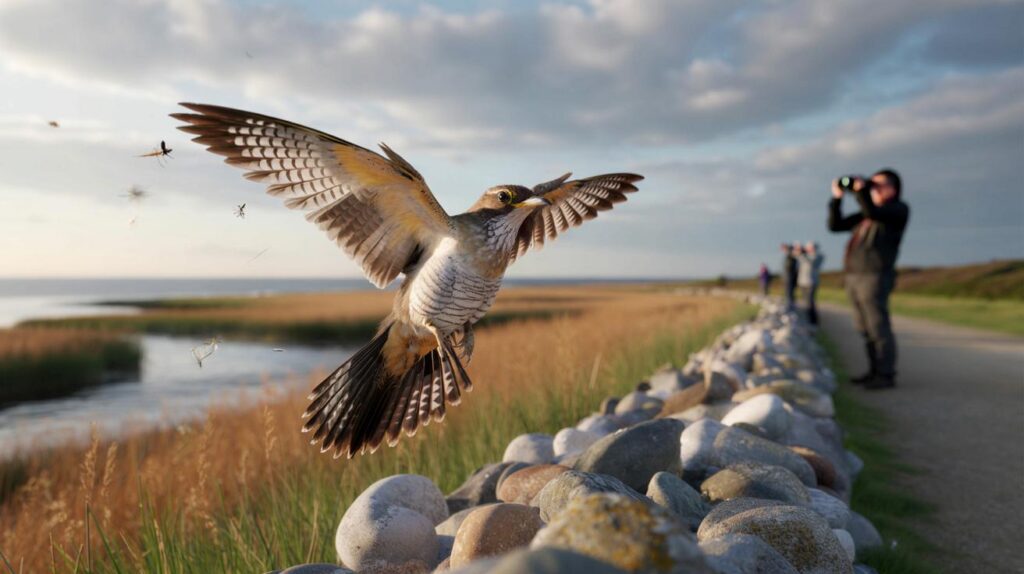
A small drama has played out above the shingle and reeds, where sharp-eyed walkers have shared whispered messages and phone snaps.
For 10 days, a juvenile cuckoo has circled the skies at Salthouse on the north Norfolk coast, drawing locals with binoculars and curious beachgoers alike. The bird belongs to a species the RSPB marks as red-listed, and its brief stopover hints at a remarkable journey about to begin.
A rare visitor with perfect timing
The common cuckoo, despite its familiar name, now carries the UK’s highest conservation concern. Numbers have fallen sharply since the late twentieth century, and sightings along the Norfolk shore carry extra weight. This juvenile has timed its stay to feed, build fat, and prepare for a long, solo flight to Africa. Several watchers say it has been moving between the heath, the shingle ridge and the marsh edge, offering short, teasing fly-pasts before melting back over the reeds.
Red-listed by the RSPB and active over Salthouse for 10 days, the juvenile cuckoo is fuelling up for Africa.
Local photographer Adam Spruce has visited repeatedly in the past week, hoping for the clean, open-wing shot. On close views he noted the young bird’s pale-edged feathers and neatly barred underside. He also believes it has been browsing berries between insect feeds, an uncommon but not impossible tactic when energy demands spike before migration.
What locals have seen
Reports describe a compact, dove-sized shape with a long tail and a purposeful, level flight. Adults show a steely blue-grey mantle and chest, though juveniles often appear browner above with crisp barring below. There is no classic two-note “cuck-oo” at this time of year: young birds keep quiet, and the adult song has faded.
| Fact | Detail |
|---|---|
| Status | UK red list (highest conservation priority) |
| Length | 33–36 cm |
| Wingspan | 55–60 cm |
| Typical weight | 100–140 g pre-migration |
| Diet | Caterpillars and other insects; occasional berries reported |
| Usual hosts | Reed warbler, meadow pipit, dunnock |
| Where to look in Salthouse | Shingle ridge, reed margins, Salthouse Heath edges |
Why this matters for you and the county
Norfolk sits on a major migration corridor. Each reliable sighting helps show how birds use the coast’s mosaic of heath, reedbed and arable margins before longer flights. When a red-listed species lingers for 10 days, it signals that the habitat still offers food and shelter. It also hands everyday walkers a chance to tune their eyes for a bird whose future depends on decisions from gardens to saltmarsh management.
Brood parasitism is the cuckoo’s defining strategy: it lays in other birds’ nests, leaving hosts to rear the chick.
Cuckoos rarely build nests. Females target species with accessible cups, often matching egg colour and pattern. In Norfolk, reed warblers along ditch lines take a heavy share of the burden. The juvenile seen at Salthouse almost certainly fledged from a nearby host, then moved independently to feed and map the coastline before its first trip south.
How to identify a juvenile cuckoo quickly
- Overall shape: dove-sized with a slim body, long tail and pointed wings.
- Colour and pattern: brownish upperparts with pale-fringed feathers; fine black-and-white bars below.
- Head: small, with a light eye-ring that can look bright in good light.
- Flight: level, direct, with short glides; not as fluttery as a kestrel or as buoyant as a gull.
- Behaviour: hawks insects from low perches, then drops to the ground; may pause on fence posts and reed tops.
- Voice: largely quiet now; do not expect the classic spring call.
Best times and places to look this week
Try early morning or late afternoon when insects lift from the shingle and reed edge. Scan the skyline from the beach car park towards the heath, then check the field margins around the village. Short circuits between Salthouse Heath and the coastal path often produce a brief, unmistakable silhouette as the bird cuts across the wind.
Keep at least 30 metres away, avoid flushing the bird from feeding spots, and limit playback or pishing.
Migration next steps: 3,500 miles on instinct
Within days, this juvenile will likely push south-west across England, then head through Iberia or Italy and on towards the Sahel. The ultimate goal may be the Congo Basin, a journey that can stretch to roughly 3,500 miles. Young cuckoos navigate without their parents. They ride pressure systems, refuel at hedgerows and wetlands, and cross hostile water and desert with quiet efficiency.
Tracking work by UK scientists, including projects run by the BTO, shows varied routes and stopovers. Some birds favour Spain and Morocco; others arc east into Italy and Libya. Weather patterns, fat reserves and food pulses steer those choices. A 120-gram bird depends on grams of fat laid down now, so a few quiet feeding days on the Norfolk coast can make the difference between a clean crossing and a forced, risky stop.
A cuckoo’s fuel is measured in grams: a handful more today can power hundreds of miles tomorrow.
How you can help in 5 minutes
- Report what you see to your local bird group or county recorder, with time, place and behaviour.
- Plant shrubs that host caterpillars—willow, hawthorn and native honeysuckle raise caterpillar numbers.
- Reduce pesticide use in gardens; keep a small patch messy for moth larvae.
- Give feeding birds space; dogs on leads near the reed edge help wildlife and avoid flushes.
- Support hedgerow and ditch maintenance that favours reed warblers and other host species.
Context: what ‘red-listed’ really means
The UK’s red list highlights species with rapid declines, small breeding ranges, or historically low numbers. A red-listed bird is not necessarily scarce everywhere, but it faces serious pressure in the UK. For cuckoos, climate shifts, prey availability, and changes in host populations all play roles. That tangled web runs from Norfolk’s reed-fringed ditches to the Sahel’s shrinking wetlands.
Extra notes for keen watchers and families
If you head out with children, set a simple challenge: count raptors and large gulls for five minutes, then add a “mystery bird” category for anything with barred underparts. You’ll prime young eyes to separate shapes quickly. Bring a small notebook and mark wind direction and cloud cover; cuckoos often move on a light tailwind, and you might predict a brief flurry of movement around a change in weather.
For photographers, think in short bursts. Stand with the sun behind you, pre-focus on a fence line, and wait for a low pass. Avoid chasing; the bird wastes energy when flushed, and you’ll miss the clean shot. If it settles near berry-laden hedges or nettle strips where caterpillars gather, hold back and let it feed. Your patience increases the bird’s chances of banking the fat it needs for the first major leg south.



Caught it over the shingle ridge at 6:40am today—barred underside clear as day. Thanks for the early/late tip! 🙂 Pretty sure it nabbed a hairy caterpiller by the reed edge.