
On a busy Nottingham commute, something small but striking has started turning heads, softening glances, and slowing footsteps.
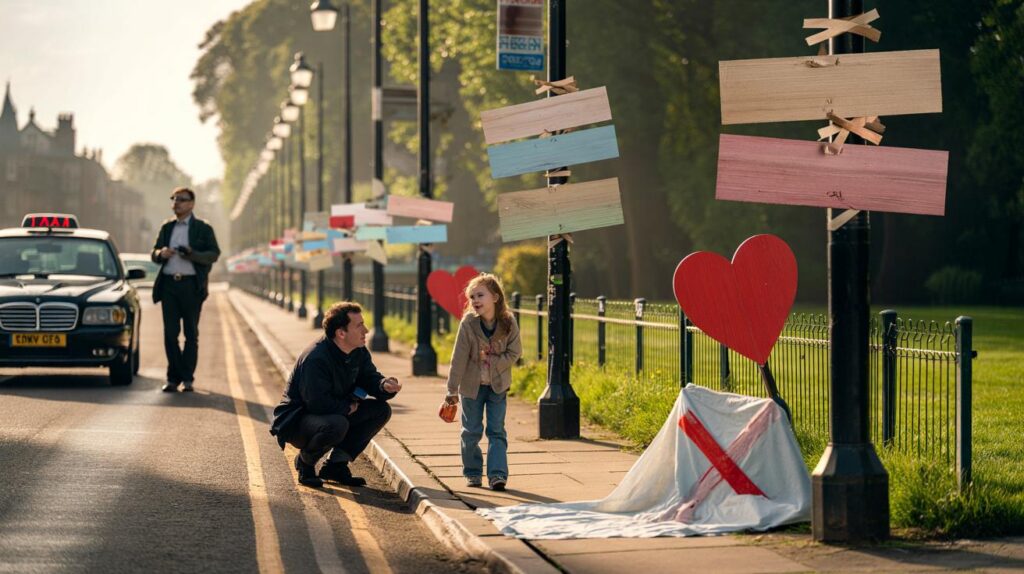
Early this week, a short stretch of Mansfield Road near the Forest Recreation Ground changed tone. Hand-painted boards now dangle from lamp-posts and a fence line, carrying messages such as “we are kind” and “we are welcoming”. The signs arrived soon after St George’s flags vanished from the same posts. No one has stepped forward to claim responsibility, yet locals have plenty to say.
A 160m strip becomes a message board
About 10 wooden signs now punctuate a 160m run of Mansfield Road. They sit at eye level, easy to catch while waiting at lights or walking to the tram. Some sit on a metal fence beside the park, paired with red cardboard hearts. By Tuesday, the flags that previously ran the same route had gone. The timing suggests a deliberate swap, but the people behind both moves remain unknown.
Ten hand-painted signs, one short city stretch, and a mood shift you can feel at pavement level.
Passers-by report a softened atmosphere. Commuters slow down. Families point things out to children. The language on the boards is plain, almost childlike. The effect feels intentional: warm words in a cool week, right where people share public space under the same lamps.
Residents report a change in mood
Reactions from nearby residents skew positive. A long-time local taxi driver who moved from Turkey more than three decades ago described a sense of relief. A healthcare worker from Northern Ireland, now settled in England, said the previous flags felt pointed and territorial, drawing on memories of how banners can divide streets. The new boards read differently to him: hopeful, open, neighbourly.
Several residents said the flags signalled exclusion; the new boards feel like an invitation to belong.
- A driver who lives nearby said the signs make daily journeys feel lighter and less tense.
- A healthcare worker linked the flags to experiences of division and described the signs as a healthier civic marker.
- A Nottingham filmmaker watched the boards go up and praised the simple positivity of the messages.
- A woman who moved from South Africa as a teenager said the words mirror the welcome she first felt on arrival.
- A local gardener thought the signs countered the previous display and better reflect how most neighbours treat each other.
People also noticed the red hearts pinned to the fence. Small, low-cost touches often pack the most charm. They look temporary, yet they carry weight—especially along a route many people use daily.
Who put them up, and will they stay?
At the time of writing, no group has claimed the action. The flags that appeared before came amid a broader push on social media, styled as a patriotic show of pride. That movement also drew criticism, with some residents linking the St George’s Cross to far-right appropriation and current tensions around immigration. On Mansfield Road, the council says it does not plan to remove the boards, matching its decision not to strip the flags when they went up.
The council’s stance: as with the flags, the signs can remain on the lamp-posts.
Local authorities usually weigh safety, highways guidance and community impact when objects appear on street furniture. Items that obstruct drivers or damage infrastructure tend to come down. Low-risk displays sometimes stay in place, especially when neighbourhood sentiment leans in their favour. On this stretch, the balance appears to favour the painted boards.
What the signs are doing right now
They change the immediate feel of the pavement. They lower the perceived temperature of a debate that had moved onto the street. They offer a simple invite to share space with courtesy. None of that requires a manifesto. A few words on wood do the job.
The wider debate about flags and belonging
England’s flag carries layers of meaning. For many people, it signals sport, civic pride and national heritage. Others see it through the lens of political appropriation and exclusion. The same cloth can stir very different reactions depending on context, timing and scale.
Public space hosts those differences. A flag on a house reads one way. A line of flags on lamp-posts reads another. In cities, repetition amplifies the message. That is why people notice when a run of posts changes overnight from crosses to kindness.
Street symbols do more than decorate; they set the tone for who feels at ease—and who doesn’t.
Research on urban design and social psychology points to a clear pattern: visible cues shape how safe, welcome and connected people feel. Warm, inclusive messaging tends to prompt prosocial behaviour. It can reduce perceived threat and improve how strangers interact in close quarters. The Mansfield Road boards follow that script with friendly language and low-key visuals rather than slogans that challenge or divide.
Balancing pride and inclusion
Plenty of residents say you can hold both positions: pride in country and kindness to neighbours. One filmmaker suggested pairing the two—celebrating national identity while stressing that warmth and welcome are part of it. The boards hint at that blend. They frame belonging as a shared value, not a test.
What next on Mansfield Road?
Painted wood and cardboard will weather. Strings will snap. The conversation will not. If the signs stay, local groups may offer to maintain them. If they come down, the memory of how that 160m felt will linger. Either way, the episode offers a practical lesson in how small, low-cost gestures can change a street.
- Keep it safe: fix any display securely and avoid blocking drivers’ sightlines or crossings.
- Keep it polite: messages that invite tend to lower tensions; statements that taunt tend to raise them.
- Keep it temporary: short runs and regular checks limit clutter and damage.
- Keep it local: involve neighbours and nearby businesses; informal support matters.
If you plan a community message
Check your council’s guidance on attaching items to lamp-posts and fences. Ask about permitted materials and fixings. Cable ties and lightweight boards usually work better than nails or screws. Use weatherproof paint or sealant so debris does not drop onto the pavement. Mark a date to inspect and, if needed, remove items.
Risks, benefits and how to stay on the right side of the rules
Community displays come with trade-offs. They can brighten a day and nudge behaviour in kinder directions. They can also spark arguments or create trip hazards if they fall. Good stewardship helps. Agree a simple plan with neighbours: who checks the fixtures, who tidies up, who speaks to the council if issues arise. Keep shapes and colours modest to reduce distraction for drivers near junctions.
- Benefits: improved sense of welcome, stronger neighbour connections, gentle counter to polarising narratives.
- Risks: visual clutter, reduced visibility at busy junctions, disputes about messaging.
- Mitigations: clear fixings, short durations, inclusive wording, basic maintenance rota.
What residents say they want now
The people who spoke on the street asked for calm, kindness and room to belong. They preferred signals that bring people in, rather than push them away. They also wanted their road to feel safe to walk at any hour. The boards, for now, move the needle in that direction.
This small Nottingham experiment shows how quickly a street can change when the symbols change. Ten pieces of painted wood cannot settle national debates. They can, though, set a gentler standard for how we share the public realm, one lamp-post at a time.



Small change, big mood shift. Whoever put these up, thank you — it defintely made my walk to the tram less tense.
Who decides what goes on lamp-posts? If flags can stay and so can signs, where’s the line on clutter and driver distraction near junctions?