
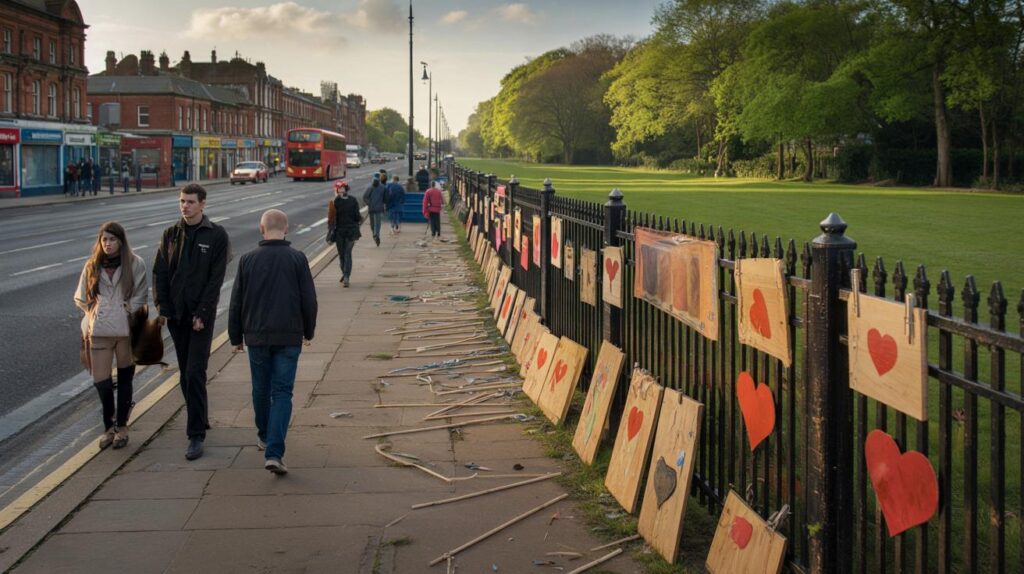
On a busy Nottingham artery, a string of fresh messages has appeared overnight, prompting smiles, questions and quiet nods.
They sit where something else flew only days ago, and the switch has set off a revealing conversation about belonging, pride and the tone of a street.
A quiet swap on Mansfield Road
Along a 160m stretch of Mansfield Road, beside the Forest Recreation Ground, around 10 hand-painted boards now hang from lampposts and a metal fence. The phrases are simple and direct: “we are kind” and “we are welcoming”. Red cardboard hearts punctuate the line like mile markers of goodwill.
Until this week, St George’s flags lined the same lampposts. The flags came down on Tuesday. No one has claimed responsibility for removing them, nor for putting up the new boards. What is clear is that the mood on the pavement has shifted.
Ten home-made signs over 160 metres now greet pedestrians where St George’s flags recently flew, and the council says it will not remove them.
Residents’ first impressions
Reactions from people who use the road daily have been strikingly consistent. Many describe a lightening of the atmosphere. A taxi driver who moved from Turkey three decades ago said it felt like a release. A healthcare worker who grew up in Northern Ireland—used to streets where flags signal territory—said he no longer felt on edge walking past the lampposts. A local filmmaker watched the boards go up and called the messages a welcome tonic. A woman who arrived from South Africa as a teenager, escaping apartheid, said the words took her back to the warmth she felt on first arriving. A Nottingham gardener called them a needed counterweight to what came before.
- Relief: several residents said the signs eased tension on a main route used by thousands.
- Belonging: migrants and long-term locals alike read the boards as an invitation, not a warning.
- Tone: people used words like “hopeful”, “positive” and “kinder” to describe the change.
- Nuance: one passer-by felt the messages could have sat alongside flags that express national pride.
From flags to feelings
The flags formed part of a social media push branded Operation Raise the Colours, framed by supporters as a show of pride and patriotism. In recent months, public displays of St George’s crosses have multiplied across towns and cities. Many cheer the sight. Others, looking at England’s heated arguments over immigration and identity, feel uneasy when national symbols cluster on civic furniture. The cross, in some contexts, has been appropriated by far-right groups, and that association can colour how people read it on a street corner.
Symbols do a lot of work with few words. A lamppost draped in a national flag may feel festive to one neighbour and exclusionary to the next. A run of boards saying “we are kind” can, conversely, lower shoulders and invite eye contact. The same emblem, on a football shirt or a pub window, lands very differently from a line of flags along a road. Place matters. So does timing.
Public symbols are not neutral; they tell pedestrians who belongs, who is welcome and how safe the next hundred metres might feel.
What the council says
Nottingham City Council has indicated it will not take the signs down, mirroring its stance on the flags. That approach avoids taking sides in a culture row, while keeping the focus on safety and obstruction. Attaching items to lampposts usually requires permission and must not endanger road users or pedestrians. In practice, many councils assess low-risk displays case by case and act only if there is a hazard, a complaint, or damage to highway assets.
The boards on Mansfield Road are light, tied on, and set high enough to avoid head height. If they stay intact and do not create clutter, they may well remain until weather or time does the job.
| Where | Mansfield Road, alongside the Forest Recreation Ground, Nottingham |
|---|---|
| What changed | St George’s flags came down; hand-painted “kindness” signs went up |
| How many | About 10 boards |
| Distance | Approximately 160 metres of lampposts and fence line |
| Extras | Red cardboard hearts pinned to the fence |
| Council stance | Not removing the flags previously; not removing the signs now |
Why small signs can make a big difference
Environmental psychology points to a simple truth: modest cues shape behaviour. Streets that show care—flowers tended, litter picked, greetings posted—tend to feel safer and friendlier. Messages that prime kindness can nudge people towards it. None of this fixes deeper pressures, but the tone of a place affects who lingers, who hurries and who avoids it after dark.
On Mansfield Road, the boards also do practical work. They channel an argument into a gentler form. The national flag is a powerful symbol. Some read it as unifying; others, given recent politics, read it as a test of allegiance. The new boards set a different baseline: anyone can sign up to kindness, whatever they think about national identity. That does not erase disagreement, but it can lower the temperature while residents and officials work out longer-term norms for public displays.
What comes next on Mansfield Road
The origin of the signs remains unknown. If they were installed overnight by a small group, the question is how long they will last. Weather will take its toll. If they are vandalised or removed, the debate will flare again. If they endure, the message could seed further acts—window notes above shops, pavement chalking near schools, or a noticeboard curated by local groups.
There are practical choices ahead. If flags return, should they share space with the boards? Should the council publish guidance for temporary displays on lampposts, setting size, fixings and time limits? A simple permit process could reduce friction while protecting safety and heritage assets. Consultation need not be a saga: a pop-up stall at the Forest Recreation Ground on a Saturday could gather views across age and background in a morning.
How residents can shape the street
People who use Mansfield Road every day can help set a shared tone without picking a side in a flag war. Small steps add up over 160 metres.
- Form a micro-stewardship group for that stretch, mixing traders, bus users, dog walkers and students.
- Agree simple standards: no sharp fixings, no obstruction, a four-week limit on temporary displays.
- Hold a quarterly “street hour” for litter picking, repainting tired railings and refreshing noticeboards.
- Invite competing messages into the same frame: a co-designed panel with rotating themes—welcome, pride, remembrance—so no one emblem dominates.
- Speak to ward councillors about a low-cost, rapid permit for lamppost items that meet safety rules.
Beyond one road: the wider picture
Across England, many places are wrestling with the meaning of flags in civic space. Football nations’ banners go up in summer and draw grins. Political marches bring a different palette. Context decides impact. In districts with rising diversity, warmth in the street scene can calm nerves and reduce the sense of lines being drawn. Kindness boards may feel slight next to big arguments, yet they are visible in the everyday bustle that matters most: the school run, the bus queue, the walk to the shop.
For those weighing risks and benefits, the Mansfield Road case offers a useful test. There is little cost, minimal hazard, and tangible shifts in how people say they feel. Pride does not vanish; it is reframed as care for neighbours. That balance—keeping room for national symbols while making space for messages of welcome—could help other streets navigate the next display that goes up a lamppost.



Do these “we are kind” boards actually improve safety, or just the perception of it? Any stats from similar streets, pls? Curious but sceptical.
If kindness signs stop the daily horn symphony, I’ll paint a few myself.