
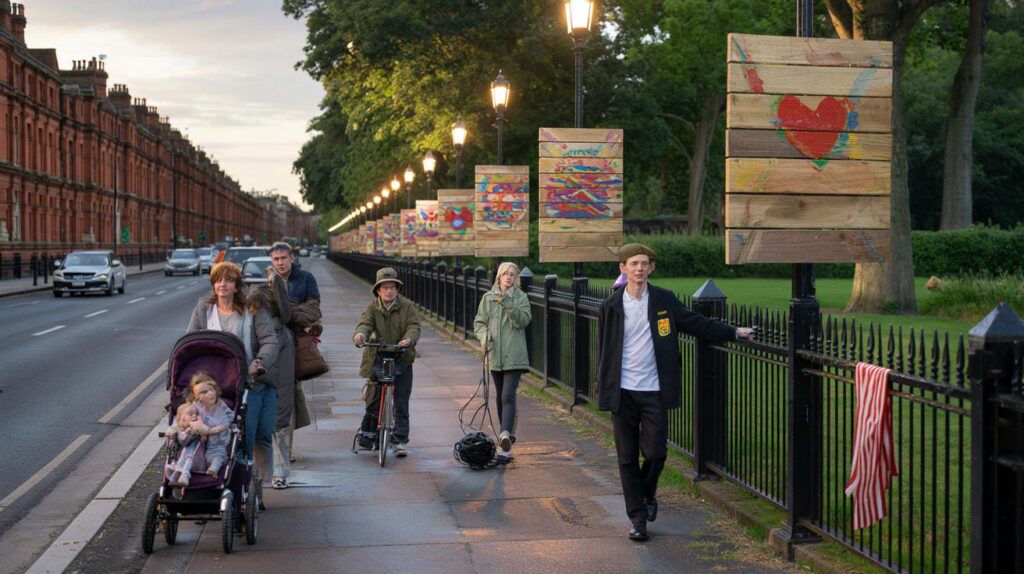
A quiet change on a busy city road has stirred strong feelings, soft smiles and a debate about pride and belonging.
Along Mansfield Road, beside the Forest Recreation Ground, handmade boards now hang from lamp-posts where flags flew days ago. The messages are short and bright. “We are kind.” “We are welcoming.” Red cardboard hearts sit on a nearby fence. The flags came down on Tuesday. No one has publicly claimed responsibility for the swap.
What changed on Mansfield Road
Residents counted around ten hand-painted boards spaced along a 160-metre stretch of the A60, one of Nottingham’s busiest corridors. The signs arrived after a wave of St George’s flag displays that spread via social media in recent weeks. Locals say the tone on this particular stretch feels different now. The City Council says it does not plan to remove the boards, echoing its stance when the flags went up.
About ten handmade boards now line a 160m strip of Mansfield Road, replacing recent flag displays, and the council says they can stay.
Who took the flags down and who installed the boards remains unclear. The signs appeared at height, attached to lamp columns and a metal fence. They use bright paint, simple lettering and heart motifs. Their placement suggests a single, coordinated effort rather than scattered acts.
Voices from the pavement
Conversations on the kerbside reveal why this modest intervention resonates. A taxi driver who moved from Turkey decades ago called the change a relief and said the street feels gentler. A healthcare worker from Northern Ireland said the flags made him uneasy, recalling how flags can mark territory and send exclusionary signals. A young Nottingham filmmaker described the boards as a positive statement that reflects the city’s character. A woman who arrived from South Africa as a teenager said the hearts and words matched the welcome she felt upon arriving in Britain. A local gardener praised the signs as a needed counterweight to the previous mood.
- Location: A60 Mansfield Road, by the Forest Recreation Ground.
- What’s new: around 10 hand-painted “kindness” boards and red hearts.
- What’s gone: St George’s flags removed on Tuesday.
- Who’s responsible: unknown for both the removal and the installation.
- Council stance: no removal planned for the boards, mirroring its approach to the flags.
Several residents framed the boards not as anti-flag, but as a reminder that civic pride can sit alongside warmth to strangers. Others admitted the earlier flag display felt confrontational on a gateway road used by thousands each day.
Pride, patriotism and a social media push
The earlier flag wave grew under the banner “Operation Raise the Colours”, a grassroots call to fly the St George’s Cross. Supporters cast it as pride and patriotism. Detractors feared the symbolism amid tense national conversations about immigration and identity. Across England, displays became a canvas for competing meanings. Context mattered: a flag outside a home reads differently to a row of flags across lamp-posts on a main road.
On Mansfield Road, the tone has shifted from assertion to invitation. The boards don’t erase patriotism; they recast the street’s message as hospitality. That reframing echoes a pattern seen in towns where residents use small-scale art to soften public spaces and reduce friction.
Local authority position and practicalities
Nottingham City Council says it will not remove the new boards, just as it did not take down the flags. That decision avoids a head-to-head with residents and keeps the temperature low. It also leaves practical questions. How long do the boards stay? Who looks after them? What happens if fixings fail or weather damage creates hazards?
The council’s consistent approach—no removals for flags, no removals for boards—keeps the peace while people talk.
| Detail | Current picture |
|---|---|
| Where | Mansfield Road, 160m stretch by the Forest Recreation Ground |
| What changed | Handmade “kindness” boards replaced recent flag displays |
| How many boards | About 10 |
| Responsibility | Unknown for removal and installation |
| Council stance | No planned removal of boards, consistent with its approach to flags |
Most councils publish guidance for items fixed to street furniture. Officers typically consider road safety, column loading, maintenance access and sightlines. If an attachment blocks visibility, risks damage or distracts drivers, removal usually follows. Organisers who label installations with a contact number and remove them after a set period tend to avoid friction. That approach also helps crews if a storm loosens a fitting.
The bigger picture: symbols, safety and belonging
Symbols do heavy lifting on public land. A flag can serve as a benign marker of sporting support or a pointed statement of the boundaries of belonging. A hand-painted slogan can read as warmth or as an implicit rebuke. Streets absorb these meanings and feed them back to passers-by. The same object means different things to different eyes. That is why this 160-metre stretch feels like more than timber and paint.
Urban research backs the intuition. Small, low-cost interventions often nudge behaviour and mood. Cheerful signage can reduce littering. Artful crossings can slow cars. In places with diverse populations, short phrases—kind, welcoming, friendly—can set a tone without drowning out other identities. The trick lies in keeping messages open rather than combative.
If you want to add community messages
Residents who wish to contribute safely can take a few simple steps that respect the street and the law:
- Ask the council’s highways team for permission, particularly for lamp-posts and railings.
- Use light, removable fixings that do not drill or pierce columns.
- Keep items clear of junctions, signals, speed signs and pedestrian sightlines.
- Choose weatherproof, recyclable materials and remove them after a short window.
- Add a small label with a contact name and number for maintenance or removal.
Community groups often frame these efforts as pop-up art rather than permanent fixtures. A weekend display tied to a clean-up day, a school project or a food-bank drive can draw volunteers and keep focus on shared goals. A simple before-and-after walk-through with neighbours can test whether additions help people feel safer and more welcome.
One practical idea is to pair kindness boards with data. A group could run a two-week survey at bus stops along Mansfield Road, asking commuters whether they feel more at ease and whether the area looks tidier. Combine that with a litter count and a basic speed observation before and after installation. The results might reveal which messages work, which locations help, and how long displays should stay up.
Another option is to rotate themes. For a month, emphasise kindness. Next, highlight local volunteering hours or shared achievements, such as park improvements. A calendar of low-key, positive messages spreads ownership across the neighbourhood and reduces the risk that a single symbol gets loaded with all the arguments of the day.



Do signs on lampposts actually make anyone feel safer, or is this just vibes?
Thanks to whoever put them up; walking past the Forest Rec felt calmer today. Small things add up. Definately kinder than the recent vibe.