
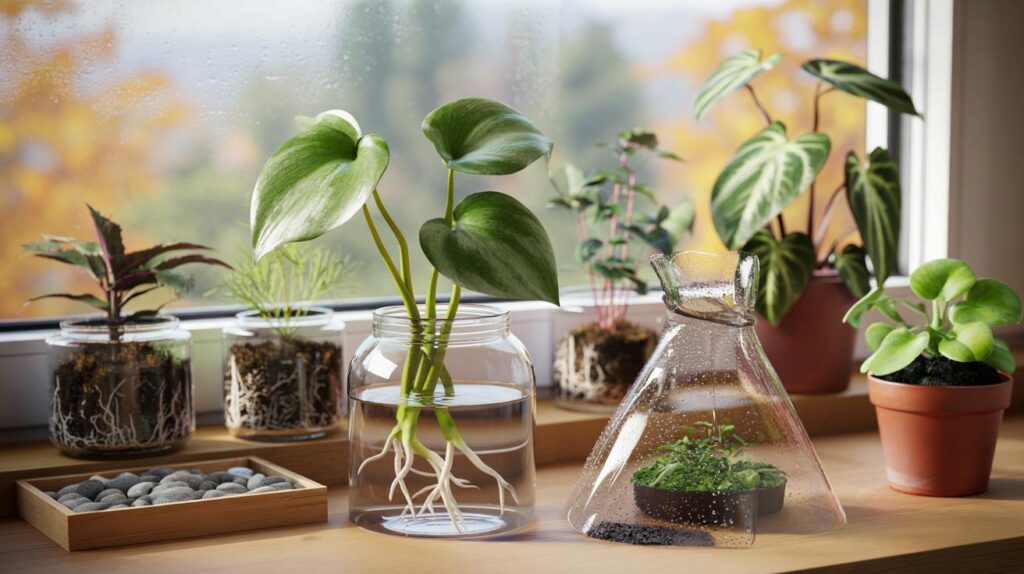
As autumn settles and windows fog, your indoor jungle enters a quiet crossroads with calmer air, softer light and surprising promise.
Across the UK, October brings a shift you can use. Cooler rooms, shorter days and steady humidity create a gentler lane for propagation. Instead of racing for summer growth, cuttings focus on roots. That change tilts the odds towards you, even if you’ve never tried taking cuttings before.
October’s hidden window for propagation
Why room temperatures tip the odds
Most homes hover between 18°C and 22°C in October once heating clicks on. Plants tolerate that well. Fewer heat spikes mean less water stress and fewer wilt events. Night dips to 16°C slow leaf expansion and push carbohydrates to the base of the cutting, where roots form. You get steady rooting rather than fast, floppy stems.
October’s stable 18–22°C indoors and mild nights reduce stress and channel energy into root growth.
Seasonal light that roots rather than stretches
Autumn light softens. You get bright, indirect brightness rather than harsh midday glare. That suits tender cuttings. Leaves still photosynthesise, yet they avoid scorch. Shorter days also nudge plants to allocate resources to underground structures. Place vessels near an east or bright north window and you’ll harness that softer beam without crisping tender foliage.
Soft, indirect autumn light powers photosynthesis while avoiding scorch, reducing the risk of weak, stretched growth.
Choose and prepare cuttings like a pro
Houseplants that root fast in autumn
These crowd-pleasers respond well this month:
- Pothos (Epipremnum aureum)
- Tradescantia (often called inch plant)
- Heartleaf philodendron and other vining types
- Syngonium (arrowhead vine)
- Pilea peperomioides
- Ficus elastica (rubber plant, from semi-hardwood tips)
- Monstera adansonii and small Monstera forms
Pick winning stems and clean tools
Choose firm, pest-free growth from healthy donors. Avoid yellowing or wind-battered tips. A good cutting measures 10–15 cm. Aim for two nodes and at least one healthy leaf. Use sharp, disinfected blades. Wipe sécateurs with 70% isopropyl alcohol or wash in hot, soapy water and dry. Cut just below a node at a slight angle to expose maximum cambium.
One node below the water or substrate, one node above the surface: that simple layout speeds rooting.
Step-by-step: the no-fail method
Water, soil or moss: choose your lane
| Method | Typical time to first roots | Pros | Watch-outs |
|---|---|---|---|
| Water | 7–21 days for easy vines | Clean view of roots, easy to manage | Transition shock when potting, change water often |
| Soil (peat‑free mix) | 10–28 days | No transition, stronger first roots | Risk of overwatering if mix lacks drainage |
| Sphagnum moss (damp) | 10–21 days | High humidity at the node, clean roots | Mould if too wet and stagnant |
Cut, place, wait: a simple rhythm
Rooting boosters that cost pennies
- Change water every 48–72 hours to limit bacteria.
- Cover soil cuttings with a loose, clear bag to make a mini dome. Vent daily to prevent mould.
- Target 55–65% relative humidity. A nearby tray of pebbles and water raises local humidity safely.
- Warmth under the pot (a gentle heat mat set to ~20°C) speeds formation without cooking roots.
Healthy roots look white or cream and firm. Pot up when they reach 3–5 cm rather than waiting for a long tangle.
Avoid the autumn traps
Moisture control, pests and hygiene
- Water discipline: keep mix evenly moist, never sodden. Lift the pot; it should feel light before you water again.
- Air movement: crack a window for 10 minutes daily. Stale air invites mould.
- Heating hazards: keep cuttings away from hot radiators and cold draughts. Aim for steady, middle‑of‑the‑room conditions.
- Fungus gnats: cover soil with a thin layer of horticultural sand, use yellow sticky traps and bottom‑water.
- Tool hygiene: clean blades between plants to avoid spreading disease.
- Sensitive species: for Ficus elastica and other latex‑bearing plants, wear gloves and avoid eye contact with sap.
Signs of success and when to pot up
Look for perky, green leaves and a slight lift at the tip. In water, roots appear white and firm. In soil, new growth usually signals rooting. Once roots reach 3–5 cm, shift water cuttings to a small pot with airy mix. Water lightly to settle, then keep in bright shade for a week. Feed sparingly after four weeks with a weak, balanced fertiliser at half strength.
Make it social and save money
From one plant to many: what you can actually gain
Start with three donor plants. Take four cuttings from each. That gives you 12 new plants. If similar shop plants cost £6–£12 each, you’ve created £72–£144 of value for the price of a bag of mix. Share spares with friends, swap for new varieties, or group several rooted cuttings in one pot for instant bushiness.
12 cuttings from three donors can replace a month’s plant budget, while keeping your original plants intact.
Calendar and care for winter
- Week 0: take cuttings, set them under bright, indirect light.
- Week 1–2: change water, vent domes daily, maintain 18–22°C.
- Week 2–4: roots reach 3–5 cm. Pot up gently.
- Week 4–8: bright shade, light watering, no heavy feeding. Rotate pots so growth stays even.
If a window is dim, add a small 10–15 W LED grow bulb on a timer for 10 hours. At 28p/kWh, that costs roughly 4–6p per day and keeps growth compact through darker weeks.
Practical extras you’ll be glad you knew
Futureproof your method
Note which parent plants rooted fastest, which mixes drained best and how long each stage took. Those notes build your own playbook for January and March, when you can repeat the cycle. Try one cutting in water, one in soil and one in moss from the same plant to see which method fits your home conditions.
Safety, rights and realistic risks
Many aroids contain calcium oxalate; keep them away from pets and children, and avoid chewing any plant material. Some branded cultivars carry plant breeders’ rights; don’t sell those without permission. Leaf loss can happen after potting; trim damaged leaves and keep the root zone stable. If rot starts, recut above the damage and restart in fresh water with stricter hygiene.
What to do with success
Group multiple rooted cuttings of the same species in one pot for fuller plants within a month. Create mixed shelves of Pilea, Tradescantia and pothos for contrasting textures. Use leftover stems for a second round. With each cycle, your collection grows at near‑zero cost, and your rooms gain fresh, living structure just as the days shorten.



This is the first propagation guide that explains WHY October works—18–22°C + softer light = roots, not leggy stems. The one‑node‑above/one‑below tip is gold. I’ve got Tradescantia and a rubber plant tip ready; will try moss with a vented bag and a cheap heat mat at ~20°C. Also, noting the 3–5 cm root rule will save me from waiting too long. Thanks, this was super clear and definately motivating!