
Dahlias don’t hibernate neatly; they either shrivel or turn to soup when winter storage goes wrong. The line between sleep and rot is thinner than you think.
I’m standing in a cold shed in late November, fingers stiff, tapping each dahlia tuber with a knuckle like a greengrocer testing a melon. The crates look hopeful, labelled with names that sound like party guests—‘Cafe au Lait’, ‘Bishop of Llandaff’, ‘Totally Tangerine’. Yet one gentle squeeze and a tuber sighs inwards, slick and sweet-smelling. Rot has crept in the way fog crawls under a door.
The odd thing is, the tubers looked perfect when I lifted them. Plump, clean, tidy cuts. I’d done “everything right”. A fortnight later, one corner of the crate turned to beige custard. *I could smell the sweet-sour note of rot before I saw it.*
The enemy wasn’t cold.
The silent slip from dormancy to decay
Rot in storage is rarely dramatic. It’s a whisper: a tiny wound on the crown, a bead of stem sap that stays sticky, a smidge too much moisture trapped overnight. Add a snug plastic box and a room that warms in the day and chills at dusk, and biology does the rest. You don’t see it happen. You just notice, a week on, that the skin dimples when pressed and a grey bloom of mould powders your thumb.
What hurts most is that rot often starts in the “safest” places. A heated spare room. A sealed tote. A garage that seems dry. That’s the trick: tubers aren’t dead, they’re alive at a simmer. They breathe, even asleep. Box them without air and they sweat. Swing their temperature and they sweat more. Where there’s condensation, there’s trouble.
I’ve heard every theory in village halls and on allotment paths—bleach baths, talc, cat litter, strict fasting in paper bags. The logic underneath is simple. Fungi like Botrytis and bacteria like Pectobacterium slip into cuts and feast when three things align: warmth above about 10–12°C, free moisture on the skin, and stale air. Stable coolness—roughly 4–7°C—plus dryness and oxygen tip the balance back. **Storage isn’t about keeping tubers cosy; it’s about keeping them calm.**
From last bloom to the box: the method that actually works
Lift your dahlias once the first hard frost has blackened leaves and stilled the plant. Cut stems to 10–15 cm, label crowns, and leave clumps upside down somewhere airy for a day so juices drain from the hollow stem. Then cure them—10 to 14 days at about 10–15°C, out of sun, with good airflow. Curing toughens skins and heals micro-wounds. Brush off soil rather than washing under a tap. If you must rinse, do it quickly and let them dry completely before packing.
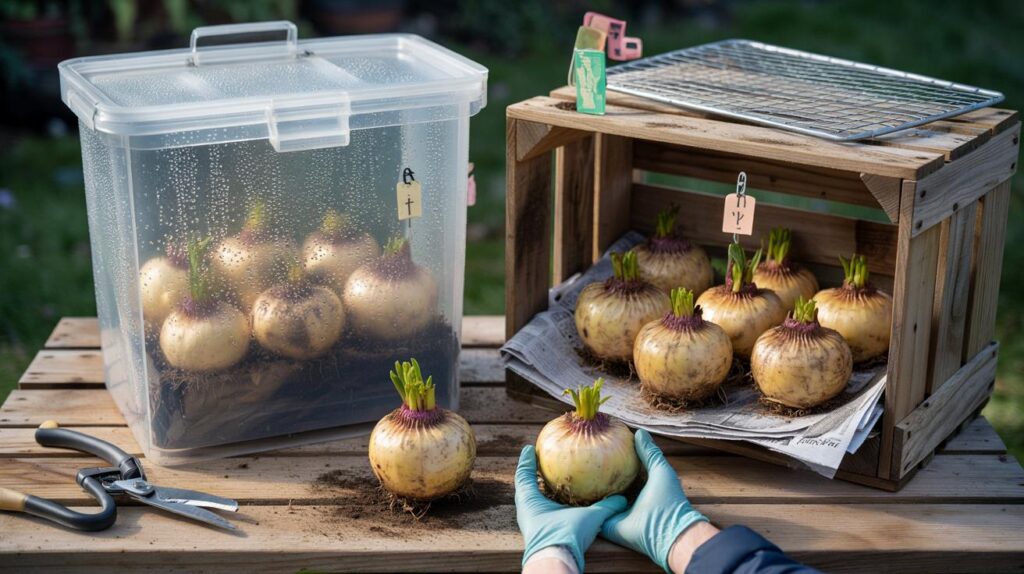
Pack in a breathable box: cardboard or a wooden crate lined with newspaper. Nest tubers in barely moist, peat-free compost, dry coco coir, vermiculite, or wood shavings that aren’t cedar. Keep the medium just dry enough to prevent shrivelling, not bone-dry. Store somewhere dark and steady: 4–7°C is the sweet spot—an unheated spare room, a frost-free shed, a cellar. Check monthly, turning clumps so you can spot soft spots early. **Let’s be honest: nobody really does that every day.** Aim for once a month and you’ll still save most of them.
We’ve all had that moment when a perfect clump goes jelly-soft right under the label you love most. The culprits tend to repeat. Washing and putting away wet. Cutting the crown too close and exposing the vascular ring. Sealing tubers in tight plastic that traps their breath. Stashing them in a loft that swings from chilly to toasty every afternoon. Or the reverse—letting them desiccate in a hot cupboard, then panicking with a water spray. A calm rhythm beats a heroic rescue. **Slow, cool, and boring wins.**
“Think like a potato,” a veteran grower in Cornwall told me, grinning. “Cool, dark, aired. Not parched. Not steamy. And keep mice out—they love a dahlia dinner.”
- Target storage temperature: 4–7°C, with little daily swing.
- Medium: dry-ish vermiculite, compost, coir, or non-aromatic shavings.
- Air: breathable boxes, no sealed plastic bags.
- Prep: cure 10–14 days; brush soil; dust cuts with sulphur or cinnamon.
- Layout: crowns up, tubers not crammed, labels on crowns not on loose necks.
- Checks: monthly squeeze test; remove any soft tuber cleanly with a sterile knife.
- Pests: wire mesh lids deter rodents; a dab of peppermint oil on the shelf helps.
Spring-ready without the heartbreak
If something shrivels midwinter, don’t bin in a rush. A little wrinkling is just thirst. Wrap the clump in slightly damp newspaper for 24 hours, then repack. If you spot one mushy tuber on an otherwise firm crown, carve it away to clean tissue, dust the wound, and return the clump to a fresher medium. If a whole crown collapses, compost it and keep the label—your memory and notes still carry value into next season.
Think about your storage place as a habitat you’re building rather than a cupboard you use. Stable shelves rather than a draughty floor. A small digital thermometer with a humidity reading you glance at fortnightly. A habit of leaving lids cracked and stacking fewer layers, so you don’t squash the shy breath out of living tissue. **The win isn’t “perfect storage”. The win is keeping 80–90% alive with less fuss than last winter.**
There’s joy in the check-ins. A faint earthy perfume on a cold Sunday. The quiet note of resilience when a clump you’d given up on firms again after curing or a gentler medium. That first hint of life in March when necks feel springy and crowns look clean. You’re not just storing plants; you’re stewarding potential. Share the near-misses as well as the saves with neighbours and allotment pals. It turns a lonely winter chore into a slow, communal story.
Every winter is a new test of calm, not a copy-paste of last year. Temperature, damp, mice, even the thickness of tuber skins vary. Treat each box as a little experiment: one with vermiculite, one with compost, one with shavings; a note on which corner of the shed keeps steady. The payoff comes fast in spring, when you divide living crowns and pot up stout pieces with a couple of robust eyes. The best growers aren’t lucky so much as curious. They do small things consistently. They learn the smell of “fine” and the sigh of “not quite”. Let your dahlias teach you where that thin line sits, then nudge it your way.
| Key points | Details | Interest for reader |
|---|---|---|
| Curing beats cleaning | 10–14 days at 10–15°C, good airflow; brush soil, avoid heavy washing | Reduces wounds and moisture that spark rot |
| Cool, dry, breathable | Store at 4–7°C in cardboard or wooden crates with dry medium | Stability and oxygen stop condensation and decay |
| Inspect, don’t fuss | Monthly squeeze test; remove soft bits; tweak medium if shrivelling | Simple habits save most tubers without daily chores |
FAQ :
- How cold can stored dahlia tubers get without damage?Keep them above freezing. Brief dips to 1–2°C may pass, but sustained frost kills cells and invites rot once they thaw.
- Should I wash tubers before storage?Brushing is safer. If you rinse, dry them fully and cure again. Wet skin plus warmth equals mould.
- What’s the best packing medium?Dry vermiculite or peat-free compost keeps humidity even. Coir works well too. Avoid scented cedar shavings; they can desiccate.
- How do I handle mould spots in January?Open the box, remove affected tubers, trim back to clean tissue, dust with sulphur or cinnamon, refresh the medium, and improve airflow.
- My tubers look wrinkled—are they ruined?Not necessarily. Rehydrate gently by wrapping in slightly damp newspaper for a day, then repack drier. Don’t soak them in water.



Brilliant write-up—’Think like a potato’ finally clicked for me 🙂 I lost half my Cafe au Lait last winter to sealed plastic and a toasty loft; your call for breathable boxes + 4–7°C explains the soggy custard mess I found. Going to cure 10–14 days and try vermiculite this time. Also love the monthly squeeze test—simple, not fussy.