
Laundry stacks grow as spring breezes arrive, yet indoor space stays scarce. Households want calm, quick drying without tripping over racks.
A budget bit of hardware has sparked chatter among large families and flat‑dwellers alike. It promises outdoor capacity, a tiny footprint, and a price tag that undercuts most gadgets in the laundry aisle.
What this €24.99 buy actually is
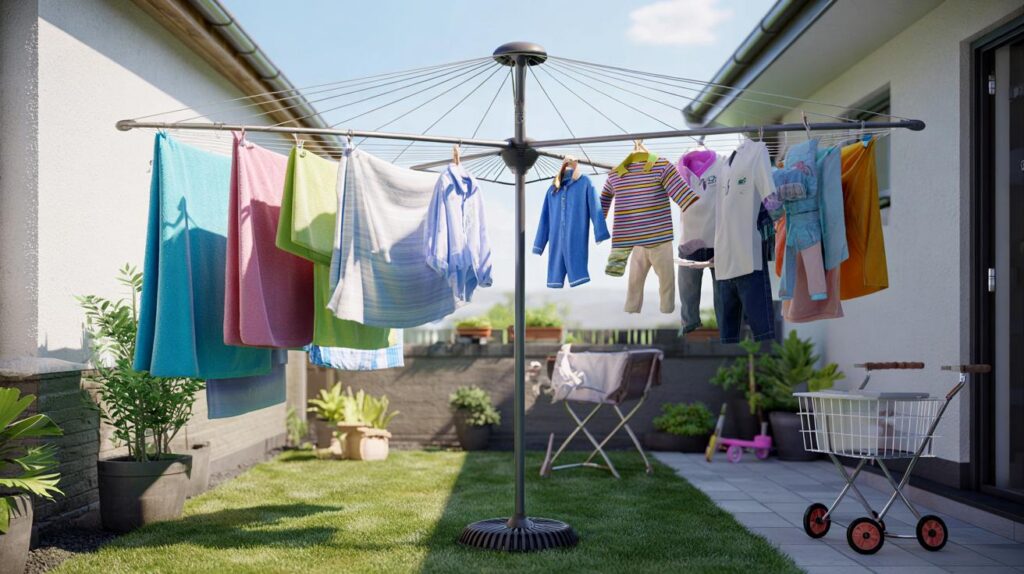
Lidl is pushing a compact, umbrella‑style rotary airer designed to plant in a garden or sit neatly on a balcony. It opens with one movement, presents multiple lines in a circle, then folds down to a slim mast when you need the space back. At €24.99 — around £22 at current exchange rates — it targets busy homes that run back‑to‑back washes and want the drying out of the living room.
€24.99 for a folding rotary airer that takes outdoor drying off the floor and out of the hallway.
- Format: umbrella/rotary airer with radiating arms
- Structure: steel mast and reinforced lines
- Rated load: up to 50 kg of wet laundry
- Weather resistance: lines designed to handle wind, UV and frost
- Fixing: supplied ground sleeve with lid for clean removal
- Folded footprint: minimal; mast blends into the background
Capacity and stability in real weather
The headline figure is capacity. Lidl’s model is pitched to handle up to five average loads at once. That suits a household that washes sheets, towels and uniforms on rotation, without turning a balcony into a hedge of poles. The arms hold their tension, and the circular layout curbs overlap, which speeds evaporation on still days.
A 50 kg rating gives leeway for dense textiles. Steel in the central tube adds stiffness when wind picks up, while the reinforced lines avoid sag that can bunch fabric and slow drying. The included ground sleeve is the practical bit: sink it properly, drop in the mast when you need it, then cap the sleeve when you don’t. No stub left to stub a toe on.
How the footprint works day to day
Open, the arms reach far enough to take bath sheets and double duvets at full spread. Closed, the whole assembly retracts to a lean vertical that hugs a fence line or disappears behind a planter. On a compact terrace, that change from broad to slim means you can host dinner without weaving around laundry. In a small garden, the mast reads like any slim post once the lines fold in.
What buyers report — and the one gripe
User feedback skews positive, with roughly eight in ten reviewers saying they would recommend it. People praise the value, the way it holds steady in blustery spells, and the straightforward assembly. A common note is the absence of a protective cover, which some shoppers expect with rotary designs; those who want one tend to source a universal cover separately.
Strong value, stable under gusts, quick to set up — but no included cover. Stock goes fast when the weather turns.
Seasonality matters. When the first dry weekends hit, stock runs thin. If you miss the initial drop, store managers usually hint at staggered arrivals, but availability can vary.
Could an airer beat your tumble dryer costs?
Energy maths tilts the case. A typical vented or condenser dryer uses about 2.5–3.0 kWh per cycle. At £0.30 per kWh, that’s roughly 75p–90p a load. Run five loads a week and you spend £3.75–£4.50. Line‑drying costs nothing beyond time, and even if you finish indoor drying with a dehumidifier for an hour, you usually stay far under a dryer’s draw. On that basis, a £22 airer can pay for itself in a month or two of regular use.
| Drying method | Typical energy per load | Estimated running cost per load | Notes |
|---|---|---|---|
| Rotary airer outdoors | 0 kWh | £0.00 | Weather‑dependent; fastest in breeze and sun |
| Tumble dryer | 2.5–3.0 kWh | £0.75–£0.90 | Consistent timing; higher fabric wear |
| Airer + dehumidifier finish | 0.2–0.4 kWh | £0.06–£0.12 | Useful in damp weather or overnight |
Figures vary by appliance and tariff. The pattern holds: free wind wins on cost, and a dehumidifier fall‑back still reduces the bill sharply compared with full tumble cycles.
Faster drying, fewer hassles
- Space items with a hand’s width between edges to keep air moving.
- Put thicker pieces on the outer lines where the breeze is strongest.
- Peg at corners to stop billowing that flips damp sections inward.
- Rotate the arms every hour in still air to prevent cool spots.
- Beware UV fade on dark cottons at midday; turn inside out.
- Shake towels before hanging to lift fibres and cut the cardboard feel.
For balconies, check building rules before fixing a sleeve. If ground fixing isn’t possible, some households drop the mast into a weighted parasol base as a temporary measure, keeping the footprint stable without drilling.
Who it suits — and what to check before you queue
Large families benefit most, as do sports households with muddy kit and towel mountains. Pet owners gain, since fur sheds outdoors rather than on the carpet. Flat‑dwellers who juggle prams, scooters and plant pots get their walkways back once the mast folds. Garden users avoid a maze of freestanding racks that block doors and step paths.
Check the free radius where the arms will swing. Measure clearance for your biggest sheets, and confirm the soil or base can take a sleeve. If you live in a gusty spot, site the sleeve leeward of hedges or fences to break wind without throwing shade. Consider a universal cover if you plan to leave the unit outdoors year‑round; it keeps lines clean and avoids grit in the hub.
Shoppers face a timing test. This kind of stock lands with the first warm spell and can vanish after a single weekend. Stores usually carry a few waves through spring. If you rely on public transport, phone ahead to avoid a wasted trip. The price tag has little fat in it, so significant discounts are rare until the very end of the season.
If you want to push capacity further, pair the rotary with a small indoor rack and a dehumidifier for wet weeks. Use the rotary for bulk pieces and keep smaller garments inside to finish overnight. That hybrid setup keeps rooms uncluttered, trims energy costs, and reduces the fire risk associated with draping clothes on radiators.



At £22, this seems a no‑brainer for families. Five loads at once and no racks in the hallway? My dryer costs ~80p a cycle, so this could pay for itself in a month, just as you said. Anyone tested rust after a wet winter?
50 kg rating feels optimistic. Do the reinforced lines actually stay taut with towels + jeans? And how does the steel mast cope in gusts on a balconey? I’d love real‑world pics before I drill for the sleeve.