
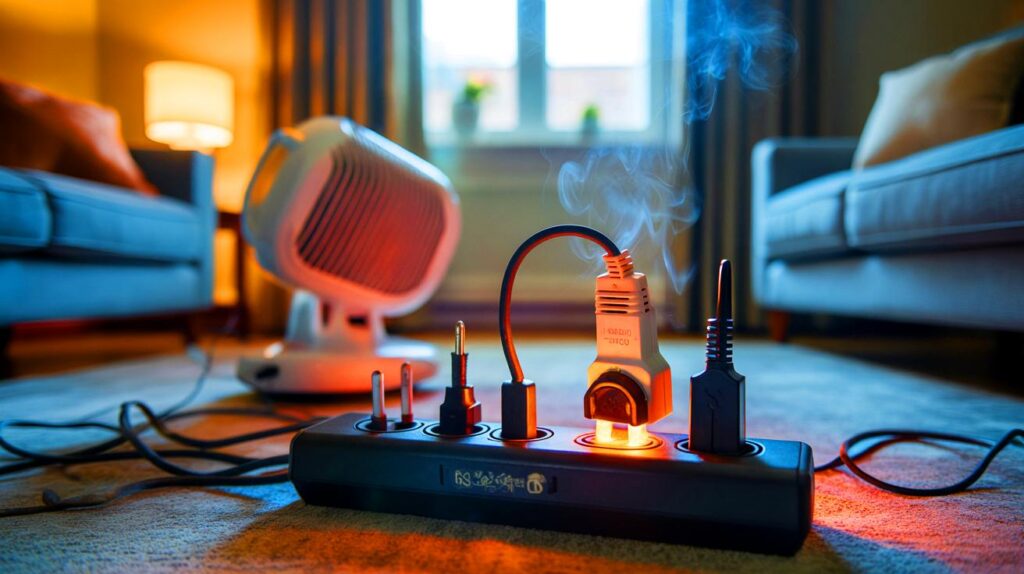
As temperatures drop, households reach for quick heat. Few check the hidden limits of plugs, leads and overloaded sockets.
Across the UK, portable heaters fly out of cupboards the moment a room feels chilly. Many end up in the nearest multi‑socket block, sharing a lead with chargers, lamps and a TV. That habit looks harmless. The maths says otherwise.
Why people keep risking it
Speed and convenience drive the choice. You see a spare socket on a power strip and you use it. The strip has an on–off switch and a surge protector light, so it feels safe. The cable is warm, but not hot, so you ignore it. This is how small overloads turn into overheated plastic, scorched plugs and, too often, fire calls.
Never plug a portable heater into a power strip or extension lead. Use a wall socket, on its own, every time.
The numbers that catch people out
Most portable electric heaters draw between 1,000 W and 2,500 W. A standard UK extension lead or multi‑socket adapter is usually rated at 13 A. On 230 V mains, 13 A equates to about 2,990 W in total—across all sockets on that strip. Many “cube” adapters and travel blocks are rated lower, at 10 A (≈ 2,300 W).
That means a single 2,500 W heater already uses around 84% of a 13 A strip’s entire capacity. Add anything else—an iron, kettle, hair dryer, even a microwave—and you can tip the load beyond the fuse, heat the cable, and damage the plug or strip long before a breaker trips.
| Heater setting | Current at 230 V | Share of 13 A capacity |
|---|---|---|
| 1,000 W | ≈ 4.35 A | ≈ 33% |
| 1,500 W | ≈ 6.52 A | ≈ 50% |
| 2,000 W | ≈ 8.70 A | ≈ 67% |
| 2,500 W | ≈ 10.87 A | ≈ 84% |
Surge protection does not raise a strip’s current rating. It won’t stop cables overheating when you overload them.
What a power strip is actually for
Multi‑socket leads are designed for multiple low‑power devices: laptops, routers, lamps and chargers. They spread convenience, not heavy load. Heaters start at a high draw and stay there. The sustained current heats the weakest points: coiled cable on a reel, thin conductors in a cheap block, worn contacts inside an old socket, or a wrongly rated adapter.
Safer set‑ups at home
What to do instead
- Plug the heater directly into a wall socket. Use one appliance only on that outlet.
- Keep one metre of clear space around the heater. Avoid curtains, bedding, sofas and rugs.
- Stand the heater on a flat, stable surface. Never on furniture, piles of clothes or a worktop edge.
- Choose models with a tip‑over switch and overheat cut‑out. Check the plug has a 13 A BS 1363 fuse.
- Stay in the room when it’s on. Turn it off before bed or when you leave.
- Test smoke alarms monthly and replace any yellowed, cracked or scorched sockets.
If you have no spare wall socket
Use a single‑outlet, heavy‑duty extension lead rated 13 A, with a short, thick cable. Fully unwind extension reels; many reels drop to 3–5 A when coiled. Keep the heater as the only device on that lead. Place the plug where you can see it and check it for warmth by touch. Avoid smart plugs and Wi‑Fi sockets unless they are clearly rated 13 A continuous; many are 10 A and run hot at high loads.
As a rule of thumb, keep continuous loads below 80% of any lead’s rating to reduce heat build‑up.
Placement and housekeeping that reduce risk
- Keep heaters away from water and steamy rooms. Moisture adds shock risk and corrodes contacts.
- Stop daisy‑chaining: never plug one power strip into another.
- Inspect plugs and leads seasonally. Replace any with nicks, kinks, scorch marks or loose housings.
- Vacuum dust from heater grilles. Dust restricts airflow and trips overheat protection sooner.
- Do not cover heaters with clothes or towels. Use a clothes airer instead, placed well away.
Other heavy‑draw appliances to keep off strips
These common items can max out a multi‑socket on their own. Give them a wall socket and their own space.
- Kettle: 2,800–3,000 W
- Iron: 2,000–2,600 W
- Toaster: 1,800–2,400 W
- Hair dryer: 1,800–2,200 W
- Microwave (input): 1,500–2,000 W
- Tumble dryer or portable air‑con: 2,000–3,000 W
- Pressure washer or electric heater fan: often 1,800–2,500 W
The hidden traps people miss
Warm plug, hidden damage
Warmth at the plug or strip means resistance and wasted energy. That heat can soften plastic and loosen contacts further, which raises resistance again. It’s a loop that ends in smoke. If a plug feels more than mildly warm, switch off and rethink your set‑up.
“It’s fused, so it’s fine”
The 13 A fuse protects against severe faults, not against persistent overloads that slowly cook a cable. Residual current devices (RCDs) protect against shock, not against too much current through a lead. Treat ratings as hard limits, not suggestions.
Money, comfort and smarter choices
Electric heaters convert electricity to heat with near‑perfect efficiency at the point of use, but the cost adds up quickly. As a guide, a 2 kW heater uses 2 kWh per hour. At 28p per kWh, that’s about 56p an hour. Zoned heating makes sense: warm the room you’re in, shut doors, use draught excluders, and set the central heating a degree lower to save energy without sacrificing comfort.
If you rely on a portable heater, pick an oil‑filled radiator for steadier heat and lower surface temperatures, or a ceramic model with a thermostat for tighter control. Both should still go into a wall socket only.
A quick self‑check you can do today
- Read the rating label on your heater and your extension lead. Compare wattage to the 13 A limit (≈ 2,990 W).
- Count what else shares the strip. Chargers are small; kettles, irons and heaters are not.
- Uncoil any cable reel fully. Shorten distance with a heavier‑gauge, shorter lead instead of a long, thin one.
- Feel the plug after ten minutes of use. If it’s more than warm, stop and use a wall socket.
- Fit a plug‑in timer to limit running time while you’re awake and nearby.
A single device per heater, direct to the wall, with clear space around it—this simple habit prevents fires.
For homes with limited sockets, consider having an electrician add a double‑gang outlet on the ring final circuit or install a spur to the place you actually need it. It costs less than you think compared with the damage from an electrical fire, and it removes the temptation to stack adapters. If your consumer unit lacks modern RCD protection, ask about an upgrade; while it doesn’t stop overloads, it adds a life‑saving layer against shock.
Finally, think seasonally. Before winter, test heaters, check fuses, and map which sockets sit on which circuits to spread major loads. When you know the limits—2,500 W on the heater, about 3,000 W on the strip—you stop guessing and start heating safely.



Thanks for the clear breakdown—2,500 W already gobbling ~84% of a 13 A strip shocked me. I’m moving the heater to a wall socket and keeping the strip for chargers only.
Isn’t the 13A fuse there to stop this anyway? If the plug’s just warm, how is that dangerous before the fuse blows? Genuinely curious.