
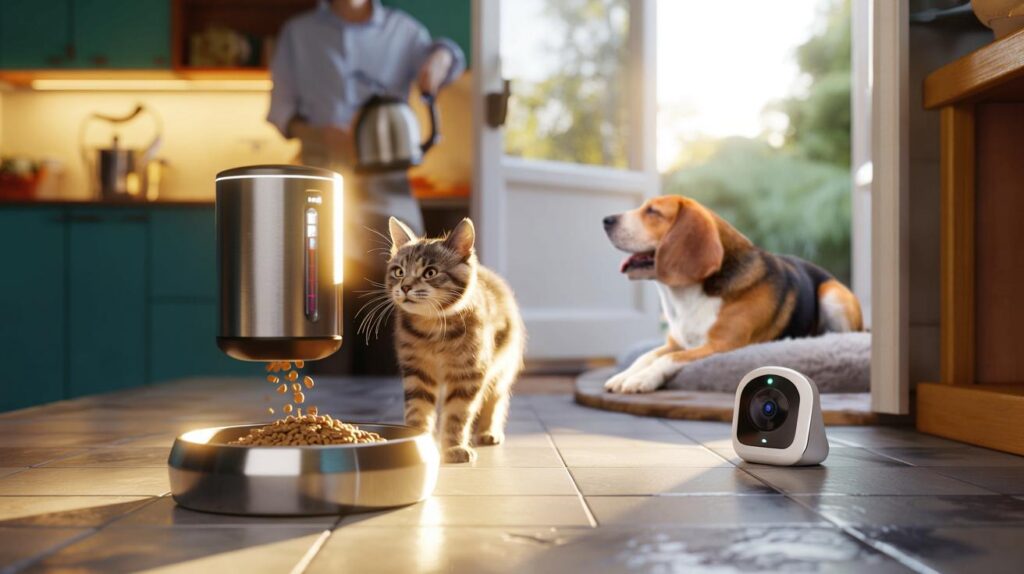
Work runs late, trains stall, and the pet bowl waits. Smart feeders and tiny cameras promise a simpler rhythm at home, where meals arrive on time and check‑ins take seconds. The stress doesn’t vanish. It softens.
The bowl clicked at 7:02, just as the first bus threw light across the kitchen tiles. My cat’s ears twitched at the same moment my phone buzzed with a grainy, sweet frame of my dog asleep under the desk. The feeder’s motor hummed—a small, domestic whirr that feels oddly like care—while the camera caught the slow nose-twitch that says, I’m fine. I put the kettle on and stopped watching the clock. Later, mid‑meeting, I snuck a look and saw a stretch, a yawn, a return to snooze. No drama. Just proof that home was okay. The old ache of leaving had less space to breathe. Something shifts.
Little machines, smaller worries
Smart feeders and pet cameras don’t replace us. They remove friction. The 6 a.m. scoop, the lunchtime dash, the gnawing worry at 5:45—taken off your brain and handed to a quiet schedule. You still fill the hopper and top up water. The tech just does the repetitive bit with a metronome’s calm. Pets learn the beat and, in that, tension melts away. You, too. Morning chaos becomes a routine with fewer rough edges and fewer apologies to a hungry friend.
Ask Mia in Manchester, who adopted a rescue beagle that panicked between meals. She set a Petlibro feeder to small, frequent portions and paired it with a Furbo cam pointing at the kitchen mat. Week one, the howling eased. Week two, the dog started napping after the 1 p.m. drop. Week three, fewer chewed skirting boards. UK Pet Food says more than half of households share life with an animal, which means a lot of people juggling real‑world commutes with pet needs. When trains run late, a timed feeder buys you peace and your pet a predictable afternoon.
There’s a simple logic to it. Animals anchor to patterns. A steady feed schedule becomes a cue: food arrives, calm follows. Cameras add reassurance—not to spy, but to confirm that the pattern holds. Calm, predictable routines reduce the chance of scavenging, stress vomiting, and that frantic door‑scrabble when you return. The tech lowers the pulse of the day. You see the rhythm, nudge it, and move on with yours.
How to get the best from smart feeders and cams
Start with your pet’s natural day. Dogs do well on two to three feeds; many cats thrive on smaller, spaced portions. Set the feeder clock to those beats, then test portions with a kitchen scale once. Let the camera live at head height, angled to a bed or mat, not the litter tray. If your device has a chime, pick a neutral tone and keep it consistent. Train it like any cue: chime, food, calm. Treat tossers? Use them as a recall tool before meals, not a sugar rush at midnight.
Avoid tinkering every day. Pets love stability more than novelty. Let’s be honest: nobody really does that every day. Common hiccups: overfilling the hopper “just in case”, creating a mountain of calories; placing the cam too high, so you only film ceilings; talking through the mic for long stretches, which can confuse sensitive animals. You’ll also meet the tyranny of push alerts. Trim notifications to motion around the bed or feeder only. Notifications are not instructions. They’re your conscience saying, “All good.”
Keep it human. Teach the tech to serve your life, not run it. If a camera talk‑back calms your spaniel, use a soft, short phrase and pair it with a familiar cue when you’re home. If your cat resents the chime, switch it off and let the bowl’s hum be the cue.
“Less is more with pet tech. You’re building a steady soundtrack, not a fireworks display.”
Then give yourself simple guardrails:
- Weigh a portion once, then trust the setting.
- Place cams at pet height, pointing at calm zones.
- Mute alerts you don’t act on within a week.
- Review the routine monthly, not daily.
- Keep a manual bowl for sick days or power cuts.
When the tech fades into the background
We’ve all had that moment when you lock the door and feel a flick of guilt as a nose presses the window. Smart feeders and pet cams don’t cure that. They shrink it to size. After a fortnight on a schedule, you stop doom‑scrolling your living room. You start glancing—an honest check‑in, then away. The dog naps after the noon feed. The cat hears the motor and saunters, not sprints. You come home to a quieter house and a welcome that feels less needy, more warm. I realised I was the one being trained, not the cat. There’s a softness in that. Tech as scaffolding. You build the day you want. The machines hum, doing their small job, while you get back a bit of headspace. That’s the secret with these gadgets. They matter most when you almost forget they’re there.
| Key points | Details | Interest for reader |
|---|---|---|
| Right rhythm beats big portions | Smaller, timed feeds calm behaviour and prevent overeating | Happier pet, fewer messes, steady weight |
| Camera placement matters | Pet‑height angle toward a bed or feeder, minimal alerts | Useful clips, less phone noise, real peace of mind |
| Set it, then step back | Monthly tweaks, clear rules, backup plan for outages | Low maintenance care that survives busy weeks |
FAQ :
- Do smart feeders hurt the human–pet bond?Used well, they support it. You remove hunger spikes and build a calm routine, then enjoy better time together when you’re home.
- Can I use wet food in an automatic feeder?Only in models designed for it, usually with ice packs and sealed trays. Dry kibble feeders clog with wet food.
- Is it okay to talk to my pet through the camera?Short, consistent phrases are fine. Skip long chats. Some animals get confused if they hear you but can’t find you.
- What about privacy and security?Choose brands with two‑factor login, end‑to‑end encryption, and local video storage options. Change default passwords and update firmware.
- What happens in a power cut or Wi‑Fi drop?Look for feeders with battery backup and a “keep schedule” mode. Cameras won’t stream offline, so keep a manual fallback bowl at home.



This nails it—the hum of the feeder wierdly feels like care. Since I switched to small, timed portions, my cat stopped the dawn yowling. Solid advice on cam placement too; head‑height changed my clips from ceiling art to useful moments.