
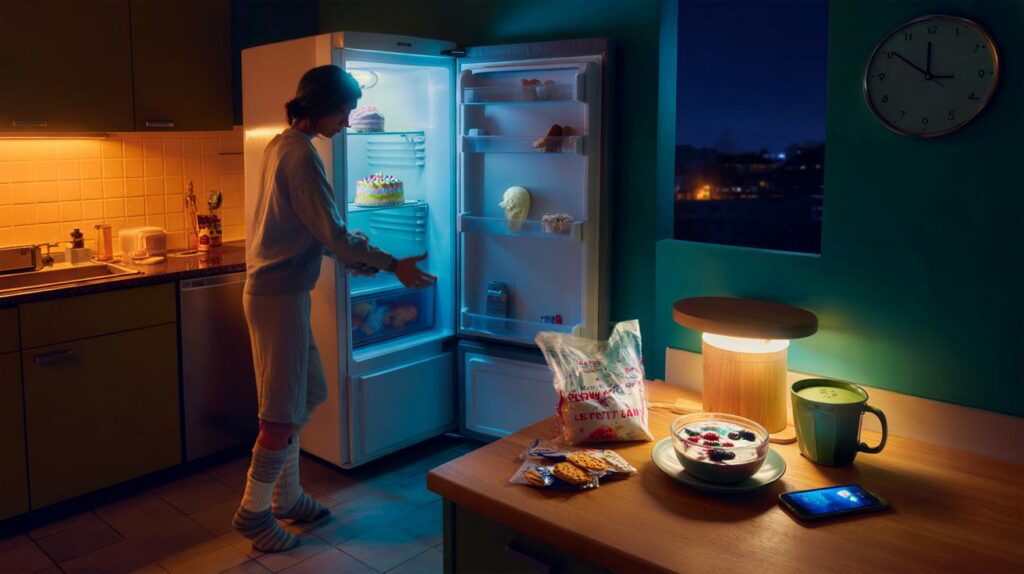
You’re lying on the sofa at 22:11, credits rolling, phone glowing, and the kitchen starts calling like a neighbour tapping the window. You’re not hungry-hungry. You’re sugar-hungry. The kind that makes your brain whisper about biscuits you forgot you had. You half-laugh, half-sigh, and start bargaining with yourself: one square of chocolate, two at most. Ten minutes later, the wrapper looks like confetti.
It’s 22:47 when I pad to the fridge, socks sliding on cool tiles, the blue light painting the room like a quiet aquarium. There’s leftover birthday cake, a scoop of vanilla, the sort of promise that softens a hard day. I eat with the door open, as if the cold could cancel the calories. My phone pings; a friend sends a “same” selfie with icing on her lip. We both grin at the absurdity of it. *It feels scripted, like we’ve watched ourselves do it before.* We’ve all had that moment when the kitchen light feels like a stage spotlight. It’s not just you.
What your body is really asking for after 22:00
By late evening, your body’s clock has shifted the rules of the game. Melatonin starts to rise, which nudges your metabolism into a slower gear, while your brain grows a little foggier in the self-control department. Insulin sensitivity tends to dip as the day wears on, so quick sugar looks like an easy fix for a tired system. The reward circuitry in your brain goes on high volume, spotlighting sweet, soft, fast energy as the hero of the hour. It’s biology doing its best with low battery.
Scientists see it again and again in the lab. Give people short sleep or push their body clock late, and they eat more in the evening — the snack window grows wider, the choices sweeter and fattier. One study found participants ate hundreds of extra calories after 22:00 when sleep was restricted, with a clear tilt towards ultra-palatable foods. In real life, it looks ordinary: a long commute, a late dinner, a couch, and the biscuit tin that suddenly feels magnetic. No one sets out to do it. The pattern just repeats until it feels like personality.
There’s logic under the craving. Sleep loss lowers leptin (the fullness signal) and raises ghrelin (the hunger spark), leaving you peckish even if you’ve eaten. Evening brings a natural **circadian insulin dip**, so sugar hangs around longer in your bloodstream — which weirdly makes your brain want more, not less. Add a day’s worth of decisions and stress, a dash of blue light from screens, and your prefrontal cortex — the sensible bit — gets quieter. The dopamine system, meanwhile, is wide awake and whispering about chocolate. Nature isn’t plotting against you. It’s negotiating.
How to break the late-night sugar loop
Start earlier than you think. Anchor your evening with a dinner that actually lands — protein, fibre, and some fat — then plan a small **buffer snack** around 21:00–21:30 if you need one. Greek yoghurt with berries. An oatcake with peanut butter. A few dates with tahini. Dim the lights at 21:30 to cool the brain’s tempo, and swap the last episode for a 10-minute wind-down: shower, stretch, breathe. Brushing your teeth early is an underrated signal that the kitchen has closed for the night. It’s a gentle fence, not a prison.
Don’t fight sugar with a stare-down. Change the stage. Put sweets out of sight, not out of bounds. Build a routine that makes the right choice the easy one: water bottle on the table, peppermint tea within reach, snacks pre-portioned rather than open-ended. If you do want dessert, put it on a plate and sit with it, not with the packet. Soyons honnêtes: no one actually does that every day. The goal isn’t perfection; it’s to reduce the number of nights where the craving drives the car.
Night shifts complicate the map, and stress does too. A simple rule helps: if the craving arrives like a wave, ride it for five minutes before you decide. Text a friend, step onto the balcony, fold laundry, breathe. Often that tiny pause lets the tide fall on its own.
“At 22:00, your brain isn’t weak; it’s protective. It’s asking for quick relief. Give it comfort with structure, not punishment with rules.”
- Set a kitchen “lights out” time and dim screens after 21:30.
- Keep a planned snack ready: yoghurt and berries, cottage cheese and pineapple, or a small banana with almond butter.
- Drink something warm and simple: mint or rooibos. The cue matters.
- Move three minutes: stairs, squats, a slow stretch. State shift beats willpower.
- Make sugar boring: single-serve portions, not family packs in arm’s reach.
The bigger picture you can actually live with
Your late-night sugar story isn’t a moral test. It’s the meeting point of light, timing, stress, and habit — plus a brain that’s spent all day making choices. Change one lever and the whole evening feels different. Change two, and the craving shrinks from a foghorn to a doorbell. Maybe this week it’s dinner with more fibre and fat, and a set bedtime. Maybe next week it’s swapping your last episode for a short walk and a cup of mint tea. Tiny, boring wins stack faster than heroic vows. There’s room here for pleasure, for pudding, for planned sweetness that lands softly. Share what’s worked for you. There’s always a trick someone else hasn’t tried yet.
| Point clé | Détail | Intérêt pour le lecteur |
|---|---|---|
| Body clock shifts at night | Melatonin rises, insulin sensitivity falls, reward circuits run hot | Explains why sugar feels irresistible after 22:00 |
| Plan a buffer snack | Protein + fibre + fat around 21:00–21:30 | Prevents the 22:30 binge without feeling deprived |
| Change cues, not willpower | Dim lights, brush teeth, warm drink, portioned sweets | Makes better choices easy when your brain is tired |
FAQ :
- Is eating sugar after 22:00 “bad”?It won’t ruin you, but late-night sugar hits harder as insulin sensitivity drops. You’re more likely to overeat and sleep less soundly. Aim for planned, small portions rather than grazing.
- Does fruit count as sugar at night?Fruit contains natural sugars, plus fibre and water that slow the hit. A small apple or berries with yoghurt is a steadier choice than sweets or ice cream.
- What if I work night shifts?Flip the strategy to your schedule. Treat your “evening” as the last third of your shift, dim light on breaks, and keep a protein-rich snack before your longest stretch without food.
- How long until the cravings ease?Many people notice a change within a week of better sleep timing and a consistent evening meal. The urge may still arrive, but it feels quieter and easier to ride.
- Should I cut sugar completely at night?All-or-nothing often backfires. A small planned dessert — a square of dark chocolate, a yoghurt pot — can be saner than total bans that lead to blowouts.



Super clair. J’ai tester le “buffer snack” à 21h (yaourt + fruits) et, surprise, zéro raid sur le placard à 22h45. Brosser les dents plus tôt marche aussi, ça coupe net l’envie. Merci pour le ton déculpabilisant et les astuces faisables au quotidien. Je garde l’idée de tamiser les lumières et d’éteindre les écrans vers 21h30; chez moi, le dernier épisode sera remplacé par une douche + étirements. On verra si la ghreline me lâche enfin.
Des sources précises pour la baisse d’insulino‑sensiblité après 22h ? Études, auteurs, année ? Je suis preneur.