
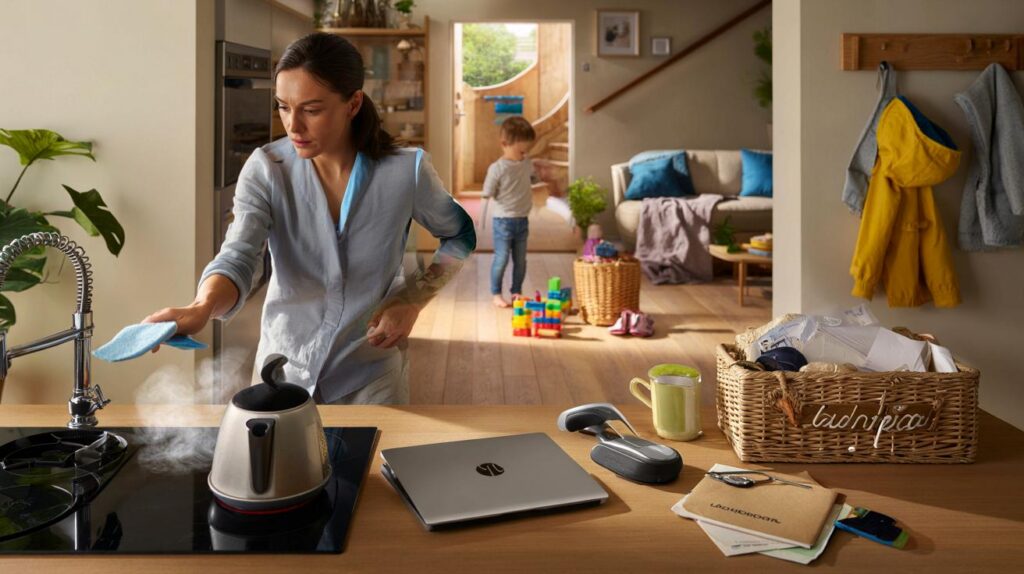
The living room looks fine until 7.42 p.m., when the sofa coughs up two toy dragons, a PE kit and what used to be a blueberry. The house didn’t fall apart in a day; it unravelled in moments between meetings, school runs and bedtime back‑and‑forwards. The question isn’t how to clean more. It’s how to clean faster, without thinking about it.
The kettle clicks on, the laptop fans hum, and a small sock blinks at you from the stairs like it’s judging your life choices. You wipe a crumb trail with your sleeve, answer a ping on Teams, then forget where you put the banana that went missing an hour ago. That’s when the doorbell goes and your brain whispers, “If only the hallway looked half decent.” The mess isn’t dramatic, it’s relentless. You can clear it… right until someone tips Lego into a shoe. We’ve all had that moment when you wonder if a tidy home is for other people. Then something clicks.
Why tiny routines beat weekend marathons
Big cleans look heroic on Sunday but they hide a week of stress. Micro‑routines — the kind you do while the kettle boils — are boringly powerful. They ride on habits you already have, like brushing teeth or locking the door, so the house stays on an even keel without grand gestures.
Think of Aisha, a GP receptionist with two kids, who time‑boxed a “7‑minute evening reset” to a single playlist. She starts when the first song hits the chorus and stops when it ends. No bargaining, no perfection. Three nights in, her hallway stopped eating shoes. Two weeks in, her Saturday felt like a Saturday again.
This works because the brain loves anchors. Pair a task with a cue — kettle, school drop‑off, brushing teeth — and the decision load drops. When a job is tiny and predictable, resistance falls away, and the floor stays clear enough to exhale. The house doesn’t get spotless. It gets stable.
The quick‑clean schedules that actually work
Try the 3×3 Clean: three minutes, three times a day. Morning: swipe bathroom mirror, sink, loo seat; dump laundry in the basket on your way out. After work: clear hotspots — post, shoes, the anything drawer — then quick hoover trail from hallway to kitchen. Lights‑out: reset sofa cushions, collect cups, run the dishwasher. Set a timer, stop when it beeps. Done is better than pristine.
Layer it with the Two‑Minute Rule: if it takes under two minutes, do it now. Wipe the hob while the pasta water boils. Empty the bin when you tie the nappy bag. Fold a micro‑pile every time you walk past the airing rack. Let’s be honest: nobody really does this every day. The trick is to do it most days, so tomorrow isn’t carrying yesterday’s weight.
Build a weekly “Loop You Can Live With”. Mon: surfaces and crumbs. Tue: floors and skirting trail. Wed: bathroom swipe + fresh towels. Thu: laundry heavy lift. Fri: entrance and bags. Sat: the 20‑minute “Sunday Sweep” brought forward, so Sunday stays free. Keep tools where you use them: a cloth in the bathroom, a mini spray under the sink, a spare bin liner in the bin. Two-Minute Rule, 3×3 Clean, and Sunday Sweep make a small triangle you can actually keep.
“I stopped ‘cleaning the house’ and started cleaning moments,” says Liv, a Brighton mum who keeps a microfibre cloth next to the toothbrush. “If I can see my taps shine before work, I don’t spiral.”
- Kettle Clean: four minutes to clear counters, load mugs, and wipe the hob ring you used.
- Doorline Rule: tidy only the part you can see from the doorway. Walk away.
- Laundry by colour‑day: darks Mon, lights Wed, towels Fri. No thinking, no piles.
- Launchpad basket by the door: keys, letters, school slips, library books — one home.
- Nightly 7: set a seven‑minute timer, whole family tidies to one song. Game over at the click.
Make it stick without burning out
Go for frictionless. Keep wipes where spills happen, stash a hand hoover on charge by the stairs, place a basket at the bottom step so you never go up empty‑handed. Label shelves so kids can “help” accurately: cups, bowls, lunch bits. It doesn’t have to be perfect; it has to be lighter.
Use cues you can feel. Start the Kettle Clean when the switch flips. Begin the bathroom swipe after face wash at night. Pair the Friday bag reset with checking the school newsletter. If you miss a day, you haven’t failed — you’ve stored up a slightly longer Monday. Turn the light, not the guilt, on.
Watch for traps. Over‑scheduling turns life into a checklist and steals your wins. Don’t chase spotless; chase predictable. If your partner isn’t on board, assign lanes not tasks: one owns laundry flow, the other owns floors. Trade on Sundays. If your workday explodes, ditch everything but the hallway and the sink. Tomorrow still counts.
Some homes hum when mornings feel clear and evenings land soft. Quick cleaning schedules don’t magic away mess; they turn it into routine background noise. Ask yourself which two rooms set your mood and build your triangle around them. Maybe that’s hallway, kitchen, bathroom. Maybe it’s bedroom, landing, nursery. Choose the cues you already live through, shrink every job to the shortest honest version, and stop when the timer says stop. Share your tiny wins. They’re how the house learns you’re in charge again.
| Point clé | Détail | Intérêt pour le lecteur |
|---|---|---|
| Anchor tasks to cues | Pair cleaning with kettle boils, tooth‑brushing, school run | Less decision fatigue, more consistency |
| Keep jobs tiny | 3×3 Clean and Two‑Minute Rule limit scope and time | Easier to start, easier to repeat |
| Design for reach | Tools where mess happens, baskets by doors, zones by day | Lower friction, faster wins on busy days |
FAQ :
- How do I clean with toddlers “helping”?Give micro‑jobs with labels: “Find all the blue blocks,” “Put spoons in this tub.” Make the Nightly 7 a game. Praise the attempt, fix the placement later.
- What if my partner isn’t on board?Swap outcomes, not chores: one owns “empty sink by night,” the other “clear hallway by morning.” Rotate weekly. Use a timer so it feels fair.
- Which kit actually saves time?A charged hand hoover, a caddy with one all‑purpose spray, microfibre cloths, and spare bin liners in every bin. Optional: a laundry basket per person to speed put‑away.
- How do I handle surprise guests?Run a 5‑minute Front‑of‑House: shoes lined up, post stacked, cushions fluffed, loo swipe, candle lit. Close doors to non‑public rooms. Smile.
- I fell off the routine. Where do I restart?Reset the triangle: hallway path, kitchen sink, bathroom sink. Three minutes each. Then tomorrow, do the Kettle Clean. Momentum beats guilt.



Absolutely loved the “3×3 Clean” idea. I tried the Nightly 7 with one song and my hallway stopped eating shoes, too. The cue‑pairing with the kettle is genius—less decision faigue, more action. Thank you for making “done > perfect” feel actually doable for a knackered mum.
Not sure this reduces mental load—feels like more micro‑decisions packaged as routines. If the partner isn’t on board, isn’t that just shifting the burden back to mum again? Any data (even anecdoctal) on dads sticking to “lanes” after week three, or does it fizzle?