
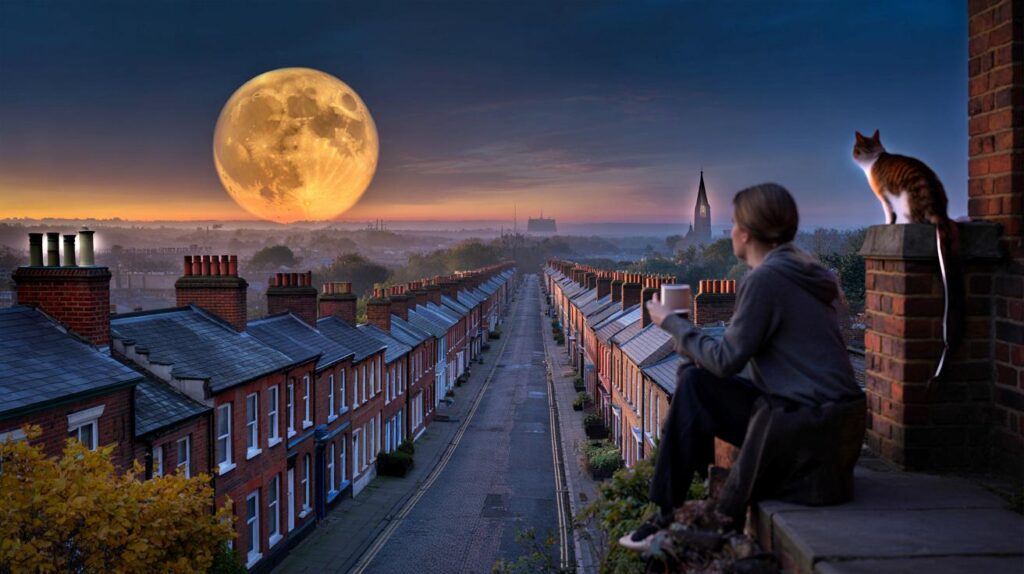
A rare seasonal quirk is about to light up the UK: an October Harvest Moon that also happens to be 2025’s first supermoon. It’s the full Moon tied to gathering and glow, arriving a touch later than usual and a touch larger than normal. The sort of sky moment that flips your evening from ordinary to cinematic.
I was walking home past the allotments, the air smelling faintly of bonfires and damp earth. A neighbour stopped, hand shielding her eyes, and nodded at the orange disk climbing over the terraced roofs. It looked impossibly close, the kind of moon that pulls you into the street and makes you forget your bag of potatoes. *For a minute, nothing else mattered.*
The cats went quiet, the buses hummed, and somewhere a child said, “It’s bigger, isn’t it?” I didn’t have a telescope and didn’t need one. The Moon seemed to swell as it rose through the city haze, gold softening to cream. It felt closer.
Why this Harvest Moon is different
Most years, the Harvest Moon lands in September. This time, the title jumps to October because that full Moon sits nearest the autumn equinox. That timing twist is unusual enough — and then comes the kicker.
The full Harvest Moon falls on 6 October 2025, and it will be 2025’s first supermoon. That single night ties together tradition and orbital geometry. Expect it to look a shade larger to the eye and distinctly richer in colour at the horizon.
We’ve all had that moment when you glance up, and the Moon feels like a proper character in the evening instead of background scenery. In 2020 the Harvest Moon also arrived in October — a reminder that this shift does happen, just not every year. Roughly once in three, the equinox lines up so the October full Moon claims the harvest name. This year folds in the supermoon factor, nudging the spectacle into that “call your mum and step outside” category.
The logic is clean once you step through it. “Harvest Moon” is simply the full Moon nearest the equinox, not a fixed month on a calendar. Around this time, the Moon’s path meets the horizon at a shallow angle for the UK, so successive moonrises come earlier than usual, keeping evenings bright for several days. A supermoon adds a physical boost: the Moon is closer to Earth at perigee, up to about 14% larger than at its farthest and as much as 30% brighter at the eyepiece. Your eyes translate those numbers into mood and colour.
When and how to see it best
Think in windows, not just minutes. The nights of 5–7 October will all look gorgeous, with the peak on the evening when the full phase lands. The sweet spot is moonrise to the end of twilight, when the Moon is low, golden and framed by rooftops or trees.
Look east just after sunset on 5–7 October for the biggest, goldest views. Check a moonrise time for your postcode and get to your spot 15 minutes early. Fields, seafront promenades, bridges, and south-facing hills are ideal. If you’re in a city, use a long street that runs roughly west–east so the Moon climbs straight over it like a glowing coin.
There’s an easy method that works. Pick a landmark — a church spire, a pier, a block of flats — and place yourself so the Moon will clear it within the hour after sunset. That gives you scale and drama, plus the psychological “Moon illusion” that makes the low Moon look huge. Bring a hot drink, a hat, and a second layer. Let the show breathe.
Common errors are simple and human. People turn up too late and find the Moon already high and pale. Or they pick a spot with a hidden eastern horizon, so the first glow is blocked by a row of houses. Weather can tease in October, so have a Plan B a bus ride away. Let’s be honest: nobody does that every day.
Don’t stare only on the exact night. The Harvest Moon’s magic stretches across a few evenings because the Moon rises roughly 20–30 minutes earlier from one night to the next in the UK at this time of year, instead of about 50 minutes. That “evening-after-evening” rhythm is what made it so useful to farmers working late in fading light. On coastal walks, keep one eye on spring tides across the week — big moons tug at water as well as feelings.
“Catch a supermoon near the horizon if you can — the colours and context do the heavy lifting,” a veteran skywatcher in Northumberland told me. “You’ll remember the streetlamp silhouette long after you forget the exact time.”
- Best look: the 60–90 minutes after sunset on 5–7 October
- Direction: due east at rise, arcing south overnight
- Gear: a mug, a friend, and a phone with Night mode (tripod if you’ve got one)
- Backup plan: a second location with a clear eastern view
What makes it a supermoon, and why October helps
A supermoon isn’t a special type of full Moon, it’s a full Moon happening close to perigee — the nearest point in the Moon’s elliptical orbit. That proximity shrinks the Earth–Moon distance by tens of thousands of kilometres compared with apogee, which your eyes sense as “near” even if the numbers sound dry. The effect is subtle overhead, striking at the horizon.
October also brings pretty lighting. Dry leaves, woodsmoke, and low-angle sunlight scatter reds and golds at dusk. The Moon rising through that thick slice of atmosphere picks up warm tones before it climbs into whiter light. Photographers love this stretch because street colour temperatures and moonlight blend like theatre.
Up to 14% larger and around 30% brighter — that’s the ballpark for a perigee full Moon versus a far-away one. You won’t need a ruler; your brain does the maths. What you will notice is how easily the Moon anchors a scene. A bus stop becomes a stage. A farmhouse lane feels like a film location.
How to watch, shoot, and share without overthinking it
Your best tool is a simple plan. Check the moonrise time for your town on 5, 6, and 7 October. Arrive early with a clear eastern view and a foreground you care about — a quay, a row of chimneys, a windmill. If you’re photographing on a phone, switch to Night or Pro mode, tap to focus on the Moon, and lower exposure so it isn’t a white blob.
There’s a neat gesture for bigger-than-life frames. Step back 50–100 metres from your subject — a friend, a tower, a tractor — and zoom to 2x–5x. That compresses distance so the Moon looks “closer” to the subject. On a mirrorless camera, an 85–200mm lens is the sweet spot. Shoot bursts as the Moon clears your landmark. One will sing.
Don’t worry about perfect kit. Good watching beats gear every time. If clouds drift in, they can add drama — broken skies make for painterly moons. If you strike out one night, try the next. And if you’re coastal, glance at tide charts and keep your shoes dry. The Moon will still be there when the kettle boils.
“Phones have caught up,” says a community astronomy guide in Portsmouth. “It’s not about megapixels, it’s about timing and a steady hand.”
- Phone tip: use a wall or railing as a tripod, 1/125s or faster if your app allows
- Classic mistake: overexposing the Moon until it’s a featureless disc
- Weather hack: holes in cloud often open from the west after sunset
- Sharing idea: note your exact viewing spot so friends can try it tomorrow
A moon worth making time for
Some celestial events are checklists. This one is a nudge. An October Harvest Moon that doubles as a supermoon doesn’t just tick a box; it changes the feel of an evening walk, a bus route, a back garden gate. It’s seasonal, local, surprisingly social.
Stand with neighbours you barely know. Text someone who moved away and watch the same rising light at the same minute from different towns. If you’ve got kids, let bedtime slide and let them remember how the Moon climbed over the school roof, fat and friendly. If you’re on your own, the quiet will do its work.
Next year’s calendar will juggle itself again. This one lands in October, warm-coloured and close. If you only catch a glimpse between errands, that still counts. If you end up staying for the full rise, even better. The Moon sets the pace. You just show up.
| Key points | Details | Interest for reader |
|---|---|---|
| October Harvest Moon is a supermoon | Full phase on 6 October 2025, with viewing sweet spot across 5–7 October evenings | Rare timing twist plus larger, brighter Moon |
| Best time and direction | Watch the first 60–90 minutes after sunset, looking east with a clear horizon | Maximise colour, size illusion, and photo opportunities |
| Simple watching and photo tips | Use a landmark, arrive early, reduce exposure, consider a little zoom | Turn an everyday phone into a keepsake maker |
FAQ :
- When exactly is the Harvest Moon in 2025?The full Harvest Moon lands in early October, with the peak night on 6 October 2025 and great views across 5–7 October.
- Why is the Harvest Moon in October this time?The title goes to whichever full Moon falls closest to the autumn equinox. In 2025 that’s the October full Moon, not September’s.
- What makes it a “supermoon”?It’s a full Moon occurring near perigee, when the Moon is closer to Earth. That proximity makes it appear up to about 14% larger and noticeably brighter.
- What’s the best time to look?Just after sunset on the nights around full, when the Moon is low and golden. Use a clear eastern horizon and a foreground for scale.
- Do I need special equipment?No. Your eyes are enough. A phone with Night/Pro mode helps for photos; a tripod or railing keeps things steady.



Is the “14% larger” actually noticeable to the naked eye, or mostly camera trickery? I’m a bit sceptical. Any side-by-side shots from apogee vs perigee to compare?