
In a Reggio-inspired nursery, nobody shushes a question. The day breathes with small hands, loud ideas and clay under fingernails. Parents used to colour-coded timetables ask the same thing: if children decide what and when they learn, does anything “proper” get learned at all?
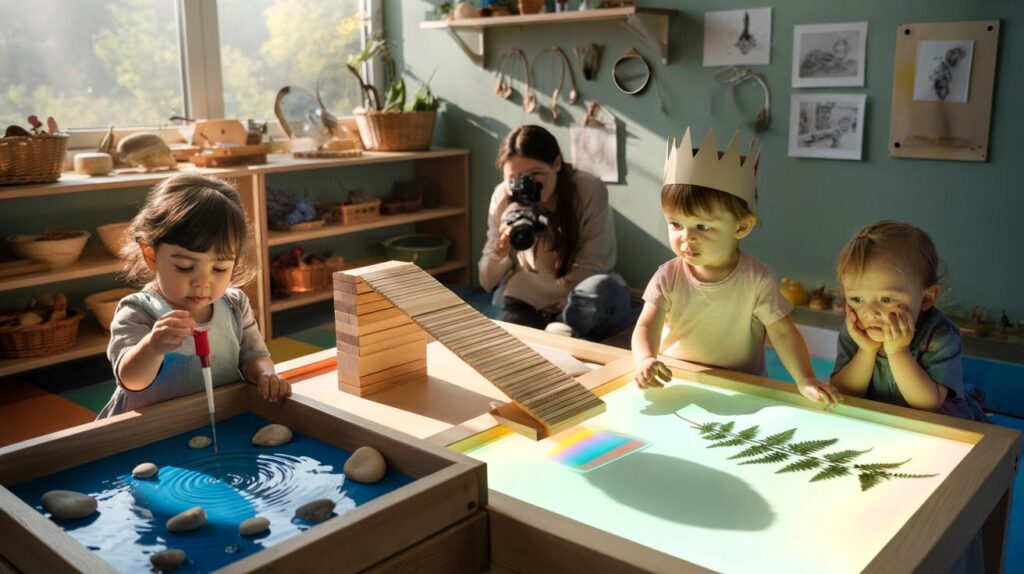
I’m standing beside a low table scattered with river stones, pipettes and shallow trays of blue-tinted water. A boy in a paper crown whispers, “It’s moving faster,” while a girl adjusts a ramp she’s made from a cardboard offcut. Their teacher kneels, camera in hand, not to stage a shot but to capture a moment of thinking. She asks, “What’s your plan?” and waits. No hurry. No bell.
Across the room, light spills onto a translucent sheet where two children trace the shadow of a fern. The walls are not wallpapered with adult-made posters, but with yesterday’s theories and sketches. No timetable, yet everything hummed.
Inside a child-led day
In Reggio nurseries, the “curriculum” comes from the children, not a scripted scheme. The adult role is to listen, document and propose materials that stretch an idea without hijacking it. You see it in the pace of the day, which follows curiosity’s rhythm rather than a countdown of slots. **Children are not empty vessels; they are protagonists.** The room itself is set up like a gentle invitation: loose parts, natural light, mirrors, and corners that say “stay a while”. It feels calm. It also feels alive.
Take Lila, four, who arrived one rainy morning staring at a puddle with a fringe of oil colours. That small “why is it rainbow?” snowballed into a three-week exploration of light, colour and reflection. The group built a shadow theatre, experimented with CDs and torches, and mixed water with glitter to “trap a rainbow”. Parents were invited to a twilight show with cardboard screens and whispering narrators. Literacy crept in through captions and tickets. Early maths appeared in measuring light strips and timing shadows.
Why this works is oddly simple. Agency feeds attention, and attention feeds learning. The Reggio idea of “a hundred languages” means children think through clay as much as through words, through sound as much as through numbers. The teacher becomes a researcher, making learning visible through photos and transcripts. We’ve all had that moment when a topic grabs us and time dissolves. We learn best when we care. Reggio doesn’t abandon knowledge; it braids knowledge through projects that matter to small people with big questions.
How to bring the approach to life
Start small with a provocation. Offer just a few beautiful, open materials linked to something your children noticed: magnifying glasses next to a wilting bouquet, wheels and cardboard by the bikes, clay beside a nest. Ask open questions like “What do you notice?” and “What else could we try?” Keep a notebook or voice notes to capture children’s words. Use that trace to decide tomorrow’s offer. A light table, mirrors, and baskets of loose parts go far. So does slowing down.
Common mistakes? Confusing freedom with absence of boundaries. Reggio rooms are free, not feral. Set clear agreements—kind hands, shared tools, tidy as community care. Another trap is the toy avalanche. Too many choices numb curiosity; rotate materials to keep the room readable. Don’t rush to rescue every wobble. Product matters less than process. Let’s be honest: nobody really does that every day. Progress, not perfection, grows the culture you want.
Listen for the idea under the chatter, then feed it lightly. Quote it back to the group, and let the room respond with materials, space and time. This is where the magic happens—long arcs of play that deepen into learning.
“Nothing without joy.” — Loris Malaguzzi
- Choose depth over dazzle: fewer materials, richer time.
- Document thinking, not just outcomes: photos with children’s words.
- Invite families into the story: a note, a corner display, a question at pick-up.
- Use the environment as a third teacher: light, mirrors, reachable tools.
- Plan from yesterday: today’s offer answers last night’s questions.
The bigger picture
Reggio isn’t a franchise. It’s a stance: children as capable citizens whose questions deserve a full reply. In practice that means nurseries that look like studios, adults who look like co-pilots, and days that feel less like a script and more like a conversation. It also means trusting slow time. A child can spend forty minutes balancing three pebbles and learn balance, focus and frustration management in one go. **The future needs people who can notice, persist and collaborate.** That starts here, with small projects that teach big habits—listening, hypothesis, revision, care.
| Key points | Details | Interest for reader |
|---|---|---|
| Children drive the curriculum | Projects grow from children’s questions and are extended by teachers through materials and time | See how agency boosts attention, motivation and genuine understanding |
| Environment as third teacher | Light, space, loose parts and displays that document thinking guide behaviour and exploration | Simple room changes can transform learning without buying new toys |
| Documentation and community | Photos, transcripts and displays make learning visible and invite families into the process | Turn “play” into evidence colleagues and parents understand and support |
FAQ :
- Is Reggio the same as Montessori or Steiner?They share respect for the child, but differ in method. Reggio is project-based and emergent; there’s no fixed set of materials or sequence.
- Do children still learn reading and maths?Yes. Literacy and numeracy appear inside meaningful projects—labels, maps, measuring, counting, stories—then are revisited with growing precision.
- How do teachers plan without a set curriculum?They plan responsively. Observation and documentation guide what to offer next, aligned with early years goals and children’s interests.
- What about children who crave structure?Structure exists in routines, agreements and the environment. Choice sits inside a clear frame, which helps anxious learners relax.
- Is it only for expensive private nurseries?No. Many public settings are Reggio-inspired. The core moves—listening, materials, documentation—are mindset shifts more than budget lines.



Beautifully written. The part about the teacher as researcher and ‘making learning visible’ really resonates—I can see how photos plus children’s words turn play into evidence for families. The environment-as-third-teacher examples (light, mirrors, loose parts) are practical, not Pinterest fluff. Also, “plan from yesterday” is a mantra I’m stealing. This definitley reframes agency as a tool for attention, not chaos.