
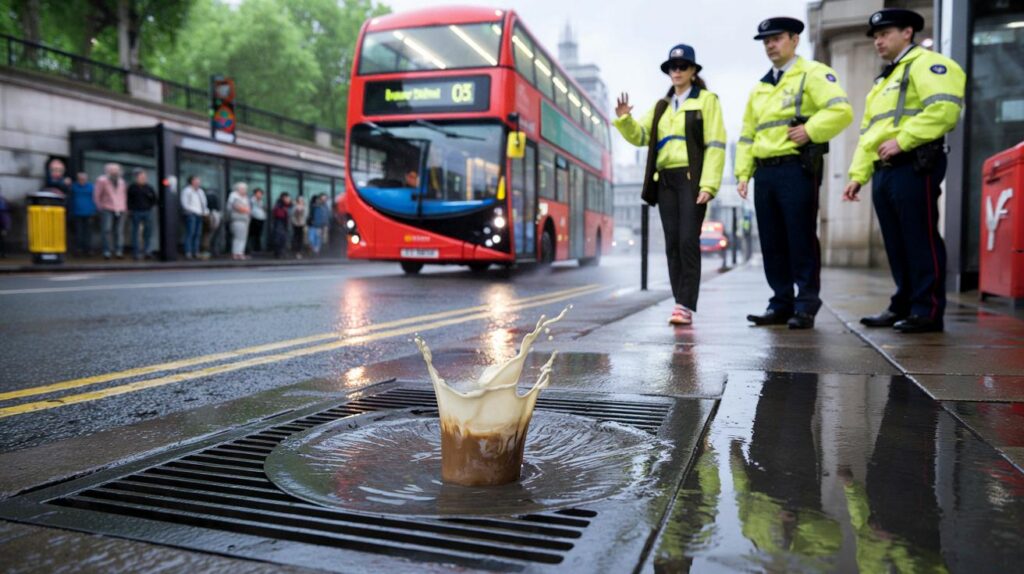
A quick sip, a crowded pavement and a split-second choice at a Richmond bus stop set off a citywide argument.
The episode began with a reusable cup and ended with a cancelled penalty. In between came a blunt lesson on street gullies, environmental law and how far councils should go to police minor missteps.
What happened at the bus stop
Burcu Yesilyurt, a Kew resident, was waiting near Richmond station when her bus pulled in. To avoid a spill on board, she tipped the remnants of her coffee into the roadside gully and moved to board. Three enforcement officers stopped her at once. Minutes later, she held a £150 Fixed Penalty Notice citing Section 33 of the Environmental Protection Act 1990.
She said the exchange felt heavy-handed. She had not realised pouring liquid into a road drain could count as an offence. She asked if any signs warned passengers not to do so. She said she was given no answer. She also said officers told her she should have put the liquid in a nearby bin instead.
Body-worn video from the encounter was later reviewed by Richmond upon Thames Council. The council said the officers acted within policy. Even so, it reversed the fine, calling the breach “minor,” and pointing out that an appeal would likely have succeeded.
The £150 penalty was withdrawn after review. The council said the case would likely have been overturned on appeal.
The law behind the notice
Section 33 makes it an offence to deposit or dispose of waste in a way that risks polluting land or water. That includes pouring liquids into street gullies. Councils can issue Fixed Penalty Notices for such breaches as an alternative to prosecution.
The reason is simple. Many road drains do not feed into a treatment works. They carry run-off straight into rivers and streams. Coffee contains acidity, sugars and sometimes milk. In small volumes the risk is low. In aggregate, across a busy borough, the load builds up and harms water quality and wildlife.
Street drains are not sinks. In many streets, what goes down the grate ends up in the Thames.
Why the council backed down
By mid-afternoon, an email arrived in Ms Yesilyurt’s inbox. The council had cancelled the Fixed Penalty Notice “on review” and apologised for any distress. It stressed that an appeal route exists on all notices and suggested this case would probably have been rescinded anyway.
The decision reflects two tensions now familiar across London. Residents want clean streets and healthy rivers. They also want fair, proportionate enforcement. A rigid approach can alienate the very people councils rely on to follow rules voluntarily.
Richmond says it remains committed to protecting its waterways. The U-turn suggests it also heard the public mood: a small splash of coffee, absent any warning signs, should not carry the same weight as dumping waste.
A pattern of contested penalties
Local enforcement has drawn scrutiny elsewhere. A £600 notice for wind-blown rubbish was recently cancelled after challenge. Proposals to fine people for feeding ducks prompted a backlash. These rows share a theme: when does zero tolerance start looking like zero discretion?
Strong rules need strong judgement. Residents will support enforcement when it feels fair, consistent and well signposted.
What should you do with leftover drinks?
If you are caught with a few mouthfuls before a bus or train, there are safer options than a road gully.
- Keep the lid on and finish it later, or empty it into a sink or toilet at your destination.
- Ask a nearby café to pour it away into a proper sink if you cannot board with it.
- If you must bin it, seal the liquid in its cup with the lid on to avoid leaks, then place it in a litter bin.
- Carry a reusable bottle or cup with a screw top to avoid last-second decisions.
- Never pour liquids into street drains, even if they look like basins.
How fixed penalty notices work
Fixed Penalty Notices are civil-style tools for criminal offences. Paying one closes the matter without a court hearing. Not paying can lead to prosecution. Councils set the level within legal limits; for environmental offences, local amounts in England often run from £80 to £400 depending on the behaviour and policy.
Most notices include instructions for challenging the decision. This is not a formal statutory “appeal” like a parking ticket, but councils accept representations and can cancel if evidence supports it. If you maintain your innocence and a council presses on, you can defend the case in court.
- Act quickly. Deadlines to pay or challenge are short.
- Provide context and evidence, such as photos of the location or lack of signage.
- Ask for body-worn footage if officers recorded the incident.
- Keep records of all correspondence and the time you submitted it.
Why drains matter in busy boroughs
Most UK streets use a separate drainage system for rainwater. Those gullies capture oils, grit and debris from the road and channel them to rivers. Water companies do not treat this flow. Even small volumes of milk, paint, detergents or coffee contribute to oxygen depletion and algal blooms. In warm spells and low flows, the impact is more pronounced.
Councils therefore try to change habits as well as punish egregious breaches. Signs near hotspots, paint stencils reading “only rain down the drain,” and public campaigns can shift behaviour more safely than surprise fines. Consistent, visible rules also reduce arguments at the kerb.
Signage, discretion and common sense
Ms Yesilyurt has called for simple signs near bins and bus stops. That would support the environmental goal while avoiding gotcha moments. Richmond’s review hints at a pragmatic line: educate first, and reserve penalties for persistent or harmful cases.
Clear signs and clear reasons make compliance easy. People change faster when they know why a small act can cause a bigger problem.
Extra context for readers
There is a practical test for liquids and drains. If the substance would harm a fish tank, keep it out of a street gully. That covers paint, solvents, mop water with bleach, and milky coffee. Use indoor sinks connected to foul sewers, which lead to treatment.
If you receive an environmental Fixed Penalty Notice, ask yourself three questions. Was there intent or harm? Were signs present? Do the council’s photos or video match your account? If your answers raise doubts, set out the facts calmly and request a review. Many councils will reconsider where the breach is minor and the lesson has been learned.



Glad the fine was scrapped, but this exposes a gap: signage and public info. If gullies really feed the Thames, tell people clearly at bus stops and bins. Heavy-handed enforcement without notice feels overzealous, even if the law technicaly allows it. Educate first, ticket persistent offenders.
So coffee is pollution but diesel buses idling aren’t? That logic feels… selective.