
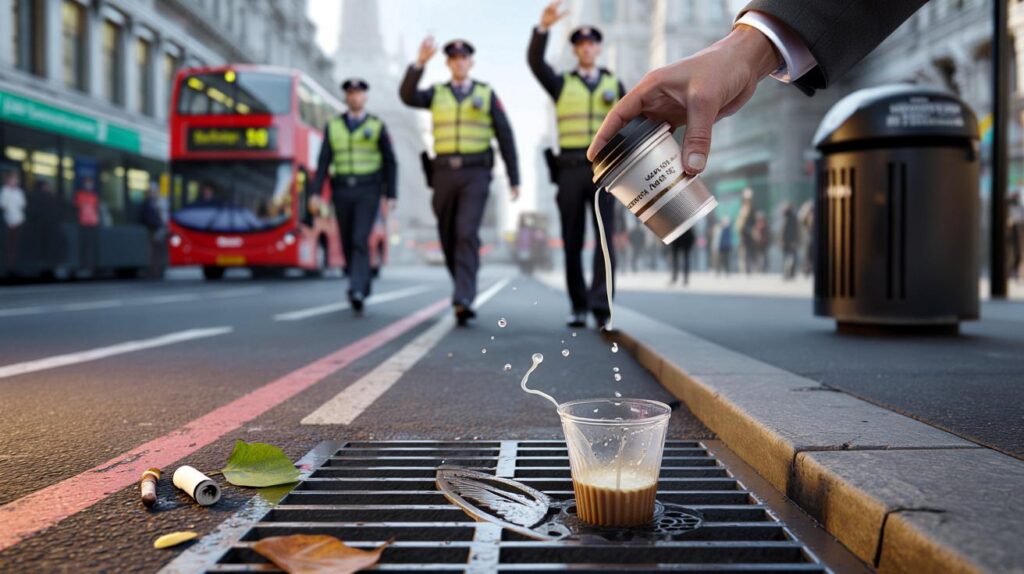
A morning commute, a reusable cup and a roadside drain collided in Richmond, triggering a flurry of questions about rules.
Richmond upon Thames Council has scrapped a £150 fixed penalty issued to Kew resident Burcu Yesilyurt after officers said a splash of leftover coffee poured into a street gully breached anti-pollution law.
What happened at the bus stop
Ms Yesilyurt tipped a small amount from her reusable cup into a gully near Richmond station as her bus approached. Three enforcement officers stopped her and issued a Fixed Penalty Notice under Section 33 of the Environmental Protection Act 1990, which covers depositing waste in a way likely to pollute land or water.
She said she felt startled by the approach and did not know that street gullies are off-limits for liquids, including coffee. When she asked what she should have done, she says an officer suggested emptying the drink into a nearby litter bin. She had intended to avoid a spill on the bus.
£150 penalty issued at a bus stop in Richmond for coffee poured into a gully; later cancelled after review.
On Wednesday at 15:00 BST, the council emailed to confirm the notice had been cancelled and offered an apology for the upset caused. The council said the contravention was minor, that the recipient had agreed not to repeat it, and that any formal appeal would likely have succeeded. Body‑worn footage was reviewed and the council remained satisfied the officers acted within guidance.
The legal line on drains
Road gullies collect rainwater and, in many streets, flow straight to rivers or streams without treatment. That protects homes from flooding but creates a clear rule: no waste down the gully. Section 33 of the Environmental Protection Act 1990 gives councils powers against disposal that risks pollution. Liquid counts as waste when discarded, whether it is paint, oil or a milky coffee.
Many people assume street drains connect to the same sewer as a kitchen sink. Often they do not. Milk and sugar add nutrients that can deplete oxygen in waterways. Coffee is acidic and contains caffeine. One cup won’t poison the Thames, yet repeated tipping by hundreds of commuters can add up.
Street gully ≠ kitchen sink: many road drains run to rivers, not to treatment works, so what goes in may go out to nature.
What should you do with leftover drinks?
- Empty liquids into an indoor sink or toilet linked to the foul sewer, at home or at work.
- Carry a leak‑proof cup and keep the remainder until you reach a proper drain.
- Ask a café to take the leftover liquid and rinse the cup before you travel.
- Use a litter bin only for the empty cup; do not pour liquids directly into bins.
- If in doubt, keep the lid on and take it with you; small amounts can be poured safely at your destination.
Enforcement under pressure
Fixed Penalty Notices (FPNs) are intended to deter behaviour that harms the environment without dragging people to court. Councils ask contractors or in‑house teams to patrol and act on littering, fly‑tipping and improper disposal. These teams wear cameras to record interactions.
Disputes tend to flare at the boundary between common sense and hard rules. In Richmond, officials have faced scrutiny for other enforcement calls that hit headlines, including a £600 penalty cancelled after rubbish blew from a resident’s bin, and proposals to fine people for feeding ducks. Those cases speak to a wider balancing act: protecting waterways and streets while avoiding penalties that feel disproportionate or confusing.
| Case | Alleged offence | Penalty | Outcome |
|---|---|---|---|
| Coffee in gully, Richmond station | Liquid disposal to road drain | £150 FPN | Cancelled after review and apology |
| Wind‑blown rubbish | Litter escaping from household waste | £600 penalty | Reported as cancelled following challenge |
| Feeding ducks | Proposed public space restriction | Consultation on fines | Policy under consideration |
How appeals and reviews work
Payment of an FPN usually ends the matter and avoids court. If you believe it was wrongly issued, ask the council for a review straight away. Many councils run a written process that checks the officer’s notes and camera footage and weighs any mitigating factors.
Act quickly: request a review in writing, keep the notice number and provide evidence such as photos, receipts or a witness statement.
If a council refuses to cancel and you still do not pay, the case can proceed to prosecution. A court then decides whether an offence occurred. That carries risk of a higher fine and costs. Early engagement keeps options open and can prevent a simple mistake becoming an expensive dispute.
Why a splash of coffee matters
Bring the chemistry into the picture. Coffee contains acids and caffeine; milk adds fats and proteins; sugar feeds bacteria. In a foul sewer, a treatment works can remove most of this load. In a surface water drain, there may be no treatment at all. That is why councils draw a bright line at the gully grate.
Scale tells the story. Imagine 500 commuters each tip 30 ml before boarding. That is 15 litres a day at one busy stop, much of it milky, hitting a stream during dry weather when dilution is low. Add cigarette butts and food scraps, and you get a steady pulse of pollution that is hard to trace but easy to prevent.
Simple changes that help
- Look for gully covers with fish symbols or “drain to river” markings; take that as a no‑pour sign.
- Switch to cups with a positive lock on the lid to carry leftovers safely.
- If you host events, set up liquid‑emptying stations leading to indoor drains.
- Ask your council to add clear stickers near bins and bus shelters explaining where liquids should go.
What Richmond’s decision signals
The council says it remains committed to protecting local waterways, while acknowledging that this case sat at the low‑harm end of the spectrum. Cancelling the notice after review signals a preference for education when someone makes a good‑faith mistake and agrees to change behaviour.
Residents, meanwhile, are asking for clearer signs and plain‑English guidance at the point of decision: near bins, bus stops and drains. A small sticker costs pennies. It can prevent a penalty, a confrontation and a public row.
If you face a similar situation
- Stay calm and ask the officer to explain the alleged offence and the law applied.
- Request the reference number and how to seek a review.
- Note nearby features that might affect the case, such as lack of signage or an unsafe alternative.
- Write your account while details are fresh and submit it with any evidence within the stated timeframe.
One final note on infrastructure: many streets in older parts of London still split rainwater and foul flows. Water companies and councils are gradually retrofitting sustainable drainage, but that takes years. Until then, the simplest fix is behaviour. Keep liquids for the sink, keep solids for the bin, and keep the gully for the rain.
For commuters in a rush, a quick rule helps. If you can see the sky through the grate, it probably leads to a river. If you see a porcelain basin, that is the one for coffee.



So coffee is now hazardous waste unless filtered through a porcelain altar? Next up: decaf licenses. Feels a bit ridiculus, but if drains go straight to rivers, maybe a warning first would do.
£150 for a splash? Seriously?