
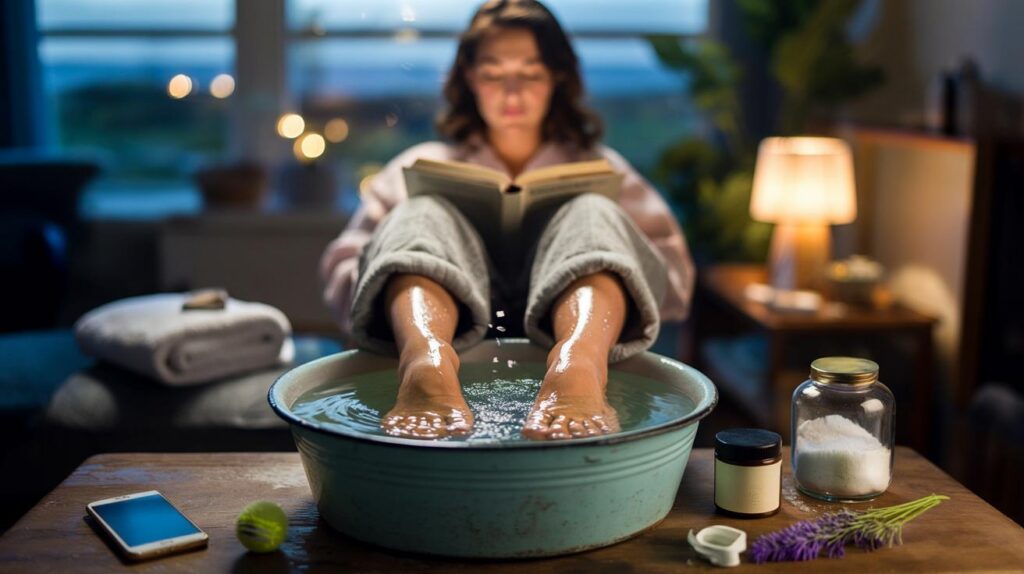
The day stacks itself on your ankles first. Meetings, buses, stairs, the unending ping of life — all funnelled into two tired feet that just want five quiet minutes. A bowl of warm water and a handful of salt look too simple to matter. That’s the trick: this tiny ritual hides more than it shows.
The kettle clicks off and steam softens the kitchen light. She carries an enamel basin to the floor, pours, and watches salt swirl like snow in a globe. The phone lies face down for once. The first touch stings pleasantly, then eases; toes uncurl, calves sigh, jaw loosens a notch. Outside, a siren threads past. Inside, a small pocket of time opens, the kind that often slips away from women first. Something lifts.
The quiet power of a salt foot bath
We think of feet as tools; the body thinks of them as a control panel. Warm salted water cues blood vessels to widen, nerves to soften, and the brain to drop its shoulders. It’s a reset button you can run from a washing-up bowl, and the benefits often ripple far beyond your toes.
Take Emma, 36, a teacher who ends most days with a basin by the sofa. She tips in Epsom salt, sets a timer for 15 minutes, and reads half a chapter while her ankles de-puff from the commute. After a week she notices she sleeps better, wakes with less calf tightness, and her heels look less like winter. She laughs about it being “a granny thing”, but she keeps doing it. Results beat image.
There’s some logic beneath the comfort. Warm water improves circulation and loosens fascia; a pinch of sea or Epsom salt makes the soak slightly hypertonic, which can help with mild swelling after long hours on your feet. The scent you add — lavender, peppermint, or nothing at all — steers your nervous system toward rest. Research is still mixed on transdermal magnesium, so treat salts as an aid to relaxation rather than a miracle mineral. The ritual itself does a lot of the heavy lifting.
Making it work in your real life
Here’s a simple method that fits a Tuesday night. Fill a basin with warm water around 40–42°C, enough to cover ankles. Add 1/2 cup (about 120 g) of Epsom or sea salt and swirl until dissolved. Soak for 12–20 minutes, then pat dry and follow with a dab of plain moisturiser to lock in softness.
Go by feel not bravado: if the water is too hot to keep a finger in for ten seconds, it’s too hot for your skin. Skip essential oils if you’re sensitive, and dry carefully between the toes — a tiny habit that saves you from damp-related niggles. We’ve all had that moment when small maintenance turns into big hassle. Let’s be honest: nobody really does this every day.
Think of it as a pocket ritual that can flex with your cycle, your week, your hormones. On premenstrual days, choose warmer water and a slower breath; on summer nights, go cooler and lighter. Small rituals can carry big weight.
“I soak, breathe, and it feels like my head unclenches before my feet do.”
- What to have to hand: salt, basin, towel, moisturiser, a book or playlist.
- Optional boosters: a tennis ball for rolling arches, a drop of lavender, a hot-water bottle under the calves.
- Swap-ins: Himalayan, sea, or Epsom salt all work here.
What the ritual gives back
The soak itself is only part of the story. For many women, it’s the rare act of doing something uncomplicated and immediate, with no app, no badge, no audience. You gift yourself a boundary and your body registers that permission. The water cools, time slows, the day loosens its grip. The returns arrive quietly: **lighter legs**, a steadier mood, fewer 2 a.m. spirals when sleep used to snag.
There’s also the way it travels. You pass it to a flatmate who runs, a sister who stands all day on the ward, a mum who won’t sit still long enough to rest. They try it once and realise they’ve been ignoring the part of them that makes everything else possible. Maybe it becomes your pre-bed cue, or the thing you do while voice-noting a friend. Maybe it’s your Sunday quick pedicure that leaves **softer heels** without the faff.
As recovery rituals go, this one costs pennies and asks for presence more than perfection. It doesn’t fix life; it steadies the edges so life feels more holdable. And sometimes that’s enough to nudge the rest. **Deeper sleep** often starts with smaller days, and smaller days can begin with a bowl, a kettle, and ten quiet minutes.
| Point clé | Détail | Intérêt pour le lecteur |
|---|---|---|
| Best salt and dose | 1/2 cup of Epsom or sea salt in ankle-deep warm water | Simple, repeatable setup that fits weeknights |
| Time and temperature | 12–20 minutes at around 40–42°C | Maximises comfort, circulation and wind-down |
| Aftercare | Pat dry, moisturise, optional arch roll with a ball | Locks in softness and eases next-day foot fatigue |
FAQ :
- Which salt works best for a foot soak?Epsom salt is popular for its feel, but plain sea salt also does the job. Choose what you like and what you have.
- Does a salt foot bath really “detox” the body?No realistic soak pulls toxins out through your feet. What it can do: ease swelling, calm the nervous system, and support better sleep.
- Can I do this while pregnant or breastfeeding?Warm (not hot) foot soaks are generally considered fine, and many women find them soothing for puffiness. If you have swelling that comes on suddenly or other symptoms, speak to your midwife or GP.
- Will it help with athlete’s foot or cracked heels?Salt soaks can soften hard skin and make care easier. For fungal issues, keep feet dry and use an antifungal if needed; the soak is a helper, not a cure.
- How often should I soak my feet?Two to three times a week fits most lives. Go by how you feel and what your week allows.



Je viens d’essayer 15 min avec 1/2 tasse de sel de mer et… jambes plus légères, esprit plus calme. J’avais pris ça pour un ‘truc de mamie’, mais l’effet est réel. Le rappel de ne pas surchauffer l’eau m’a sauvé mes petons 🙂 Merci pour l’astuce d’hydrater après, talons moins râpeux.