
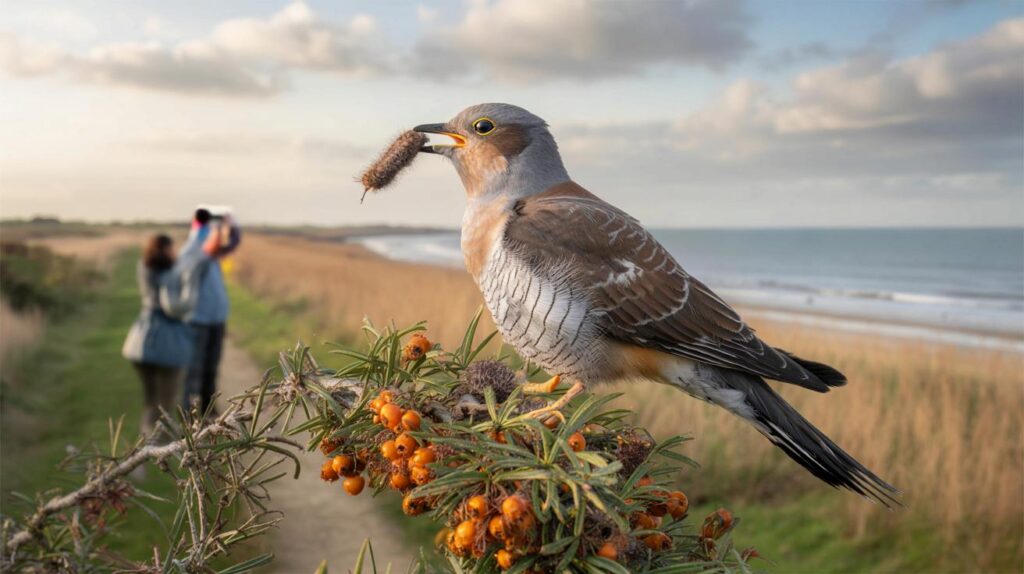
Skies over Salthouse have kept locals glancing up, as binoculars twitch and camera shutters click in an unusually busy week.
The coastal reedbeds of north Norfolk have hosted a surprise guest: a juvenile cuckoo lingering around Salthouse for 10 days, feeding hard and showing well to those patient enough to watch. Local photographer Adam Spruce returned repeatedly to the site across the week, confirming the young bird’s age and its habit of dropping into hedgerows to fuel up for the long journey south.
What witnesses saw
Walkers reported a slim, dove-sized bird sweeping low over the marsh before pitching into hawthorn and sea buckthorn. The cuckoo kept to a circuit, crossing above the shingle ridge, then back over the reedbeds with quick, level wingbeats. When perched, it flashed barred underparts and a long tail with white tips. Brief views revealed a yellow eye-ring and a slightly downcurved bill.
Several observers noted quiet moments between feeding bouts. Juveniles rarely give the famous “cuck-oo” call; instead they sit tight, then sally for insects and soft fruit when the coast looks clear. The bird showed a preference for sheltered edges—exactly the kind of cover that holds late-summer larvae and hedgerow berries.
A red-listed juvenile cuckoo has lingered at Salthouse for 10 days, feeding up before a 5,000 km, Africa-bound migration.
A juvenile preparing to leave
Young cuckoos depart after adults, often in late summer and early autumn. They travel alone, navigating a route they have never flown before. To make that possible, they build fat reserves fast. Observers at Salthouse watched the juvenile working the hedges—an efficient strategy when invertebrates lie low in cooler spells. Cuckoos specialise in large, hairy caterpillars that many birds avoid, but a hungry youngster will also take beetles and occasional fruit to top up energy.
Once ready, a bird of this age can cross Europe in stages, then make a bold leap over the Sahara. British tracking studies show two main corridors, via Iberia or Italy, both funneling birds toward West and Central Africa where they spend the northern winter.
Why this sighting matters
Cuckoos sit on the UK’s Red List, which flags species of highest conservation concern. Long-term monitoring shows severe declines in parts of England, with some regions losing well over 60% of their breeding cuckoos since the 1980s. Norfolk still records them, but many lowland sites now go quiet in spring.
Red list status signals urgent conservation priority: habitat change, prey shortages and migration hazards all play a part.
The species depends on a reliable supply of caterpillars, especially in May and June when nestlings need steady protein. Changes in land use, pesticide impacts on insects, and shifting weather patterns can starve that pipeline. Hazards also loom far from British shores: birds must survive Mediterranean bottlenecks, the Sahara crossing and Sahel drought cycles before they return.
How cuckoos live by stealth
Cuckoos do not build their own nests. Females lay single eggs in the nests of other birds—classic “brood parasitism”. Host species in Norfolk often include reed warbler, dunnock and meadow pipit. The cuckoo chick hatches quickly and pushes out rival eggs or chicks, monopolising food deliveries. The tactic looks ruthless, but it has evolved over millennia and creates a delicate balance: if hosts decline, cuckoos soon follow.
Where and when to look around Salthouse
Birders had their best views along the margins of the reedbeds and hedgerows near the village and the shingle ridge. Early morning brought calmer air and fewer walkers; late afternoon produced steady feeding flurries before the wind dropped. Keep your distance, scan hedges slowly and watch for that long, barred tail swinging as the bird shifts along a branch.
- Stay at least 25 metres from perched birds and stick to established paths.
- Avoid playback of calls; it stresses birds and spoils sightings for others.
- Use 8x or 10x binoculars; a 300 mm lens or longer helps if you plan to photograph.
- Log your sighting with a county recorder or a national survey app to aid monitoring.
- Check wind: light easterlies or calm spells often keep birds low and visible along hedges.
Conditions that often help
Late-summer high pressure, bright but mild afternoons and a gentle onshore drift can concentrate insect life along warm hedges. Those edges hold the food a juvenile needs. When the wind stiffens, watch the lee side of hedgerows, where birds shelter and feed in short bursts before dropping out of sight.
At a glance: the Salthouse cuckoo
| Length of stay | 10 days observed |
| Age | Juvenile (fresh barring, no adult male song) |
| Wingspan | About 55–66 cm |
| Migration distance | Roughly 5,000 km to West/Central Africa |
| UK conservation status | Red List (highest concern) |
What sets it apart from lookalikes
Brief views can trick even experienced eyes. Sparrowhawks share the same grey-and-barred palette, and kestrels work similar edges. These markers help:
- Flight style: cuckoo flies with level, elastic wingbeats; sparrowhawk shows snappy flap-glide; kestrel often hovers.
- Tail: cuckoo’s long tail has neat white spots at the tips; sparrowhawk tail bars look broader and squarer.
- Head and bill: cuckoo shows a slim, slightly downcurved bill and yellow eye-ring; sparrowhawk has a more powerful, hooked bill.
- Behaviour: cuckoo frequently perches exposed on hedges and wires; sparrowhawk hugs cover then bursts through.
Why you might see more—or less—next year
Local records can swing with insect fortunes. A warm, settled spring boosts caterpillars and can lift breeding success for host species, which in turn supports more cuckoos. Cold snaps at the wrong time can crash larval numbers and ripple up the chain. Habitat work that encourages insect-rich margins and healthy reedbeds gives hosts better odds and helps cuckoos indirectly.
Support insect-rich habitats—hedgerow blossom, untreated field margins and diverse wetlands feed the entire cuckoo story.
How to add value to a sighting
If you catch up with a cuckoo around Salthouse, make a quick note: time, behaviour, food taken, wind direction and exact location. Those five details turn a casual record into useful data. A series of such notes across August and September tells local recorders when juveniles pass through, which patches they use and how long they linger. That pattern guides future habitat work, from hedgerow planting to reedbed edge management.
For families, a short field exercise helps younger birders: count how many minutes the bird spends perched versus feeding in a single half-hour watch. Compare your numbers with a friend on a different day. You build a tiny dataset that shows how weather nudges behaviour, and you anchor a memory that will make next spring’s first “cuck-oo” feel closer to home.



Ten days in Salthouse—what a holdout! I definately thought juveniles moved on faster. Loved the detail about it dropping into hawthorn and sea buckthorn to tank up for that 5,000 km push.
Cuckoo or sparrowhawk—anyone else squinted?