
One Essex seaside promise pulled me east from Liverpool Street. The welcome felt gentle, the setting pristine, and the mood oddly familiar.
I stepped off the train at Frinton-on-Sea to a handwritten board touting cream teas and not a vending machine in sight. Within minutes the soundtrack shifted to wartime melodies drifting from shop doorways, and the streets thinned to a quiet that felt curiously staged. A day later, the ride back to London felt less like a commute and more like resurfacing.
A station without vending machines
Frinton-on-Sea sits a few stops beyond Clacton, neat as a postcard, polished as a show home. The station platform speaks of gentler rhythms: chalked-up treats, a tidy forecourt, no plastic-blazing retail kiosks. It sets the tone before your first cuppa. The first walk into town reinforces it. Pet shops pulse with jaunty numbers from a different century. Charity shops hum with brassy marches. The effect is theatrical, and it doesn’t let up.
At street level the details pile up. Blue-and-navy interiors, pristine window displays, an absence of litter. You notice glances that linger a beat too long on fresh faces. Not unfriendly, but firm. You’re a guest in a place that guards its habits.
A seaside town that prizes order over impulse, ritual over novelty, and hush over hustle can feel like time travel.
A club where the past sits on velvet
Across from the little theatre sits the War Memorial club, known locally as “the Mems”. Inside, the décor turns the dial back several notches. Portraits of the late Queen look down on royal-blue velvet banquettes. Union flags line a wall above a display that resembles a small shrine. A drum rests beside plastic poppies. Trophies sparkle with austere pride. On a shelf, well-thumbed military comic anthologies share space with bric-a-brac that could have been lifted from a careful attic clear-out.
Membership is the gatekeeper. On arrival, expect to write down your details, provide a local contact and produce a slip if you’re visiting on a temporary pass. The room acknowledges you the second you step over the threshold. Heads turn, not dramatically but decisively, as if the act itself is part of the welcome. The reward is cheap beer by London standards. £5 a pint buys you a seat in a living archive.
Five moments that jarred in the first hour
- A chalkboard promising cream teas as the only refreshment option at the station.
- Wartime music spilling from shopfronts like a curated soundtrack.
- A members’ book that requires personal details and a named contact.
- Velour seating and flag-draped walls that feel like a set piece.
- Unblinking looks that clock a newcomer before the first sip.
Summer theatre with a ritual
Frinton’s summer season is a civic calendar in miniature. Weekly-revolving plays draw a loyal audience to a magnolia pebble-dash venue opposite the club. The foyer chat is brisk and knowing. The median age skews around 60. Before the lights dim, the room stands for the anthem, hands to hearts, voices steady. The pre-show hush carries its own message. This is more than entertainment; it is continuity.
The play begins and the illusion holds. Sets are tidy, cues are prompt, and crowd reactions are clipped rather than raucous. In a culture built around tradition, deviation can feel loud. The pleasure lies in the exactness, even if you don’t share the nostalgia.
Rituals bind coastal communities: the anthem, the orderly foyer, the unspoken rules that keep the room calm.
The price of nostalgia: £32 fish and chips
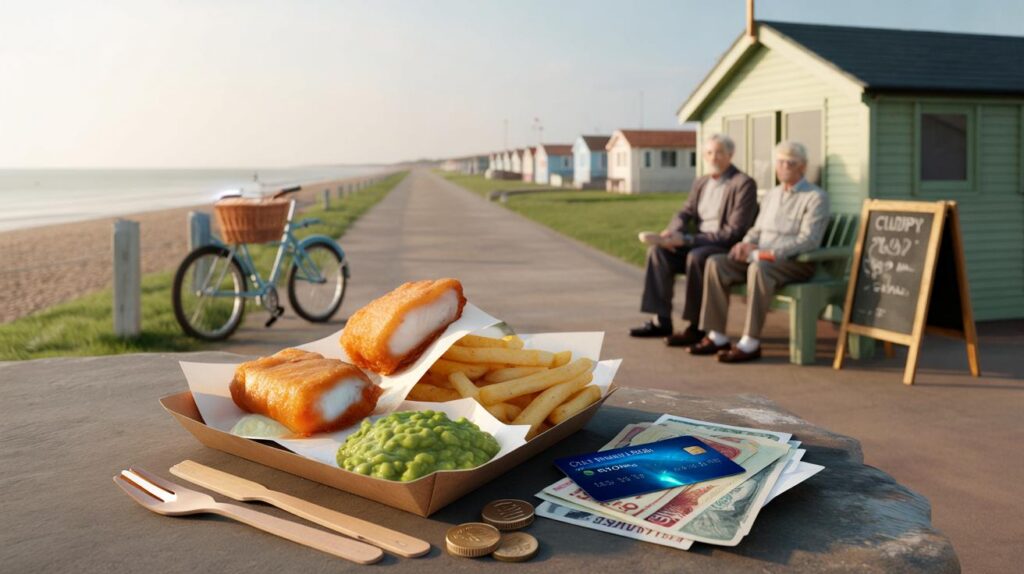
Starving after the matinee, we headed beachwards for a late tea. One small cod, one large cod, chips and mushy peas came to £32 at a seafront chippy. No one asked for ID over the counter, yet ketchup came only by the bottle. Towns across Britain argue over price versus provenance. Here, the price felt like London, but the service pace and rules felt strictly local.
| Item | What you pay | Notes |
|---|---|---|
| Pint at the members’ club | £5 | Membership or sign-in required |
| Fish and chips for two (1 small, 1 large) with peas | £32 | Seafront takeaway |
| Ketchup | Sold by the bottle | Individual sachets not offered |
The homeward train and the comfort of anonymity
Air conditioning hit like a tonic when the London-bound service pulled in. The glide to Liverpool Street reset the brain. By Bethnal Green, that familiar city invisibility returned. Nobody stared. Nobody asked your name for the ledger. The pavements smelt faintly of hot drains, and it still felt like 2025 again. The relief was physical.
What this says about seaside Britain
Frinton-on-Sea is not failing. It is tidy, loved and determinedly itself. It offers safety, order and long memory. That comes with a cost that goes beyond the bill at the chip counter. Visitors raised on frictionless cities can find the rules opaque. A town built around social clubs, summer seasons and set routines can feel wary of drop-ins. The tension is not new. Many English seaside towns carry a conservative streak, a resistance to churn that keeps streets clean and crime low, but can muffle spontaneity.
The economy tracks that identity. Independent shops lean into heritage. Entertainment follows a dependable programme. Prices reflect a captive audience at peak times. Service norms follow house rules rather than mobile-era expectations. For weekending Londoners, it’s a culture shift. For residents, it’s normal.
If you go, how to make it work for you
- Assume membership: where in doubt, ask at the door and carry ID for sign-ins.
- Carry a small float of cash: some venues prefer it, and card minimums can apply.
- Budget for food: seaside staples can hit London-level prices in high season.
- Time your train: off-peak services are calmer; direct runs to Liverpool Street can take around 90 minutes.
- Watch the rituals: stand when others stand, queue where the line forms, and you’ll blend faster.
Beyond the snapshot: questions for towns in a time capsule
There’s a wider story here about heritage as strategy. Towns that lean into nostalgia bank on repeat custom from those who treasure the familiar. That can boost stability for local traders and keep antisocial behaviour down. It can also raise barriers for new voices, new food, new arts and younger crowds. The balance is delicate. Too much change and you lose your loyalists. Too little and day-trippers ride home relieved rather than refreshed.
One useful lens is to separate the charm from the gatekeeping. Beach huts, tidy greens and orderly theatres attract families and retirees in search of calm. Ledgers at the door and side-eye for outsiders send another message. Simple switches—clear visitor passes, transparent pricing, small gestures of welcome—can preserve the mood without the chill.
Practical add-ons for your next coastal day
If you plan a similar trip, try pairing a matinee with a morning walk on the greensward before the beach crowds build. Book a late train back to avoid the rush and leave room for an unhurried tea. If you want a livelier evening, stitch in a stop at Clacton or Walton-on-the-Naze for arcades and piers, then return to Frinton’s quiet for the last hour. The contrast sharpens what each place offers.
For a simple cost check, price your day against a city equivalent: one theatre ticket, two pints and a shared chippy tea. If the totals match, decide whether you want novelty or nostalgia for your spend. Either choice can be right. The better choice is the one you walk away from with shoulders dropped and jaw unclenched, whether that happens on a breezy promenade or under a hot London sky.



£32 for fish and chips? Hard pass.