
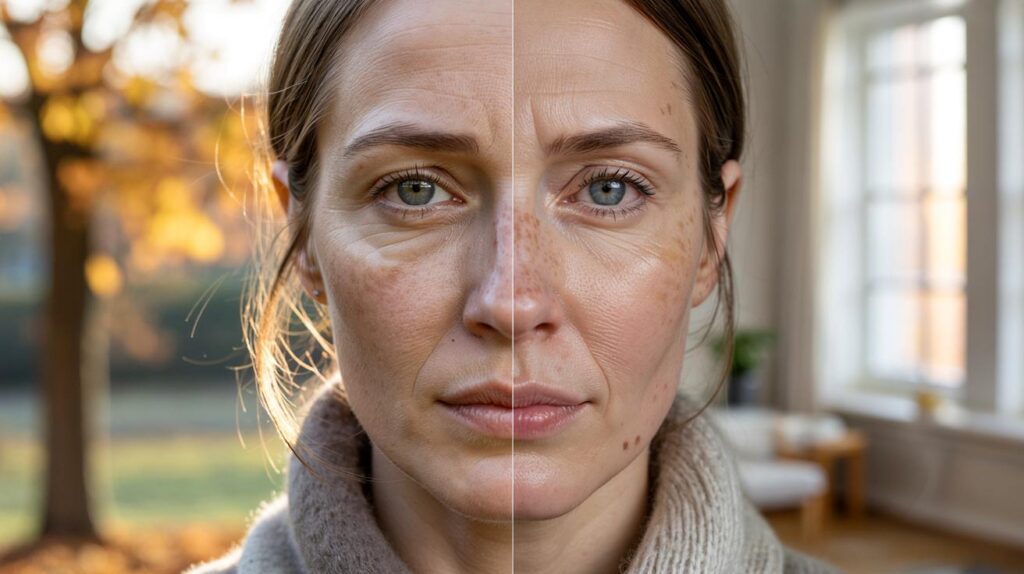
Autumn tests skin fast. One woman paused routine for a month to read signals, not labels, and face colder air.
Her name is Léa. She chose simplicity over habit as temperatures dropped and radiators clicked on. The goal was not provocation. It was a calm check of what skin does when left to its own devices.
Why anyone would stop moisturiser for 30 days
Daily moisturiser feels non-negotiable as air dries and wind bites. Many of us apply by reflex. Léa questioned that reflex. She asked whether her face had become product-dependent. She wondered if the skin barrier could adjust without a cream on top. She also wanted fewer steps and less clutter.
The experiment asked a blunt question: are we product-dependent, or can skin self-regulate when given a chance?
Dermatology textbooks describe the hydrolipid film, also called the acid mantle. It is a thin mix of sebum, sweat and natural moisturising factors. It slows water loss and keeps the surface flexible. Creams can support this layer. Overuse can also mask what the skin is trying to do. Léa pressed pause to see what happened next.
Days 1 to 5: sting, shine and second thoughts
The first days were rough. Her cheeks felt tight after washing. The nose and forehead looked shiny by midday. Redness flashed after a brisk walk. The pull to reach for a tube returned each morning.
- Tightness on cheeks within an hour of cleansing.
- Patchy redness around the nostrils and chin.
- Shine on the sides of the nose by lunchtime.
- A faint stinging in wind and heated rooms.
The biology behind the wobble
When you stop moisturiser, the skin’s feedback loops have to work harder. Sebaceous glands alter output. The barrier lipids reorganise. Transepidermal water loss rises for a short spell. This can feel like failure. Often it is simply recalibration.
Tingling and patchy redness can signal adjustment, not damage, when the barrier is finding its balance again.
Weeks 2 and 3: a slower, steadier surface
By the second week, the chaos eased. Texture felt smoother under the fingertips. The T-zone stayed shinier for shorter spells. Cheek tightness faded after washing. Red patches settled faster. Makeup went on without pilling. The look was less glossy and less “finished”. It was also more stable through the day.
Day 30: what actually changed
This was an n=1 test, not a clinical trial. Yet the pattern was clear to Léa. These were the seven shifts she noticed by the end of the month:
- Touch felt more even across cheeks and temples.
- Mid-afternoon shine on the nose reduced.
- Tightness after cleansing lasted minutes, not hours.
- Redness around the nostrils calmed more quickly.
- Flakes at the sides of the nose appeared less often.
- Foundation gripped better and creased less.
- Fewer blocked-feeling areas along the jawline.
Moisturiser proved helpful in winter storms, but not compulsory every single day for a healthy face.
The week-by-week timeline at a glance
| Period | What Léa felt | Practical response |
|---|---|---|
| Days 1–3 | Tight cheeks, shiny nose, stinging in wind | Lukewarm water rinse, gentle single cleanse at night, scarf outdoors |
| Days 4–10 | Redness settles faster, fewer flakes | Skip acids and retinoids, avoid fragrance, keep hands off face |
| Week 3 | Texture more even, shine shorter-lived | Maintain minimal routine, keep sunscreen in daylight |
| Day 30 | Stable comfort, less dependency on a cream | Reintroduce products by need, not habit |
The social test: bare skin meets busy offices
Oddly, the hardest part was not physical. It was social. Colleagues asked if she felt tired. Friends wondered if she had “forgotten” skincare. The comments ranged from caring to curious. The trial pushed against the unspoken rule that a perfect finish equals good grooming. Léa kept going. The mirror told a calmer story each week.
Perfection is a social script; function is a biological need. Skin health does not always look airbrushed.
Should you try it? Red flags and green lights
Not every face should go without moisturiser in autumn. Some situations demand support.
- Skip this experiment if you have an active eczema flare, rosacea flare, or open cracks.
- Avoid it if you are on isotretinoin or have just had a peel, laser or microneedling.
- If you work outdoors below 5°C or in strong wind, you need a protective layer.
- Children and older adults may need extra support as barrier function differs.
If you are curious and otherwise well, try a cautious version.
- Keep sunscreen in daylight. A moisturiser pause does not include sun protection.
- Use a very gentle cleanser once at night. Rinse with lukewarm water in the morning.
- Park strong actives for two weeks. That means acids, retinoids and benzoyl peroxide.
- If corners of the mouth or nostrils crack, dab a tiny occlusive at night on those spots only.
A minimal routine that respects the acid mantle
Here is a lean routine that still protects.
- Morning: rinse with lukewarm water; apply broad-spectrum SPF; add a scarf if windy.
- Midday: avoid hot air blowers against the face; sip water steadily.
- Evening: single cleanse with a mild, low-foam product; pat dry, do not rub.
- As needed: a drop of plain squalane or a tiny smear of petrolatum on chapped corners.
Use moisturiser as a tool, not a crutch. Reach for it when conditions demand, not by default.
What the science says, in plain terms
The hydrolipid film is your inbuilt shield. It blends oils from glands, water from sweat and natural moisturising factors. This layer slows water loss and keeps microbes in check. Central heating, cold wind and harsh cleansers stress it. Gentle care lets it rebuild. Some faces rebound in a week. Others need longer. The variation is normal.
A practical way to test your own tolerance
Try a 72-hour reset before any month-long plan. For three days, keep sunscreen, skip moisturiser, and cut actives. Track three signals each morning and night: tightness after washing, visible scaling, and stinging in wind. If two or more signals persist beyond day three, bring back a simple cream at night and stop the trial. If signals ease, extend to two weeks and reassess.
Beyond beauty: cost, waste and comfort
There is another angle here. Fewer products mean lower cost and less plastic. A lighter routine also saves time on busy mornings. None of this argues against creams. It argues for matching products to your skin and your weather. Léa’s month suggests many faces can manage with less, especially when you protect from sun and wind and go easy on strong actives.
Key terms, clarified
- Acid mantle: the slightly acidic surface layer that defends against microbes and water loss.
- Hydrolipid film: the blend of oils and water making up the protective surface; often used interchangeably with acid mantle.
- Transepidermal water loss: natural evaporation through skin; it rises when the barrier is stressed.



Interesting n=1, but how did you control for confounders—indoor humidity swings, cleanser strength, stress, even October weather? The “recalibration” might also be placebo or regression to the mean. I’m not against minimalism (my cabinet needs a diet), just trying to parse wether less product truly caused the changes vs. gentler habits like fewer actives and lukewarm rinses.